
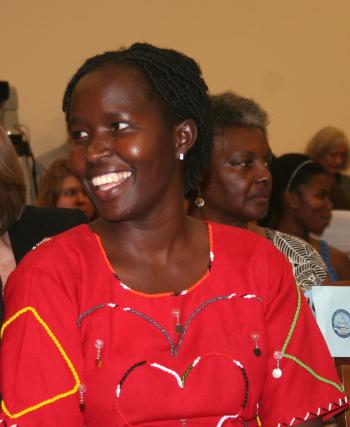

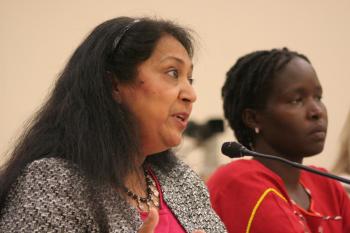
Kakenya Ntaiya, a 32-year-old women from Kenya, came close to becoming a child bride. She told the Commission that when she was five, she was engaged to be married as soon as she reached puberty. She grew up in a small Maasai village, with no running water, electricity, paved roads, telephone, or modern schools, but with deep rooted traditions.
“Throughout my childhood, I was constantly reminded that my husband was waiting and as soon as I underwent female genital cutting—a traditional rite of passage to adulthood—I was going to be his wife. All I was expected to know is how to care for a husband and the children,” Ntaiya said.
Thanks to her mother, Ntaiya was able to avoid the arrangement and continued in school. She was able to break out and managed to convince her village to send her to college in the United States, where she is pursuing a Ph.D. at the University of Pittsburgh.
Her best friend at school was not nearly so fortunate. Her education was terminated at age 12 when she was forced go “through the cutting and got married,” and one year later, she had her first child. When Ntaiya saw her recently, the women’s health had deteriorated. She looked 20 years older than herself, and had eight children, with the first born already married with two children.
Ms. Ntaiya, who started the first girls’ primary boarding school in her community, said girls need the opportunities that education can provide, which early marriage thwarts.
“An educated girl is more likely to delay marriage and child bearing and have fewer, healthier and better-educated children. She is more likely to participate in the labor force, engage in paid employment and earn more income for her family over her lifetime,” said Stephanie Baric, Senior Technical Adviser, CARE USA.
CARE conducted a four-year study on programs serving women and girls in 24 countries in Asia, Africa, and Latin America. Research found that girls in school are six times less likely to be married off to older men.
The International Protecting Girls by Preventing Child Marriage Act of 2009 (H.R. 2103) was frequently mentioned at the hearing. Its author, Congresswoman Betty McCollum (D-Minn.), appeared at this hearing. This act directs the President, through the Secretary of State, to establish a multi-year strategy to prevent child marriage in developing countries through U.S. foreign assistance programs. It also would require Department of State country reports on human rights practices include a description of the status of child marriage, specifying the rates of child marriage. While it is bipartisan, of the 103 co-sponsors, only nine are Republicans.
Facts and figures on child marriages
UNICEF Senior Child Protection Specialist Francesca Moneti provided a breakdown of the 64 million child brides in the developing world. About half of these are from South Asia, where nearly half of women (46%) aged 20-24 years were married as children. Large numbers are found in India and Bangladesh. Nearly a quarter of child brides come from Sub-Saharan Africa, where 39 percent of the women 20-24 years had been child brides.
If current trends continue, an additional 100 million girls will become child brides over the next decade, said Dr. Anju Malhotra, from ICRW.
The highest rates of forced child marriages are found in Niger, Mali, and Chad, ranging from 71 to 77 percent, according to ICRW.
Moneti pointed out a biological fact that is not commonly known: “Pregnancy stops the growth of the child mother. When an adolescent girl becomes pregnant, her growth hormone stops working for her and works exclusively for the fetus. She becomes stunted and will give birth to a stunted child, typically.”
“Having children when the reproductive organs are not mature has severe health implications for the child mother as well as for her newborn,” Moneti said. Baric testified that girls aged 10-14 are five times more likely to die from child birth, and girls 15-19 twice as likely, than women over 20.
“For those who survive pregnancy and delivery complications, long-term consequences may include obstetric fistula, reproductive tract infections and infertility. Simply put, young girls bodies are not fully developed and therefore cannot carry a pregnancy or deliver children without doing tremendous damage to their underdeveloped bodies,” Baric said.
Child mortality is much higher for the young mother. For a mother under 18, the mortality of her baby is 60 percent greater than of an infant born to mother older than 19.
“Even if the child survives, she or he is more likely to suffer from low birth weight, undernutrition, and late physical and cognitive development,” said Moneti.
Moneti linked the practice of child marriages to poverty. Citing UNICEF data on developing countries, Moneti said that girls from the poorest of families—in the lowest 20 percentile—were three times as likely to marry as children than girls in the richer upper 20 percentile.
Several of the speakers mentioned that girls forced into relationships with adult men are put at greater risk of HIV infection and domestic violence. Dr. Malhotra cited studies in countries in Africa and Latin America which found that married girls aged 15-19 were approximately 75 percent more likely to contract HIV than sexually active, unmarried girls of the same age.
Baric said that “women who married younger are more likely to be beaten or threatened, and more likely to believe that a husband might sometimes be justified in beating his wife.”
Community abandonment of the practice
Child marriage is rooted in tradition, said Dr. Malhotra. No one religion is associated with the practice. It happens in Moslem, Hindu, and Christian households.
The custom is practiced because of rewards and penalties that enforce the norm, Moneti said. Often the bride price is higher for a younger girl, or in other societies, the family may have to pay a higher dowry to marry an older girl. An individual family that chooses to delay marriage for their daughter, may be threatened, their house stoned and the girl taken away by force to be married.
The consensus of the speakers is to work at the community level to persuade parents that their daughter is harmed by child marriage and there are viable alternatives to it. Programs that act in a non-judgmental way toward the parents will more likely succeed in having parents accept that child marriage is harmful to their daughters. Large-scale “abandonment of this custom occurs when the people in a community unite and decide collectively to the end the practice,” said Moneti.
“Forced child marriages has nearly disappeared in several countries, where it used to be an entrenched practice only a generation or two ago. These countries include China, Taiwan, Korea, Thailand, and Indonesia,” said Dr. Malhotra. Large-scale abandonment is taking place in Senegal and in parts of other countries of Africa and South Asia, including India and Bangladesh, Moneti said.
Moneti described a 12-year-old girl in Senegal, who was to be married to an older man. She was very smart and wanted to continue school. A village nearby had been visited by a special UNICEF program, described by Moneti as leading to “mass abandonment of female genital cutting and child marriage by thousands of communities,” but hadn’t reached the girl’s community. The girl went to this village and asked for help. The village leaders agreed to explain why they had abandoned child marriages to the girl’s village.
The outcome was that she remained in school. Moneti was pleased to report that she became the top performing student in Senegal and is now attending the nation’s most prestigious school.
 Friends Read Free
Copy
Facebook
Tweet
Friends Read Free
Copy
Facebook
Tweet