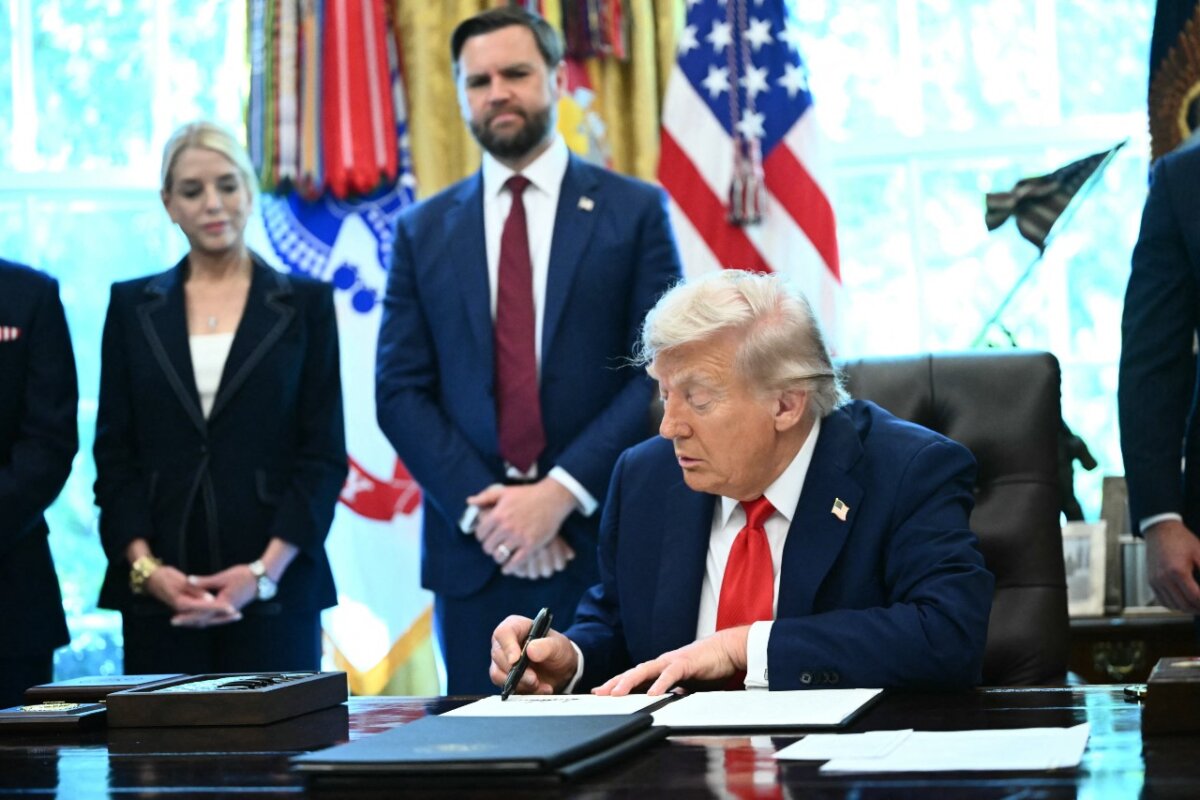

President Donald Trump on Aug. 25 signed an executive order to criminalize burning the American flag—a bid that would likely require the Supreme Court to alter existing precedent.
“Our great American flag is the most sacred and cherished symbol of the United States of America, and of American freedom, identity, and strength,” Trump said in the Monday executive order. “Desecrating it is uniquely offensive and provocative.”
It’s likely to face legal challenges in both lower federal courts and the U.S. Supreme Court. Critics of the administration and civil liberties activists describe the move as a violation of the freedom of expression permitted by the First Amendment to the U.S. Constitution.
Here’s what to know.
The executive order seeks to allow government officials to arrest and imprison individuals who burn the American flag while staying within the bounds laid out under the First Amendment.
It would authorize officials to pursue criminal prosecution, though the penalty would be based on violations of other local, state, or federal laws.
It also seeks to preempt First Amendment challenges by encouraging the enforcement of the order only through the use of “applicable, content-neutral laws, while causing harm unrelated to expression, consistent with the First Amendment.”
It asks Attorney General Pam Bondi to “prioritize the enforcement to the fullest extent possible of our nation’s criminal and civil laws” in instances of flag burning, including through enforcing laws unrelated to free expression.
This includes laws against violent crimes, hate crimes, discrimination against American citizens, other violations of Americans’ civil rights, and crimes against property and the peace, as well as efforts to aid and abet in violating such laws.
It also encourages Bondi to make referrals to relevant state and local authorities for violations of applicable laws, such as those against open burning, disorderly conduct, or destruction of property.
Trump said that those who burn the flag should be imprisoned for up to one year.
“You burn a flag, you get one year in jail. You don’t get 10 years, you don’t get one month,” Trump said. “You get one year in jail, and it goes on your record, and you will see flag burning stopping immediately.”
Though the Supreme Court has a long history of ruling widely in favor of civil liberties and the First Amendment, there are a handful of exceptions that have been made.
The most well-known of these is a prohibition against shouting “fire” in a crowded theater, a precedent from the early 20th century that the Supreme Court scaled back in favor of the First Amendment in the 1969 case Brandenburg v. Ohio.
Trump’s executive order seeks to justify the move under the “fighting words” doctrine, one of a handful of limited carve-outs to the right to free expression granted by the First Amendment.
Established in 1942 in Chaplinsky v. New Hampshire, the doctrine allows for criminal punishment of words that are likely to provoke an immediate, violent response.
However, that definition has been altered over time in favor of civil liberty protections, with current precedent limiting the definition of the doctrine to covering only direct, personal insults aimed at a single individual, which are likely to provoke a violent reaction.
Trump called flag burning “a statement of contempt, hostility, and violence against our nation.”
In line with the executive order’s argument that flag burning can be prosecuted under the “fighting words” doctrine, Trump argued that burning the flag “may incite violence and riot.”
It argues that, Supreme Court rulings on First Amendment protections notwithstanding, “The court has never held that American Flag desecration conducted in a manner that is likely to incite imminent lawless action or that … [amounts] to ‘fighting words’ is constitutionally protected.”
The executive order calls for Bondi to prosecute such instances “to the maximum extent permitted by the Constitution.”
Bryan Leib, CEO of Henry Public Relations and a Trump insider, expressed support for the executive order.
”The American flag represents far more than just fabric and stitching. It’s a symbol of our nation, the greatest nation on Earth,” he said. “I mean, a beacon of freedom that so many men and women have given their lives for, fought for, died to defend.”
Leib rejected arguments that burning Old Glory is a form of freedom of speech.
“Freedom of speech, of course, is constitutionally protected, but freedom of speech has limits,” he said. “Just as you know, we don’t allow people you know to threaten violence or you know to shout that they’re about to kill someone, I don’t think that we should be allowing for the desecration of the very symbol that unites us as a nation.”
Other civil liberty organizations—including some with a right-of-center lean—have condemned the move, however.
That includes the Foundation for Individual Rights and Expression (FIRE), who criticized the move from the White House in an Aug. 25 statement.
“Flag burning as a form of political protest is protected by the First Amendment,” the organization wrote.
“While people can be prosecuted for burning anything in a place they aren’t allowed to set fires, the government can’t prosecute protected expressive activity—even if many Americans, including the president, find it ‘uniquely offensive and provocative.’”
—Joseph Lord and Jackson Richman
BOOKMARKS
The Israel Defense Forces (IDF) said on Tuesday that missile strikes on a hospital in Gaza that killed rescue workers, medics, and journalists were aimed at a camera being used by Hamas. The terrorist group was using the camera to observe Israeli troop movements, the IDF said.
A federal judge has tossed out a lawsuit by Donald Trump’s administration that challenged a Maryland court whose judges set up a process to automatically block deportations of illegal immigrants. U.S. District Judge Thomas Cullen said he had no authority to block his fellow judges.
The U.S. Department of Health and Human Services (HHS) has warned 46 U.S. states and territories that they must remove references to gender ideology from their curricula within 60 days, or they will lose some of their federal funding. “Federal funds will not be used to poison the minds of the next generation or advance dangerous ideological agendas,” said acting Assistant Secretary Andrew Gradison.
Transportation Secretary Sean Duffy says he will cut tens of millions in grant funding to California, Washington state, and New Mexico unless they begin enforcing English language requirements for truck drivers. Duffy’s ultimatum comes after a truck driver in Florida caused a fatal crash and, when tested later, “could not speak the English language and could not understand road signs when he was operating that very deadly rig.”
A federal judge has dismissed a lawsuit against Kraft, Coca-Cola, and other companies by a 19-year-old who alleged their processed foods were designed to “hack the physiological structures” of consumers’ brains. Bryce Martinez has developed diabetes and fatty liver disease, but U.S. District Judge Mia Perez said he did not show “how often he consumed defendants’ products, in what amounts, or when.”
—Stacy Robinson
 Friends Read Free
Copy
Facebook
Tweet
Friends Read Free
Copy
Facebook
Tweet