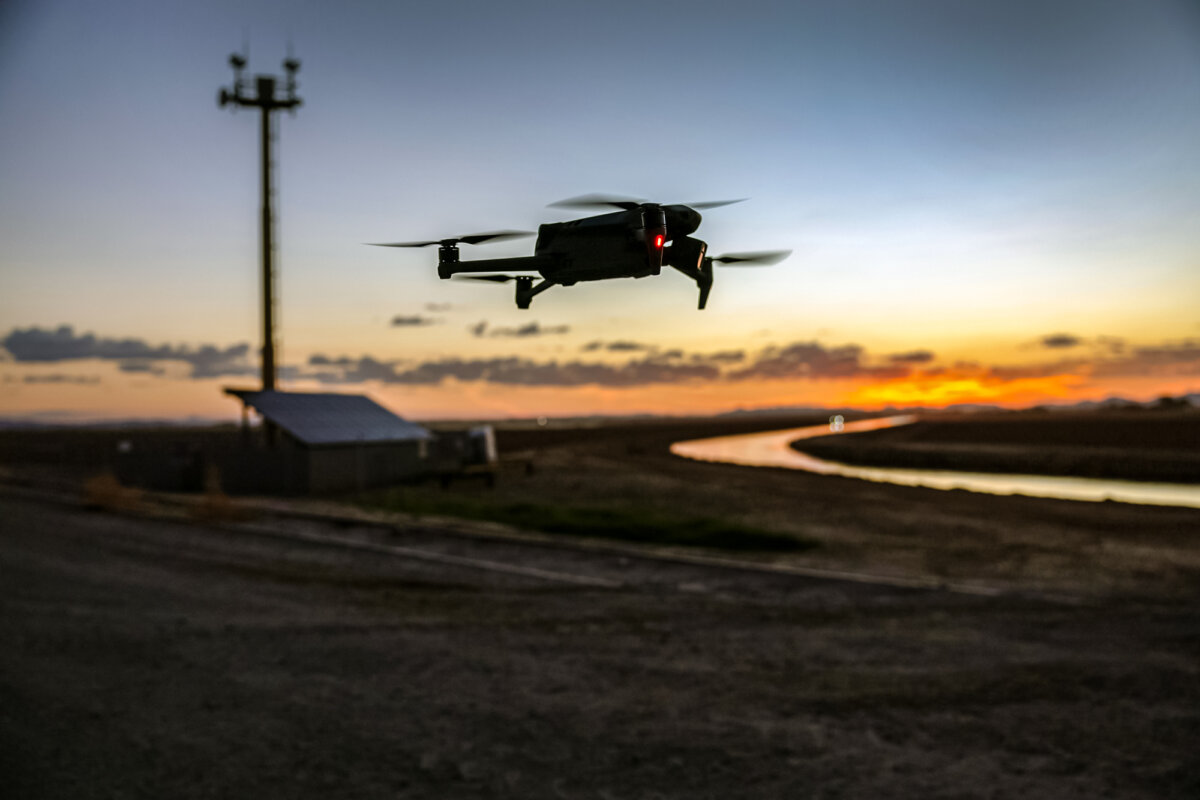

The U.S. military is prioritizing the protection of its bases in the country from drone attacks after Ukraine launched a surprise attack against Russia earlier in June and Israel is suspected of using the same strategy against Iran.
The Ukraine attack destroyed at least 10 of Moscow’s limited supply of long-range heavy bombers, which are critical components of Russia’s nuclear capability.
Israel is suspected to have smuggled drone parts into Iran and assembled them before using the drones to attack Tehran’s ballistic missile launchers and silos from within.
U.S. military leaders are increasingly concerned that similar attacks, which leverage low-cost commercial drones against expensive weapons systems, could pose a lasting threat to bases and critical infrastructure throughout the country.
However, the Army and other service branches are struggling to design and deploy appropriate technologies to defend bases on U.S. soil, owing to variables that do not need to be considered in a war zone.
“How we’re going to [defend bases] in a combat zone is very different from how we would do that in the states, obviously,” Army Chief of Staff Gen. Randy George said at a House Armed Services Committee hearing on June 4.
One key factor is the Byzantine patchwork of local, state, and federal laws governing drone flights and the military’s own rules of engagement.
Whereas officers at an outpost overseas might simply engage with an unidentified drone approaching their base before any potential harm could occur, the military lacks the authority to engage with drones on U.S. soil, unless those drones directly enter a facility’s airspace.
Even then, options are limited.
The use of kinetic systems that would simply shoot down a drone is out of the question on U.S. soil, according to military personnel, as they are not cost-effective and would also run the risk of injuring civilians or damaging property when the debris would fall to the ground.
That issue highlights the other key factor confounding military planners: a lack of counter-drone systems customized to deal with emergent threats to bases in the United States without endangering civilians.
While the military and federal government do have electromagnetic weapons that can knock out drones by interfering with their electrical and navigational systems, these weapons are typically poorly suited to an environment rich in aerial traffic because they affect all electronic systems within a given area.
Such an issue was laid bare on March 1, when more than a dozen flights on final approach to Ronald Reagan Washington National Airport outside Washington received false collision warnings, prompting at least six flights to abort their landings.
The Federal Aviation Administration later stated that the false positives were caused by government testing of counter-drone technology near the airport.
Because of that weakness in the system, the Army is now exploring the use of directed energy weapons in its counter-drone operations.
Many such systems, including variants of weapons using lasers, microwaves, and particle and sound beams, are still in development, but they bring their own problems because of high energy consumption.
According to the Congressional Research Service, the Pentagon’s newest counter-drone weapons would need to draw 100 kilowatts of power to fire a laser in a counter-drone capacity.
That is more power than the average U.S. household uses in three days, and that figure does not include the additional power requirements for cooling the significant amount of heat generated by such weapons.
It makes defending military installations on U.S. soil from drone attacks an infrastructure problem as well as a defense problem.
New Energy Sources
Secretary of the Army Daniel Driscoll, who also spoke at the hearing, said the directed energy requirements for defending U.S. bases and supply chains from future drone attacks simply cannot be met with today’s power systems.
“For a lot of the tools that are coming out, directed energy, for example, they have incredible energy requirements,” Driscoll said.
“You’re going to have to have spikes of energy come through the lines that just are not set up. The current technology is not sufficient for it.”
The key to solving the nation’s directed energy issues is in the creation of nuclear microreactors, small modular nuclear reactors that would generate power for an individual base and its weapons, he said.
Driscoll’s push toward nuclear power matches an executive order signed by President Donald Trump in May directing the Army to deploy a nuclear reactor at a U.S. base by 2028.
“Advanced nuclear reactors include … small modular reactors, microreactors, and stationary and mobile reactors that have the potential to deliver resilient, secure, and reliable power to critical defense facilities and other mission capability resources,” the order reads.
Driscoll said drone sightings over U.S. military installations have been increasing and that defending the nation’s munitions and other supplies will also require rethinking how the military stores materiel.
“When you look at the ability of these cheap drones to contest logistics lines … we know that we have got to spread out our pre-position stocks,” he said.
“It is no longer going to be sufficient to have big warehouses with a lot of American equipment sitting as a target.”
However, some military installations are not waiting for that shift in supply chains to begin securing facilities against drones.
As the threat posed by cheap commercial drones has expanded, some units have moved to drone-proof their facilities by creating specialized enclosures.
In 2024, for example, the staff at Seymour Johnson Air Force Base in North Carolina announced that they were investigating the feasibility of erecting physical barriers to protect the F-15E fighter aircraft stationed there from being attacked by small drones.
That initiative follows a 2021 call for proposals by a technology incubator in the U.S. Air Force, which sought novel solutions for creating passive barriers to defend the nation’s jets from drone attacks.
Passive countermeasures, it is hoped, will prevent a devastating attack like that suffered by the Russian military by insulating critical equipment from the effects of explosions caused by one-way attack drones.
Expansion of Counter-Drone Training
Even as solutions to the counter-drone issue remain unclear, the proliferation of commercial drones and their application in war and terrorism will profoundly shape the security space in the coming decades, according to Washington.
Former Deputy Assistant Secretary of Defense Michèle Flournoy said at a June 4 conference in Washington that the idea that drone swarms could attack key U.S. facilities is no longer theoretical, and that threat means that U.S. territory would be affected in the event of war.
“You could imagine somebody … acquiring drone swarms inside the United States [and using them] against key military targets alongside cyberattacks on critical infrastructure, alongside efforts to limit our capabilities in space, and it could have a very profound effect,” Flournoy said.
“It is a reminder that one of the other changing factors of warfare in the future is it will almost certainly include the homeland in the area of operations, not just from air and missile threats, but from sabotage to cyber to potentially drone use as well.”
To that end, the Trump administration has issued a series of sweeping new executive orders aimed at stimulating domestic drone innovation and insulating the nation against the threat of drone attacks.
The executive orders establish a federal task force to review and modernize the nation’s regulatory framework for drones, and they encourage timely publication of a list of foreign drone manufacturers deemed national security risks.
At the law enforcement level, the departments of Justice and Homeland Security are tasked with integrating counter-drone technologies into joint counterterrorism task forces and will also establish a training center to better equip officers with the tools and training necessary to secure mass gatherings such as concerts and sporting events from drone attacks.
The order directs the Federal Aviation Administration to expedite its rule-making process for restricting drone flights over sensitive sites and encourages the government to detect and identify drones in real time using remote identification technologies.
Speaking on condition of anonymity, a senior White House official said the threat posed by commercial drones to civilians is an increasingly pressing issue, especially because there have already been several incidents in which foreign nationals have been charged for flying drones over sensitive U.S. military sites.
Ryan Morgan contributed to this report.
 Friends Read Free
Copy
Facebook
Tweet
Friends Read Free
Copy
Facebook
Tweet