
News Analysis
For four decades, the Chinese Communist Party (CCP) sold the people a false promise: leave the power to us and ask no questions, and we will make you richer than your parents could have imagined.
Living standards did rise—not because central planning worked, but because the Party loosened its grip on the economy. As the country was opened to the outside, access to Western capital, technology, and markets brought more wealth to the Chinese people—and the Party took all the credit.
Meanwhile, even as incomes climbed, the Party continued to jail critics, crush dissent, and persecute entire communities of ordinary citizens who wanted no part of politics. But for the compliant majority, rising living standards bought consent.
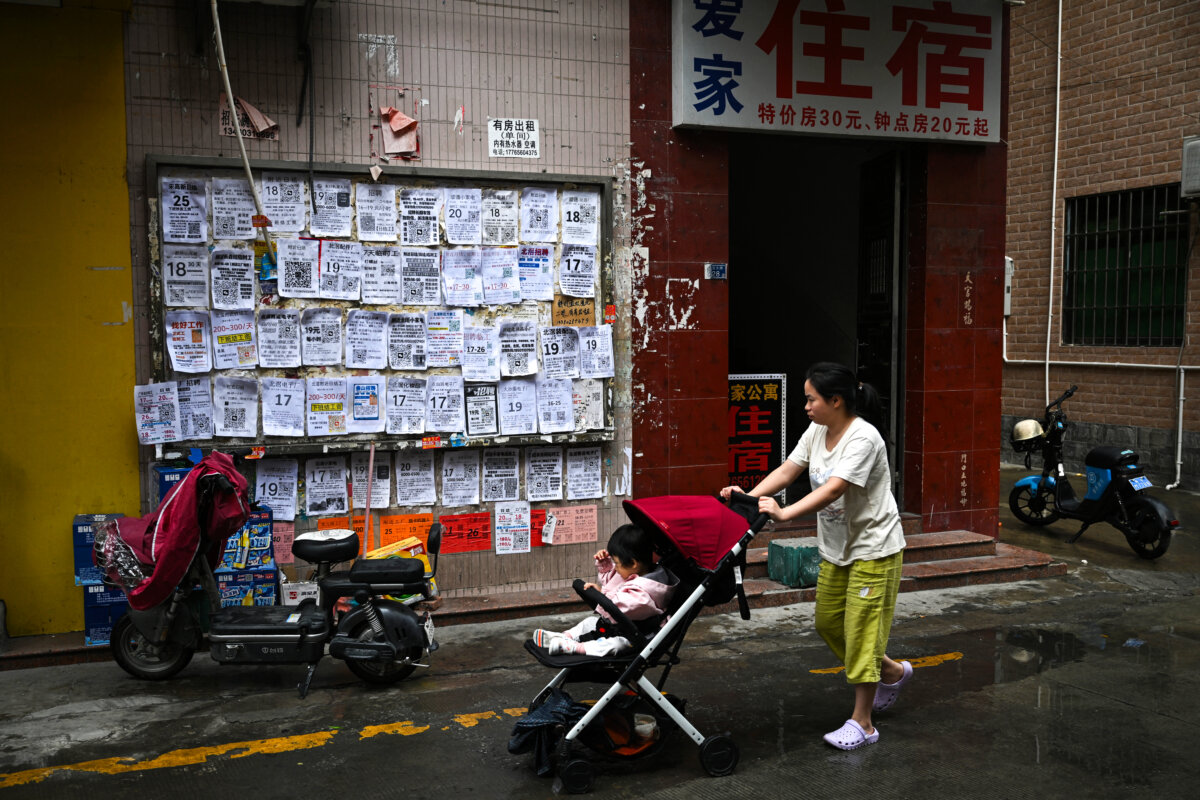
Now the money is running short. Growth is fading, prices are falling, jobs for the young are scarce, and the country’s wealthy are quietly moving their savings abroad.
So Chinese leader Xi Jinping is rewriting the deal, analysts told The Epoch Times. In place of the promise of getting rich, he’s offering the promise of getting even: the assurance that China has risen to stand as an equal of the United States, and that the long-deferred “rejuvenation” of the nation, including the absorption of Taiwan, is within reach.
Replacing the promise of prosperity with the promise of national greatness is the most consequential gamble in communist China today, said Sheng Xue, an award-winning Chinese Canadian journalist and author who has reported for Radio Free Asia and Deutsche Welle.
The Bargain That Is Breaking
The old deal had a name among China scholars: performance legitimacy.
“For a long time, the CCP’s legitimacy to rule has rested on performance legitimacy—the most important part being, ‘I’ve let you eat your fill, dress warmly, and live a better life,’” Sheng said.
In exchange, the Party “got more and more people to give up the political rights to participation and oversight that they ought to have fought for,” she said. “But now that the CCP’s economic growth has stalled—even declined sharply—that effect is wearing off.”
According to data from China’s National Bureau of Statistics, prices across the economy have been falling for the better part of three years—a deflationary spiral that Bloomberg Economics called China’s longest since the famine that followed Mao Zedong’s Great Leap Forward in the early 1960s.
Sustained deflation can feed on itself: As prices fall, companies cut wages and jobs, households delay purchases in expectation of cheaper prices later, and debts grow heavier.
Much of the cause lies in housing. The property crash has erased an estimated $18 trillion in household wealth, leaving families poorer and afraid to spend, according to Bloomberg, citing Barclays calculations.
In April, youth unemployment stood at 16.3 percent—and that figure counts only 16- to 24-year-olds who are not students. That intentional underestimation was adopted by Beijing in 2023 after the previous measure hit a record 21.3 percent, causing officials to abruptly stop publishing it for half a year. Around that time, Peking University economist Zhang Dandan drew national attention by estimating that the true rate could be as high as 46.5 percent.
The population is shrinking, too: Births fell 17 percent in 2025 to 7.92 million, the fewest since Beijing began counting in 1949, while the share of Chinese aged over 60 reached around 23 percent.
University of Wisconsin–Madison demographer Yi Fuxian noted that China recorded roughly as many births last year as it did in 1738, when its population was about 150 million.
Many ordinary Chinese feel the squeeze directly.
“Income is down, property has lost value, and my sense of security has fallen,” said a woman in her 50s in the northeastern city of Harbin—one of several residents The Epoch Times interviewed but will not be naming for their safety. “The lack of security comes from the yuan losing value.”
A man in his 50s in the port city of Dalian put it more bluntly: “At home, just being debt-free makes you a big shot.”
Manufacturing the New Mood
With prosperity harder to deliver, the Party has fallen back on national pride—and on spectacle.
“China will use spacecraft and aircraft carriers to lift the public mood,” Shen Ming-Shih, a researcher at Taiwan’s Institute for National Defense and Security Research, told The Epoch Times.
The pride those displays are meant to lift, he said, is “a rather hollow, illusory thing” that survives only as long as people “have not seen the wider world.”
The turn is deliberate. The Mercator Institute for China Studies, a Berlin research group, described a strategic shift under Xi away from raising living standards as the basis of the party’s legitimacy and toward patriotism, nationalism, and military readiness, with a strong anti-Western undertone.
The groundwork is older. In 1991, two years after troops crushed the Tiananmen Square protests, the CCP under former leader Jiang Zemin launched a “patriotic education campaign” that—as China scholar Zheng Wang has documented—rebuilt school curricula around China’s “century of humiliation” at the hands of foreign powers, recasting the CCP as the nation’s savior.
Sheng goes further, arguing that much of what looks like patriotism is not pride at all, but rather fear.
“I don’t believe that, under CCP rule, Chinese people in the broad sense possess any genuine national pride,” she said. She calls the public displays “co-risk hedging”—a crowd performing loyalty so that no one stands out.
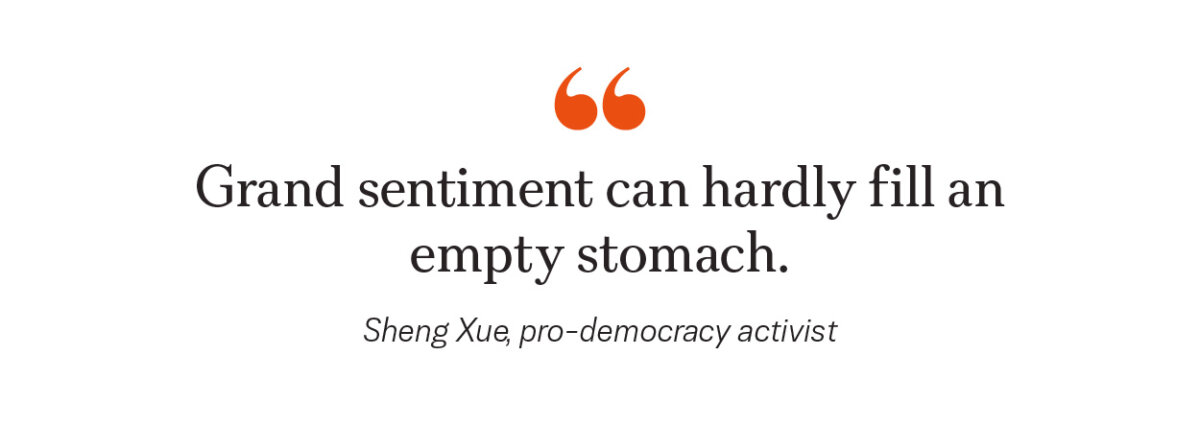
“Grand sentiment can hardly fill an empty stomach,” she said, and the display “can remain effective for keeping the CCP’s grip on power stable” only for a limited time.
The campaign is easiest to see in what Chinese consumers buy.
Domestic brands held 76 percent of China’s consumer market in 2024, up from 66 percent in 2012, according to a survey by Bain & Company and Worldpanel—a shift the government encourages as it promotes homegrown “national champions.”
Nike, once shorthand for having arrived in urban China, has logged six straight quarters of falling sales there as state-celebrated “guochao,” or national wave, brands such as Anta and Li-Ning take its place.
Some of that reflects real gains in quality, but buying foreign has also grown politically fraught. Nationalist boycotts have battered H&M, Nike, and Dolce & Gabbana in recent years, and the safe choice, in the logic Sheng describes, is to buy domestic and avoid standing out.
Not every resident sounded disillusioned.
A self-employed man in his 30s in Shandong Province offered a far more upbeat view—one that closely tracked the government’s messaging: Chinese goods, he told The Epoch Times, are now “every bit as good as overseas brands.” The United States, in his telling, is beset by “social division, the hollowing-out of industry, acting unilaterally abroad,” and he feels “more secure about the future.”
Such answers are hard to read from the outside, Sheng said. In a system where economists who “talk China down” can lose their jobs and their platforms, the safe answer and the honest one are not always the same.
Voting With Their Feet
Pride is often contradicted by what the same people do with their money and their children.
That contradiction, Sheng said, is “a textbook combination of cognitive dissonance and refined self-interest”—people who endorse “resistance to Western hegemony” in public while, in private, treating the West’s universities, courts, and property protections as “the irreplaceable safe-deposit box for China’s elite and for officials inside the system.”
Chen Pokong, a U.S.-based political commentator and author who spent years in Chinese prisons for his role in the 1989 democracy movement, describes the same split more vividly: “Their mouths shout patriotic slogans while their feet vote.”
He points to the deserted visa lines at the Russian and North Korean embassies, the crowds outside the American, Japanese, and Australian ones, and the officials who denounce the West even as they move their families and fortunes there.
The residents bore this out. Most of those interviewed by The Epoch Times said they hoped to leave or to send their children abroad.
A recent mainland graduate now in the United States said he would “do everything I can to stay,” and said China’s high schools are “like concentration camps, with no freedom of speech in society at all.”
A woman in Harbin told The Epoch Times that she wants Europe for herself and her child.
A Dalian man said the pattern starts at the top. “People with money and power—and their children—all want to go to developed countries,” he said.
At home, he added, “the internet police are everywhere, so no one dares speak their mind freely. Ninety-nine percent of ordinary Chinese have gone numb—under a boulder that size, how could any egg stay whole?”
Foreign investors have voted with their capital.
China’s net foreign direct investment, which peaked at $344 billion in 2021, fell to roughly $4.5 billion in 2024—the lowest since 1991—after Beijing broadened its anti-espionage law, raided foreign consulting firms, and barred some executives from leaving the country, according to U.S. State Department figures.
The World Bank reported that in 2025, money leaving China outweighed even a record trade surplus. A record 73 percent of European companies surveyed told their Chamber of Commerce in 2025 that operating in China had become more difficult over the previous year.
Demanding Equal Status
Set against that exodus, the CCP’s insistence that China now stands level with the United States looks less like a foreign policy than a domestic necessity, Sheng said.
It got its biggest stage in May, when U.S. President Donald Trump became the first sitting U.S. president to visit Beijing in nearly a decade and toured the Temple of Heaven over three days of ceremony. Trump handed Beijing the image it wanted, telling Fox News that China and the United States were “the two great countries. I call it the G2.”
For Xi, the value of that image is mostly at home, Sheng said. A leader fighting a sinking economy and steadily purging the very officers he once promoted needs the world’s most powerful country to receive him as a peer—visible proof, for a domestic audience, that his governance has succeeded and his hold on power is secure.
The regime “needs the outside world’s praise and submission in order to prove to its domestic public the success of its governance,” she said. The grander the welcome Beijing stages, in her reading, the more vulnerability it is working to cover.
To Shen, the demand to be treated as an equal gives the game away. It is, he said, “an expression of the Chinese sense of inferiority—the inferiority complex the Chinese have carried since the Opium War.” He drew the distinction the Party works to erase, between the country and its rulers: “China’s civilization is in fact at odds with the Communist Party.”
The posture carries a deeper irony, because the rise now being celebrated was built in large part with Western help. Washington backed China’s 2001 entry into the World Trade Organization on the bet that trade would open the country up—a bet the U.S. Trade Representative judged a failure in 2018, conceding that “the United States erred in supporting China’s entry into the WTO.”
Sheng likens Beijing’s turn on the West to “picking up the bowl to eat and then putting it down to smash the pot;” blaming the slowdown on U.S. “containment and suppression,” she said, hands the regime a scapegoat for failures of its own making.
The Machine That Stopped Reporting
Beyond recognition as America’s equal, the new bargain rests on a second and more dangerous promise: Taiwan.
Here Xi has gone further than his predecessors, Shen said, binding the island directly to the Party’s central mission of national rejuvenation.
In a 2019 speech, he called “reunification” a requirement of rejuvenation, said the matter should not “be passed down from generation to the next,” and declared unification inevitable.
In a November phone call with Trump, by Beijing’s own account, he went still further, casting “Taiwan’s return to China” as part of the postwar international order itself.
Whether China could actually take the island—and whether Xi would even know if it could not—turns on the same machinery that manufactures the public mood. That machinery, Sheng said, no longer carries unwelcome facts to the top.
“When the system no longer tolerates dissent, what the top leadership hears is bound to be victory reports filtered through layer after layer,” she said, and decisions built on them “will inevitably lead to strategic misjudgment.”
The sharpest risk, Chen said, lies in the very force Xi would need for any move on Taiwan—an army whose command he has spent years gutting.
Since 2022, more than 100 of the People’s Liberation Army’s (PLA) most senior officers have been purged or have vanished from view, according to a tally by the Center for Strategic and International Studies—most of them men Xi himself had promoted.
Of the six generals he named to the Central Military Commission in 2022, only one remains; the latest to fall, in January, were its vice chairman Zhang Youxia and joint staff chief Liu Zhenli.
Those purges have produced not a confident force but a frightened one, in Chen’s account.
The army’s own internal verdict, he said, is “fake combat capability”—the very insult rival generals hurled at one another on the way down. He points to the PLA’s drills around Taiwan, where, he said, missiles missed their targets, and to the silence that met the January purge: “Not a single service branch, not a single theater command, came out to voice support,” and the campaign denouncing the fallen officers “stopped after just three days.”
Shen doubts the army would obey an order to die for the cause at all. The fall of Zhang Youxia, he said, “has let the armed forces see Xi Jinping’s true face.”
His conclusion is blunt: “Without a just cause for a war over the Taiwan Strait, the PLA may not obey Xi’s orders and march to their deaths—especially in the face of superior U.S. military power.”
A Closing Window
Time, too, is running against Beijing.
China, Chen said, “grows old before it grows rich”—a starved camel still bigger than a horse, but sliding toward the fate of Venezuela or Zimbabwe at a speed that “caught the outside world badly off guard.”
That decline, Sheng warned, may make Beijing more dangerous, not less. A regime that senses its strength about to peak “is often more aggressive than one that is steadily rising,” she said, placing the window of greatest danger at roughly 2027 to the early 2030s—when China’s military buildup crests just as its economic and demographic slide begins to bite.
A leader cornered by a sinking economy and a nationalist promise he has staked his rule on is, in her reading, the most unpredictable kind.
“Xi Jinping has entered a back-to-the-wall situation,” she said, “so the possibility that he takes a reckless gamble still exists.”
Gu Xiaohua contributed to this report.
 Friends Read Free
Copy
Facebook
Tweet
Friends Read Free
Copy
Facebook
Tweet