



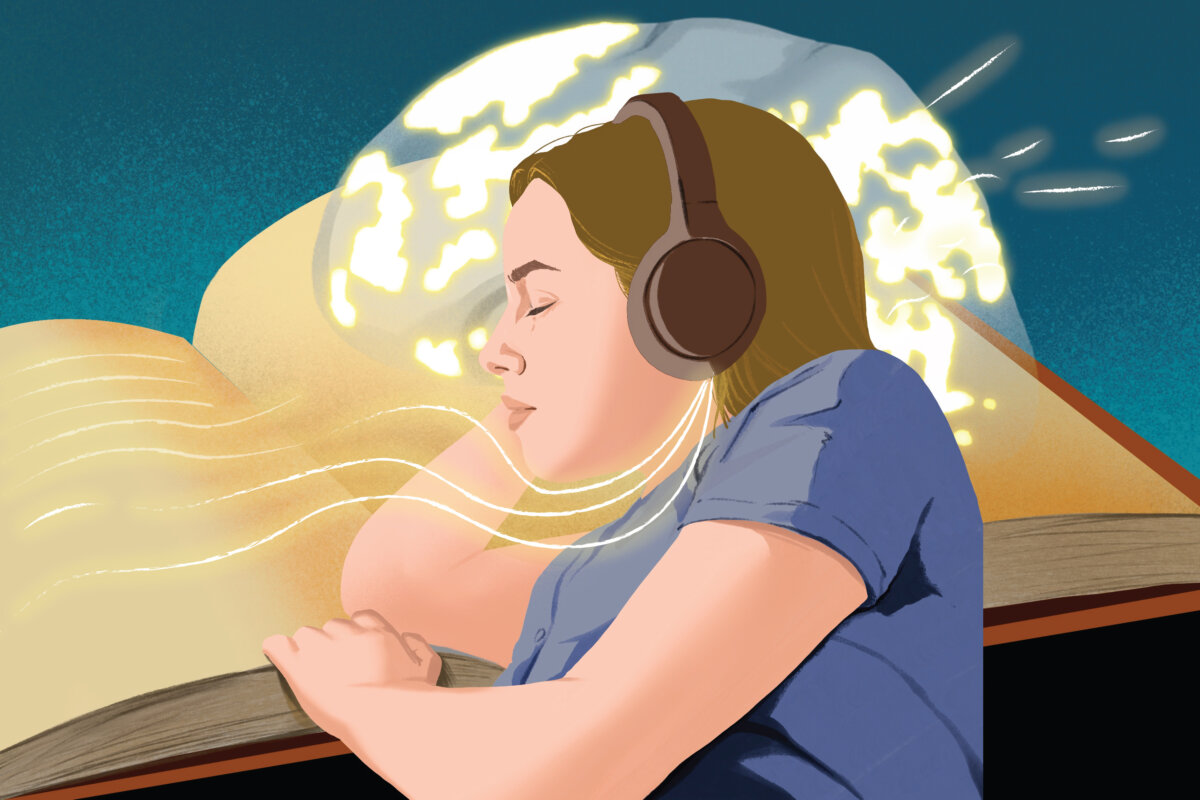
We’ve looked at how reading print books benefits your brain and learning. What about listening to audiobooks?
Scientists can now watch what happens inside the brain as it takes in a story, whether through the eyes or the ears.
Here’s what they found.
The Flexible Brain
Researchers at the University of California–Berkeley put people in an fMRI scanner and played them hours of stories via audio. They mapped each word to the brain region that lit up.
Later, they presented participants with the same stories, this time through text. When they compared how the brain reacted to both listening and reading, they found that the patterns were almost identical. The cortical areas that decode meaning lit up in the same way.
There’s a reason the two routes lead to one place: Humans listen before they read. During development, the brain doesn’t build a dedicated reading pathway. It uses the speech system already in place and asks it to improvise.Both reading and listening, it should be noted, are doing far more than they are given credit for. Drawing meaning from a stream of symbols or sound is among the most intricate feats the human mind performs without seeming to try.
The question is whether the two diverge in any way that matters—and the first glimpse appears in a classroom.
They Hear, Not Listen
If the brain treats the two so similarly, they ought to teach equally well. But that may not be the case.
In about 2010, textbook publishers began selling professors on audio versions of their books.
David B. Daniel, a professor emeritus at James Madison University, wanted proof that the format worked before charging his students for it, so he ran an experiment.
He divided his students into two groups. The first group read a chapter from a psychology textbook; the other listened to the same chapter.
Same material, 25 minutes, then a quiz.
“The difference was between an A and a D,” Daniel told The Epoch Times. “It was not pretty.”
The listeners scored about 28 percent lower.
The quiz results are telling, but what happened the moment before the quiz is what makes it interesting.When offered the choice, nearly every student chose the audio group.
“Most people, if there’s an option between something easier and something harder, they’re going to take the easier version to get the same result,” Daniel said. The students believed that they were learning; the feeling was real, but the learning was not.
Then the quiz asked them to prove whether they were learning, and the gap between feeling and knowing opened up underfoot. Daniel had slipped a question onto the end of the test itself, asking which group the students now wished they had been in. The audio listeners almost universally switched their answer.
“They didn’t know [that] they didn’t know until they had to recall it in front of a quiz,” he said.
That gap has mechanics behind it.
Print hands the reader a tactile map. A key definition may sit near the top of a left-hand page, serving as a spatial anchor that audio cannot supply. The eyes also backtrack constantly during reading, slipping back over a knotty sentence without conscious awareness.
Sure, an audiobook can be rewound, but it rarely is, and the printed page is full of natural exits, places to pause and let an idea settle.
“[In the audiobook] there were no pages, there were no natural places to pause, to build the knowledge,” Daniel said. “It just kept going and going and going.”
The cost of that forward momentum is measurable. In a separate study comparing silent reading, reading aloud, and listening, the audio condition produced the most mind-wandering, the weakest recall, and the least interest in the material.
Without a pace to hold or a page to grip, the mind drifts.
But audio still has a hand to play. Whether it wins depends on what you’re holding.
The Case for Audio
Beth Rogowsky, a professor at Bloomsburg University of Pennsylvania who spent 14 years teaching middle-school English, built a study to test the effectiveness of audio learning.
She divided 91 college-educated participants into three groups.
One group listened to sections of “Unbroken,” a World War II survival book by Laura Hillenbrand. The second group read the same pages, and the third did both at once, eyes on the text while the narration played.
Then everyone took a 48-question comprehension quiz, and again two weeks later.
The final findings?
“We found no difference in the three groups,” Rogowsky told The Epoch Times.
Daniel’s experiment found a clear learning chasm. Rogowsky’s equally careful study found flat ground. The contradiction dissolves the moment one asks what each set of readers was actually trying to do.Daniel’s students were studying hierarchical textbook material, the sort in which page six only makes sense while page two is still being held in mind. Rogowsky’s participants were following a forward-moving story.
Daniel Willingham, a cognitive psychologist at the University of Virginia who studies learning, told The Epoch Times that narratives travel easily by ear because listeners ride the familiar grammar of storytelling. Dense, layered texts are another matter.
“As I’m on page six, I’m really ideally supposed to be relating that to what I read on page two,” he said. “That’s very difficult to do. It’s easier with print, because with print, it’s easy to flip back.”
Print also surrenders the pace to the reader rather than the narrator. That control is what buys the moment to slow down and dwell on a sentence worth dwelling on.
It is worth noting that Rogowsky’s study has two limitations. First, the study was funded in part by Audible, the audiobook company. When asked whether that shaped the outcome, Rogowsky said the sponsor stayed clear of the design and the analysis, and noted that the findings flattered no single format.
The study carried a second limitation that the authors raised. The reading group used Kindles, and screen reading tends to score lower than ink-on-paper reading. Set against a printed book, audio might not have held up evenly.
Nonetheless, for books that focus more on narrative and less on visual and hierarchical structure, or for goals that prioritize general understanding over inference and deeper understanding, audiobooks appear to work well, as a large study published in Review of Educational Research confirmed.
What if you read and listen at once? A meta-analysis synthesizing 30 studies and nearly 2,000 participants found that the combined approach provided little to no benefit. Doubling the inputs did not double, or even meaningfully raise, comprehension. However, there may have been a modest benefit in reading and listening combined for struggling readers and for people learning a second language.
A Final Variable
Asked about their own habits, the experts converge on the same rule: audio for the light stories, print for the load-bearing.
“I start and end with print,” Willingham said. “I leave audiobooks solely for stuff that is pretty light stuff.”
One warning surfaced from all the experts, unprompted: None of this research is about children learning to read. Every study here measured adults, or near-adults, who could already read fluently. Comprehension and the raw skill of reading use different muscles, and a child who only ever listens is a child never asked to build the second one.
“We don’t want this to be misinterpreted as, let’s just have students listen to audiobooks and not tackle reading,” Rogowsky said.
For everyone else, the verdict is gentler. Use audiobooks during mundane tasks: while commuting, doing the dishes, and doing the laundry. But when information has to stick, read it.
In the end, the format is the smaller lever. An audiobook heard with full attention will beat a printed page read while half-distracted, every single time. The medium was never the message.
Attention was.