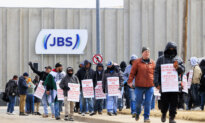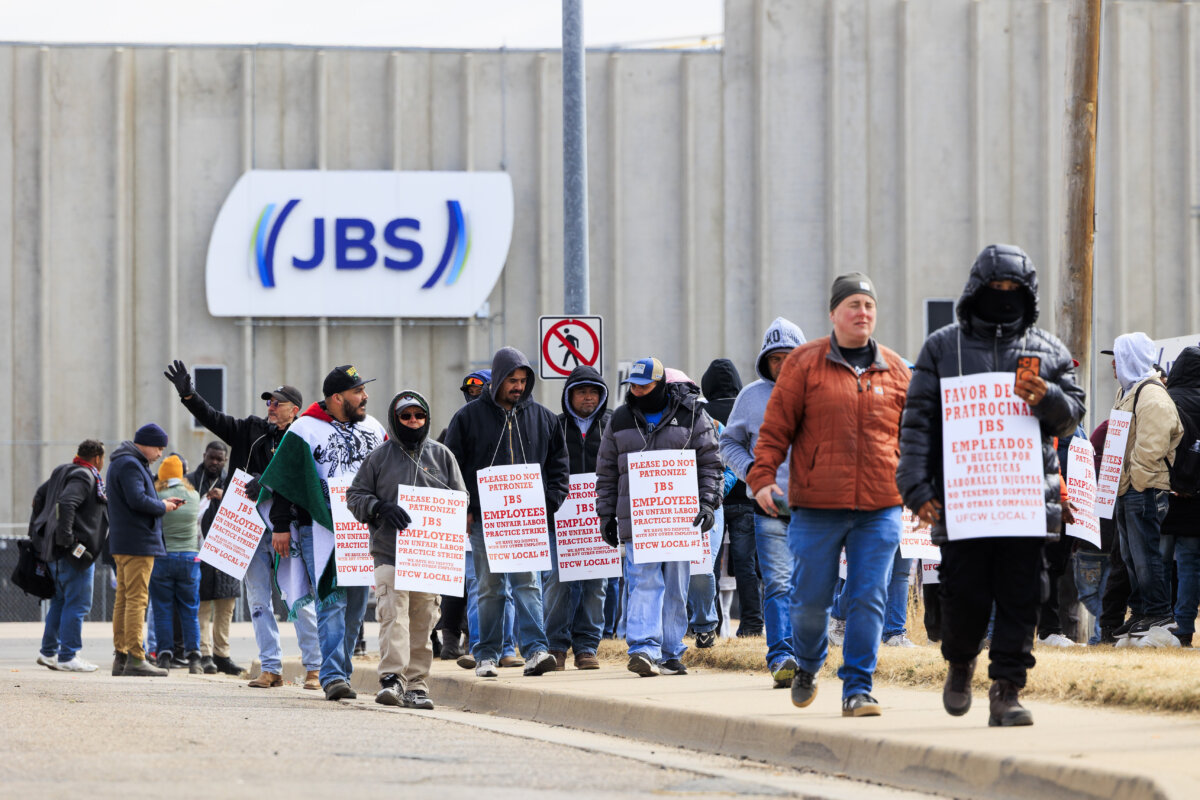

The labor union representing about 3,800 workers at JBS USA’s beef plant in Greeley, Colorado, has reached a new contract with the company to settle a labor dispute that disrupted one of the nation’s biggest beef processing facilities.
The two sides announced the tentative agreement on April 12, about a week after workers returned to the job following a three-week strike. Both the company and the union cast the outcome as a victory.
United Food and Commercial Workers (UFCW) Local 7 said that 93 percent of its members ratified the April 12 deal. It described the pact as one that “represents a contract with all gains, countless improvements, and not a single concession.”
The new agreement includes an immediate increase of 70 cents in base pay, followed by hourly raises of 40 cents in 2026 and 2027. The union said that is 10 cents per hour better than the company’s last offer before the strike began.
Although the contract does not include retroactive pay, it does provide a one-time $750 ratification bonus and a separate $500 payment in April 2027. The agreement also caps workers’ health care costs, adds vacation time, requires JBS to pay for personal protective equipment, and reimburses employees who previously had wages garnished to cover replacement gear.
“This tentative agreement is a testament to the incredible resolve of our members at the JBS Greeley plant,” UFCW Local 7 President Kim Cordova said in a statement.
JBS, a subsidiary of Brazil-based JBS S.A., said the contract largely mirrors the offer it had already put on the table before the walkout. The company also said the union agreed to withdraw seven alleged unfair labor practice charges as part of the settlement.
“The strike ultimately ended without any major changes to the company’s offer,” JBS said in a statement. “The strike at Greeley could have been avoided.”
The strike began on March 16 after roughly nine months of negotiations failed to produce a deal that met the union’s demands.
The national UFCW last year agreed to a long-term labor contract covering about 26,000 workers across more than a dozen U.S. facilities. But Local 7 opted out of that deal, saying that it did not reflect Colorado’s higher cost of living.
The strike added pressure to an already strained U.S. beef market, in which prices have surged as ranchers reduce herds in response to years of drought in the West that dried up grazing land and raised feed costs. The Department of Agriculture said the nation’s cattle inventory stood at 86.2 million head as of Jan. 1, 2026, including 27.6 million beef cows—the smallest number in 75 years.
The Greeley facility is one of the largest beef plants in the United States, with capacity often cited at roughly 5,500 to 6,000 cattle per day. For comparison, the Department of Agriculture’s most recent weekly report on federally inspected slaughter showed 524,392 head of cattle slaughtered nationwide in the six-day work week that ended on March 28, 2026, or about 87,398 head per day.
On that basis, the Greeley plant accounts for roughly 7 percent of the nation’s cattle processing capacity.
The average U.S. price for a pound of ground beef was about $6.70 in March, up from roughly $5.85 a year earlier and $3.95 in 2016, according to federal price data.
 Friends Read Free
Copy
Facebook
Tweet
Friends Read Free
Copy
Facebook
Tweet