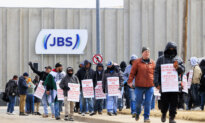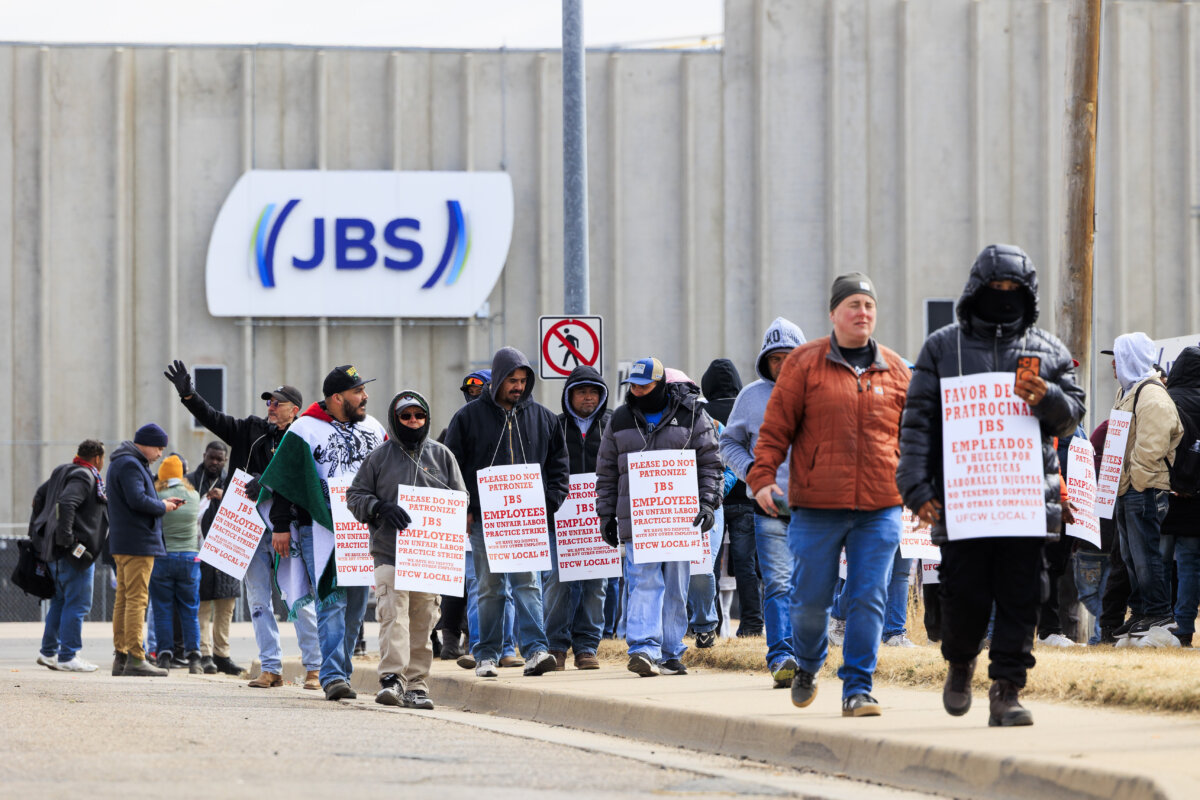

About 3,800 unionized workers at JBS USA, the nation’s largest meat processor, walked off the job on March 16, as beef prices remain at record highs.
The strike started before sunrise outside the company’s flagship beef plant in Greeley, Colorado, one of the largest facilities of its kind in the United States by volume. A video shared by United Food and Commercial Workers (UFCW) Local 7, the union representing the workers, showed participants forming picket lines in the dark as the morning shift was about to begin.
The workers are seeking higher wages, safer working conditions, and better health benefits. Local 7 said nearly all members who voted supported the walkout after about nine months of contract negotiations failed to produce a deal that met their demands.
The national UFCW last year agreed to a long-term labor contract covering about 26,000 workers across more than a dozen U.S. facilities. But Local 7 opted out of that deal, saying that it did not reflect Colorado’s higher cost of living.
According to the union, JBS offered terms similar to those of the national agreement, including a 60-cent hourly wage increase in the first year and 30-cent per hour raises in each of the following two years. Local 7 argued that it was not enough to keep pace with inflation and rising health care costs.
Considering that health care costs have increased by 22 cents per hour, the union said, a 30-cent raise would provide little meaningful gain.
The union also accused the company of making workers pay to replace required personal protective equipment. Some of that equipment can cost as much as $1,100, Local 7 said, with workers allegedly charged the full replacement cost.
“JBS workers absolutely deserve wage increases that keep pace with inflation, that support their health, that protect their retirement, and that allow the workers to work with dignity and respect,” the union said in a statement announcing the strike.
JBS USA, a subsidiary of Brazil-based JBS S.A., did not respond to a request for comment, but previously said it had complied with labor laws and offered a “strong, fair and consistent” contract in line with the broader national deal with the UFCW.
“We do not believe a strike is in the best interest of our team members or their families,” the company said in a statement provided to media. “For any Greeley beef team members who do not wish to strike and want to continue working, we will ensure they have work available and are paid.”
The company also said it planned to temporarily divert production to other plants with “excess processing capacity.”
The strike adds pressure to an already strained U.S. beef market, in which prices have surged as ranchers reduce herds in response to years of drought in the West that dried up grazing land and raised feed costs. The Department of Agriculture said the nation’s cattle inventory stood at 86.2 million head as of Jan. 1, 2026, including 27.6 million beef cows—the smallest herd in 75 years.
The Greeley facility is capable of processing roughly 5,500 cattle per day, according to a study by Colorado State University. For comparison, the Department of Agriculture’s most recent weekly report on federally inspected slaughter showed 528,642 head of cattle slaughtered nationwide in the week ending on Feb. 28, 2026, or about 75,500 head per day.
On that basis, the Greeley plant accounts for roughly 7 percent of the nation’s cattle processing capacity.
For consumers, the tighter profit margin for meatpackers has contributed to pushing beef prices to record highs. Ground beef prices were up by 15.7 percent in February from a year earlier, while beef roast prices were up by 11.6 percent and steak prices were 17.2 percent higher, according to the Department of Labor.
 Friends Read Free
Copy
Facebook
Tweet
Friends Read Free
Copy
Facebook
Tweet