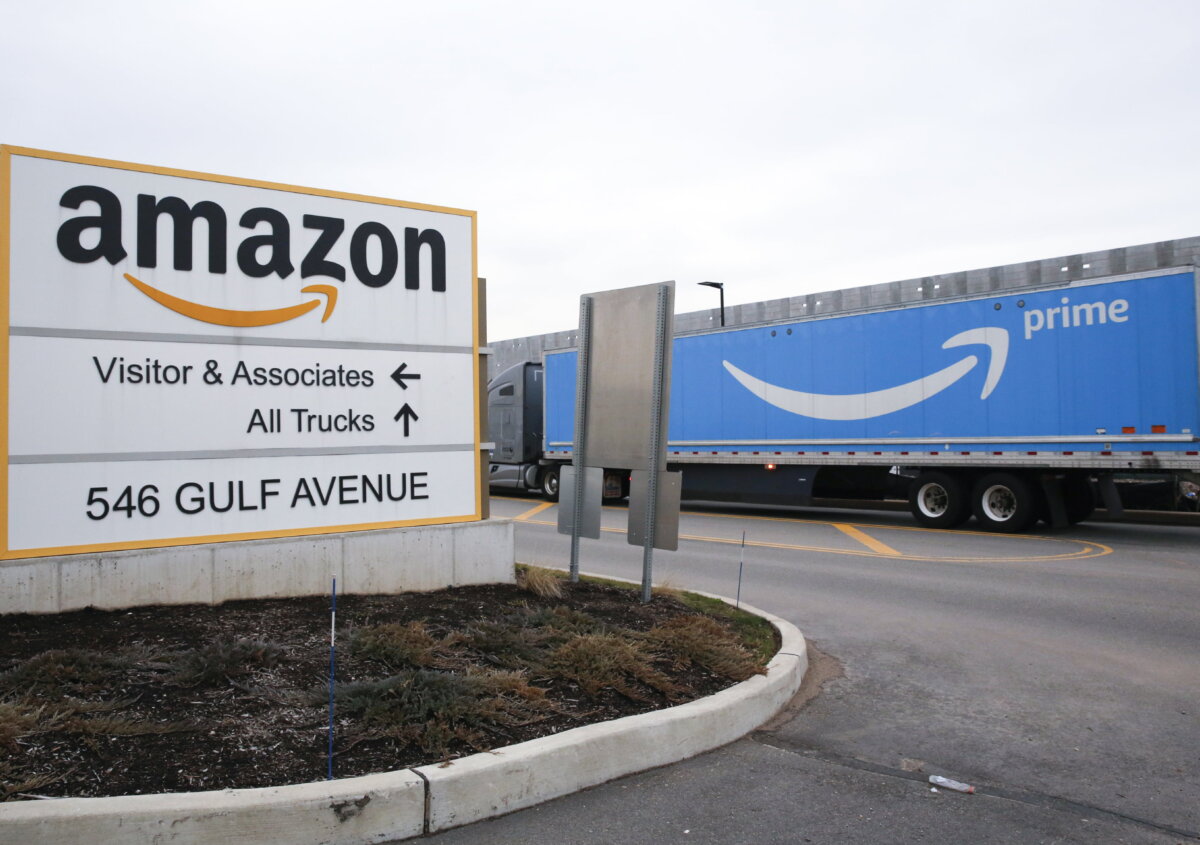

For years, Amazon’s logistics infrastructure was available only to its third-party sellers and customers. But that changed this Monday, with the eCommerce pioneer making its entire portfolio of freight, distribution, fulfillment, and parcel shipping capabilities available to every business in a head-to-head competition against UPS and FedEx.
Meanwhile, some logistics experts said the company’s new move could lead to more competitive shipping rates and ultimately lower prices for consumers.
A New Platform
“Amazon is bringing the infrastructure, intelligence, and scale of its supply chain services—proven over decades—to businesses everywhere,” Peter Larsen, vice president of Amazon Supply Chain Services, announced on May 4.
ASCS builds on one of the cornerstones of Amazon’s eCommerce success—its advanced supply chain technology, which the company has developed since the early days of the dot-com revolution.
The technology integrates multiple supply chain functions to enhance capacity, speed, and reliability in today’s retail environment.
Amazon’s expansive freight network—spanning ocean, air, and rail—allows it to offer a wide range of expedited delivery services, including time-sensitive shipments, customs clearance, and end-to-end tracking.
Its distribution and fulfillment system uses a single inventory pool and advanced forecasting to bring goods closer to demand and fulfill orders smoothly across sales channels.
Its parcel shipping service supports flexible pickup from multiple warehouses or third-party providers, offering full visibility from label creation to final delivery.
The technology has helped Amazon secure several competitive advantages: scale and scope, economies of networking, and a strong brand.
These advantages have helped Amazon grow by leaps and bounds and turn from a dot-com start-up into a giant, with sales crossing $700 billion in 2025, up by 12.38 percent from 2024.
Last week, the company reported that operating income came in at $23.9 billion, producing a 13.1 percent companywide operating margin—the highest the company has ever reported.
“With the launch of ASCS, we’re confident we can give any other business access to the same cost efficiency, reliability, and speed that we’ve built for Amazon customers,” Larsen added.
According to Amazon’s statement, several firms had already signed up for ASCS, including Procter & Gamble and 3M, which are using a broad range of ASCS services to transport materials and products across their production and distribution facilities, as well as Land’s End and American Eagle Outfitters, which use ASCS to deliver online orders.
The global supply service industry is massive, with Global Market Insights valuing it at $1.6 trillion in 2025 and expecting it to grow from $1.8 trillion in 2026 to $4.3 trillion in 2035, at a compound annual growth rate of 10.1 percent.
Taking on UPS and FedEx
While it may take some time for Amazon to expand its roster of business customers, this strategy could boost both its top and bottom lines.
“The best thing about Amazon making its supply chain services available to external businesses is that it provides a foothold in the lucrative logistics sector while diversifying revenue streams for greater resilience,” Iván Marchena, senior economist at Just2Trade, told The Epoch Times.
Marchena likened the strategy to Amazon Web Services (AWS), noting that the company is once again turning internal capabilities into a marketable service—this time targeting logistics.
AWS emerged from Amazon’s internal push to standardize its infrastructure and later evolved into a commercial cloud platform that allows companies to rent computing power and storage rather than build their own servers.
The service was launched in 2006 and has become the world’s most broadly adopted cloud platform, according to Amazon. Its customers include startups and enterprises, nonprofits, and governments.
“Most importantly, it will increase the volume of packages moving through Amazon’s network, allowing it to scale profitability as automation continues to reduce operating costs. This is likely to boost margins over time,” Marchena said.
At the same time, Amazon is expected to grab market share from the two dominant U.S. players in the industry: UPS and FedEx. Both companies’ shares dropped by nearly 10 percent following the announcement, while Amazon’s shares gained 1.38 percent. GXO and DHL also fell.
The sell-off in these companies’ shares on April 4 suggests that the market understands Amazon’s strategy, said Rich Pleeth, CEO and co-founder of Finmile, an artificial intelligence logistics operating system.
“[It’s] not just another logistics service; this is the AWS playbook applied to supply chain. Amazon built its own infrastructure, and now it wants to sell it to everyone else,” he told The Epoch Times.
“The threat to incumbents is not just scale; it is Amazon’s combination of logistics assets, data, forecasting, software, and last-mile execution,” Pleeth said.
Consumer Implications
Amrita Bhasin, a logistics expert, believes competition from Amazon will ultimately lower costs and improve package delivery times, a win for customers.
“Amazon is turning its logistics capabilities into a service, effectively productizing it in a similar way they did with AWS for cloud services. Companies may not need to build every part of their logistics infrastructure in-house anymore and can tap into Amazon’s network that is proven to work at significant scale,” she told The Epoch Times.
“More players in fulfillment usually equals more competitive shipping rates, and more competitive shipping rates mean lower prices for consumers. That’s good,” Catherine O’ Toole, director of digital marketing at Zenventory, a cloud-based warehouse management system, told The Epoch Times.
“The part worth watching now is that as Amazon controls more and more of the fulfillment ecosystem, the more leverage they will have over the brands that depend on them and, by extension, over what ends up on the shelves and at what price.”
 Friends Read Free
Copy
Facebook
Tweet
Friends Read Free
Copy
Facebook
Tweet