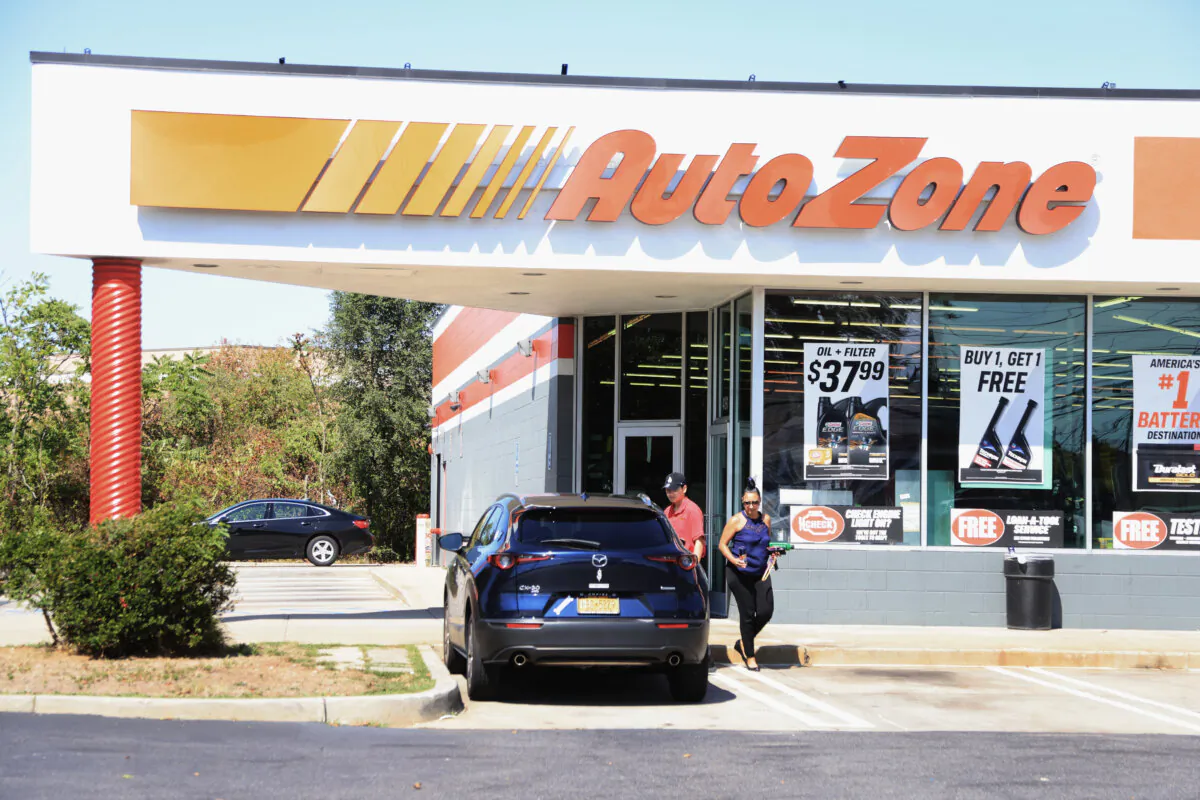

Shares of auto parts giant AutoZone Inc. fell on May 27 after the company reported higher fiscal third-quarter revenue and same-store sales, but a decline in profit margins. The company expressed confidence in future growth, noting its exposure to China has declined “significantly.”
According to its earnings report, the Memphis, Tennessee-based company’s gross profit as a percentage of sales was 52.7 percent in the third quarter of fiscal year 2025, which ended May 10. This represents a 77 basis-point decline from a year ago. The drop was driven by higher inventory shrinkage, increased commercial mix overhead, startup costs for a new distribution center, and higher operating expenses, company officials said.
During the company’s pre-market conference call with Wall Street analysts, AutoZone CEO Phil Daniele downplayed the margin decline, saying the company will continue to prioritize its growth strategy of boosting same-store sales in its almost 7,500 locations in the United States, Mexico and Brazil.
“The top focus areas for this last quarter of 2025 remains growing share in our domestic commercial business and continuing our momentum in our international markets,” Daniele said. “We understand we cannot take things for granted, [but] we must remain laser focused on customer service execution, and gaining share in every market in which we operate.”
For the period ended May 10, AutoZone reported net income of $608 million, or $35.36 per share, down 6.6 percent from net income of $651.7 million, or $36.69 per share, in the third quarter of 2024. Total sales rose 5.4 percent to $4.46 billion, compared with $4.23 billion a year ago.
The company’s same-store sales increased by 3.2 percent compared with 0.9 percent a year ago. That improvement was primarily driven by a 5 percent increase at the company’s 6,483 U.S. stores opened a year or more. However, same-store sales declined by 9.2 percent at the company’s 949 locations in Mexico and Brazil.
Excluding the impact of foreign currency exchange rates, the auto aftermarket retailer would have reported international same-stores sales of 8.1 percent, which Daniele highlighted during its conference call.
AutoZone’s results received mixed reviews on Wall Street, as it was expected to report third-quarter earnings of $37.07 per share on sales of $4.42 billion, according to FactSet.
AutoZone’s chief finance officer Jamere Jackson said the company’s inventory increased 10.8 percent over the same period last year, driven by new store growth and same store sales growth initiatives.
In highlighting the company’s third-quarter performance, Daniele said AutoZone opened 54 new stores in the United States, 25 in Mexico, and five in Brazil, for a total of 84 net new stores. Altogether, the auto aftermarket reseller had 6,537 stores in the United States, 838 in Mexico, and 141 in Brazil, for a total store count of 7,516. With 58 store openings year-to-date, AutoZone expects to open around 100 total international locations in fiscal 2025.
Going forward, Daniele said the company plans to invest $1.3 billion to expand its satellite store operations and larger mega-hubs locations, especially in the fast-growing international markets in Mexico and Brazil.
“We remain confident in our growth opportunities in this market. Today, [we] have 13 percent of our total store base outside of the [United States] and we expect this number to grow as we accelerate our international store openings,” Daniele said.
In response to analyst questions about the impact of tariffs and U.S. trade policies with China, Daniele said the impact on AutoZone operations has been minimal. Although China is AutoZone’s largest net importer of car parts, that percentage has declined “significantly over the last couple of years” since the first round of tariffs in 2016.
Ahead of the release of the earnings report, Bank of America analyst Robert Ohmes on May 21 upgraded AutoZone’s upside after raising the company’s stock from a “neutral” to a “buy.” He also bumped the auto parts retailer’s price target from $3,900 to $4,800 per share, based on the company “recession resilient history” in the face of potential prices increases from inflation and tariffs.
Ohmes told The Epoch Times that he remains bullish on AutoZone as the auto parts aftermarket could benefit from the Trump administration’s 25 percent auto tariffs, which could drive down new car sales. He also noted that AutoZone only has about 35 percent of its product sourced from China, significantly reducing its exposure to import levies.
“We see opportunities for a return to 2-4 percent industry inflation as auto parts retailers raise price to offset incremental tariff pressures,” Ohmes said via email.
“We also think the auto aftermarket could benefit from lower new car sales and higher used car pricing, as consumers may hold onto and repair existing vehicles.”
Ohmes added that AutoZone is taking advantage of strategic investments to seize opportunities to gain market share on both the DIY retail and commercial pro sides of the auto parts business. He noted that the company could gain further market share after rival Advance Auto Parts (AAP) announced in late 2024 that it planned to close more than 700 stores and four distribution centers by mid-2025 amid a companywide restructuring effort.
“AutoZone continues to invest in labor to maintain relationships with the up and down the street accounts to grow its commercial segment,” Ohmes said, adding that AutoZone and AAP stores are often located in close proximity.
The company’s shares fell 3.42 percent to close at $3,695.66 during the May 27 trading session. The stock has outperformed the broader market over the past 12 months, gaining 32.32 percent versus the S&P 500’s return of 11.63 percent. Under the company’s stock buyback program, AutoZone repurchased 70,000 shares of its common stock at an average price of $3,571 per share, for a total investment of $250.3 million. The company has an additional $1.1 billion to repurchase shares under the board’s $5 billion authorization program.
 Friends Read Free
Copy
Facebook
Tweet
Friends Read Free
Copy
Facebook
Tweet