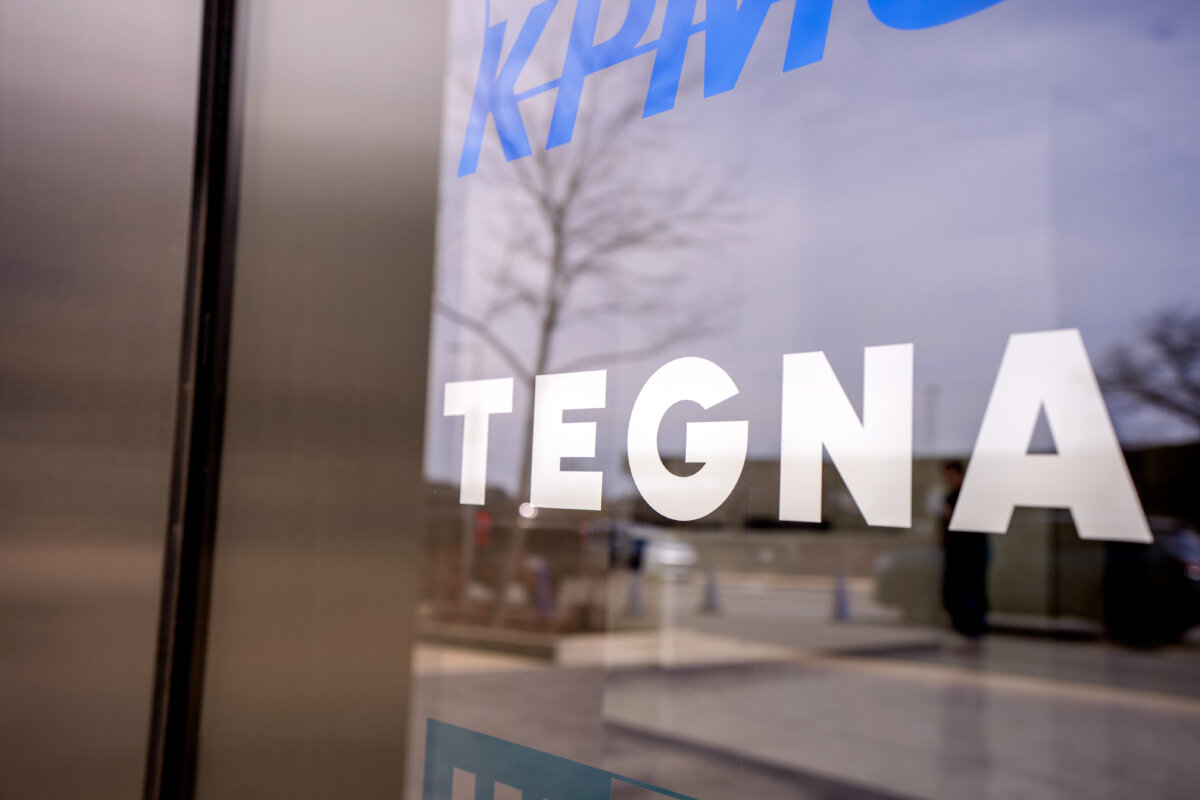

A federal judge on April 17 temporarily blocked Nexstar’s $6.2 billion acquisition of local broadcast station owner Tegna amid antitrust challenges from eight states.
U.S. District Court Chief Judge Troy L. Nunley in Sacramento issued a preliminary injunction, finding that plaintiffs were likely to succeed in their claims that the merger would reduce competition in local television markets and make it difficult for distributors like DirecTV to reject Nexstar’s demands for higher prices.
“Based on the foregoing, the court finds defendants’ rebuttal evidence is insufficient to overcome plaintiffs’ prima facie case. Plaintiffs establish ‘a reasonable probability of anticompetitive effect’ in the market,” the judge wrote in a 52-page ruling.
Nunley said the merger would make it harder to divest Tegna as a competitive entity and could result in newsroom layoffs and shutdown, causing irreparable harm to the plaintiffs.
Under the preliminary injunction, Nexstar is required to allow Tegna to continue operating as a “separate and distinct, independently managed” business unit until the antitrust lawsuit is resolved.
Nexstar said in a statement that it intends to appeal the ruling.
“Nexstar Media Group now owns TEGNA and has taken steps consistent with the Court order that has been in effect,” the company said. “We will appeal today’s decision and look forward to presenting our case on its merits before the Ninth Circuit Court of Appeals.”
The merger deal was first announced in August 2025 and approved by the Federal Communications Commission (FCC) on March 19. A coalition of attorneys general from eight states filed a lawsuit last month to stop the merger, saying it would concentrate local TV ownership.
New York Attorney General Letitia James, one of the attorneys general involved in the lawsuit, called the judge’s ruling “a critical victory” in the legal battle.
“Consolidating hundreds of local TV stations under one corporate owner would mean higher prices and lower quality programming for consumers,” James said in a statement. “We will keep fighting our case to ensure fair competition among local TV stations that serve communities across the country.”
Nexstar already operates more than 200 owned or partner stations in 116 markets and runs national networks including The CW and NewsNation. The acquisition would give Nexstar control of an additional 228 broadcast stations in 132 local markets and increase market concentration in more than a dozen areas, according to court documents.
FCC Chairman Brendan Carr said on March 19 that Nexstar had committed to “certain concrete conditions” to secure approval of the deal, including “divesting a number of stations, increasing localism, and affordability steps.”
According to the regulator, the deal would enable “broadcast TV stations to counter the growing power that national programmers have amassed in recent years” while allowing Nexstar to own less than 15 percent of TV stations.
James was joined in the lawsuit by the attorneys general of California, Colorado, Connecticut, Illinois, North Carolina, Oregon, and Virginia.
 Friends Read Free
Copy
Facebook
Tweet
Friends Read Free
Copy
Facebook
Tweet