
Federal Reserve officials are increasingly concerned that inflation may persist longer than initially expected, according to minutes from the May policy meeting.
Earlier this month, the Fed kept the benchmark federal funds rate unchanged for the third consecutive meeting. The key rate remained in a range of 4.25 percent to 4.5 percent.
Based on comments outlined in the Federal Open Market Committee (FOMC) minutes, the Fed might keep rates higher for longer amid inflation worries.
Monetary policymakers note that the risks of rising inflation and increasing unemployment have grown, fueled by trade-related uncertainty affecting the broader economy.
Meeting participants acknowledge that the central bank may face difficult tradeoffs between economic growth, employment levels, and inflation running above trend.
Staff economists project weaker economic growth for 2025 and 2026, revising down their estimates from the March meeting.
The adjustment reflects announced trade policies, which are expected to impose a greater drag on economic activity than previously forecast.
The meeting summary further states that trade policies are anticipated to slow productivity growth, thereby reducing potential GDP growth over the next few years.
A recession, the minutes say, is also a possibility.
According to the policy minutes, Federal Reserve staff believe tariffs will “boost inflation markedly” in 2025, followed by a smaller increase in 2026.
“After that, inflation was projected to decline to 2 percent by 2027,” the document states.
Increased uncertainty remains the key theme for the monetary authorities.
“The staff continued to note the large amount of uncertainty surrounding trade policy and other economic policies and now viewed the uncertainty around the projection as elevated relative to the average over the past 20 years,” the minutes stated.
“Risks to real activity were seen as skewed to the downside, and the staff viewed the possibility that the economy would enter a recession to be almost as likely as the baseline forecast.”
The financial markets were little changed following the Fed’s release of this month’s minutes.
The tech-driven Nasdaq Composite Index and the broader S&P 500 were flat, while the Dow Jones Industrial Average picked up about 120 points.
Balancing Act
Speaking in Tokyo at the Bank of Japan’s Institute for Monetary and Economic Studies conference on May 27, Minneapolis Fed President Neel Kashkari stated that monetary officials are engaged in a “healthy debate” about whether tariff-driven inflation will be transitory or a permanent fixture of the U.S. economy.
According to Kashkari, the current trade uncertainty may not be resolved for “months or years,” and the situation could lead to various retaliatory measures.
“I find these arguments more compelling given the paramount importance I place on defending long-run inflation expectations,” he said.
Ultimately, Kashkari is in the camp of keeping interest rates higher for longer until there is more clarity that these levies are affecting prices.
As for the broader economy, New York Fed President John Williams says there is some evidence suggesting consumers are curtailing their spending, which would potentially harm growth prospects.
“We are hearing more reports from businesses and others that consumers are starting to pare back some of that consumer spending,” Williams said in an interview with Bloomberg Television earlier this month.
Last month, retail sales rose just 0.1 percent, down from an upwardly adjusted 1.7 percent increase in March.
In addition, the first-quarter GDP report highlighted real consumer spending slowing to 1.8 percent from the 4 percent jump in the fourth quarter.
Consumer surveys have also indicated that the public is taking a wait-and-see approach before following through on major purchases.
At the same time, The Conference Board’s May Consumer Confidence Index rebounded, signaling more optimism surrounding employment, income, and the stock market.
The Federal Reserve has shrugged off concerns about growth.
“Although swings in net exports have affected the data, recent indicators suggest that economic activity has continued to expand at a solid pace,” the interest rate-setting Federal Open Market Committee said in the May 7 policy statement.
Vice Chair Philip Jefferson, speaking at a New York Fed conference on May 14, stated that underlying fundamental numbers show “resilience” in the wider economic landscape.
He alluded to the GDP report’s private domestic final purchases, which omit government spending, net exports, and inventory investment, as evidence of the economy’s underlying strength.
“That came in at a 3 percent rate in the first quarter, consistent with readings from last year,” Jefferson said.
The Trump Card
In the background of the Federal Reserve’s monetary policymaking, President Donald Trump is demanding rate cuts.
The president, writing in a May 17 Truth Social post, again stated that the U.S. central bank needs to lower interest rates “soon, rather than later.”
He also lambasted Fed Chair Jerome Powell for being “too late.”
“The consensus of almost everybody is that ‘the Fed should cut rates sooner, rather than later.'” Trump said. “Too Late Powell, a man legendary for being too late, will probably blow it again—But who knows?”
According to the CME FedWatch Tool, investors are increasingly betting that the institution will take its next policy action in September, pulling the trigger on a quarter-point rate cut.
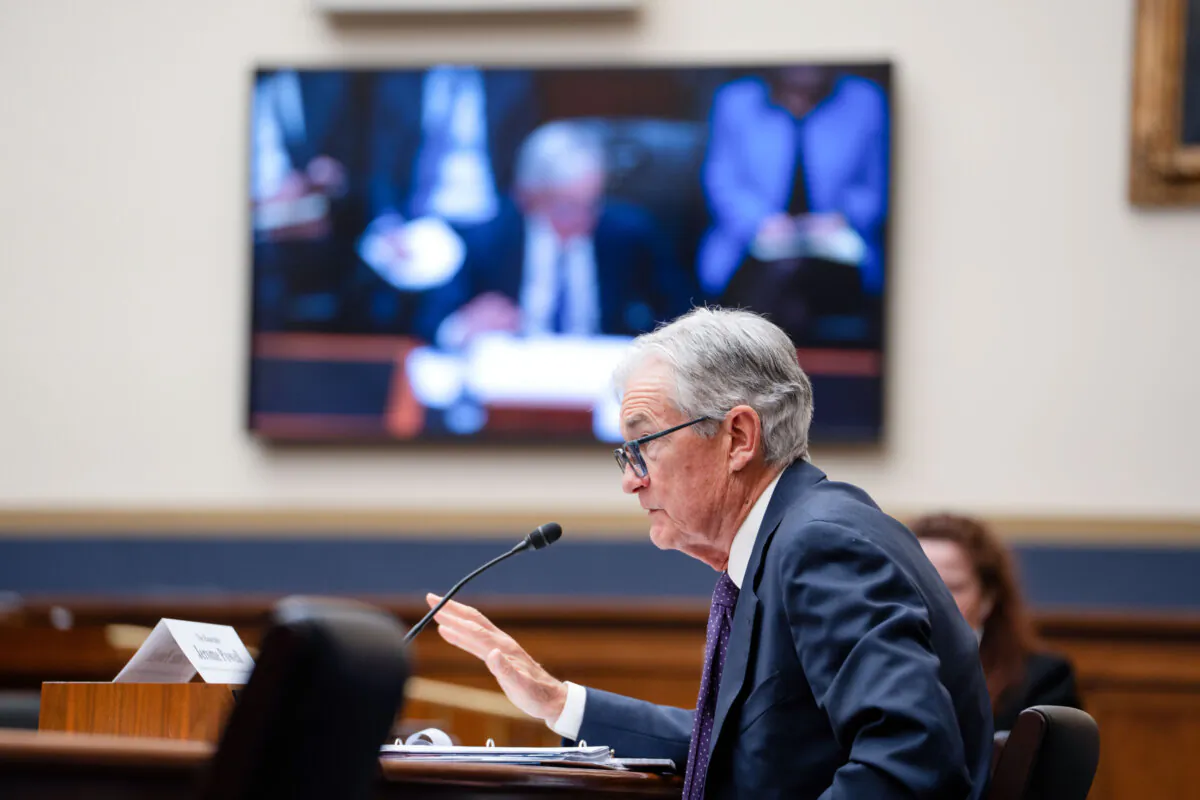
This might not be surprising, considering Powell’s recent comments that suggest the central bank will return its focus to combating inflation.
Speaking at a Fed research conference earlier this month, Powell stated that the U.S. economy could be transitioning to an era of supply shocks, elevated inflation, and higher interest rates.
“We may be entering a period of more frequent and potentially persistent supply shocks, a difficult challenge for the economy and for central banks,” Powell said in prepared remarks.
So far, the supply chain and inflation appear to be stable, with the headline annual inflation rate inching closer to the central bank’s 2 percent target.
Additionally, the New York Fed’s Global Supply Chain Pressure Index has shown little change amid Trump’s tariff plans.
Meanwhile, many economic observers suggest that this could be the calm before the storm, with early indicators pointing to renewed inflation threats.
“Tariffs are unarguably bad for the economy, throttling business profitability and causing inflation for consumers. Trade wars cause all sorts of supply chain problems, slowing economic growth and adding to inflationary pressure,” said Siebert Financial CIO Mark Malek in a note emailed to The Epoch Times.
Truflation, a real-time inflation measure that depends on millions of data points, has indicated a sizable uptick in U.S. inflation this month.
 Friends Read Free
Copy
Facebook
Tweet
Friends Read Free
Copy
Facebook
Tweet