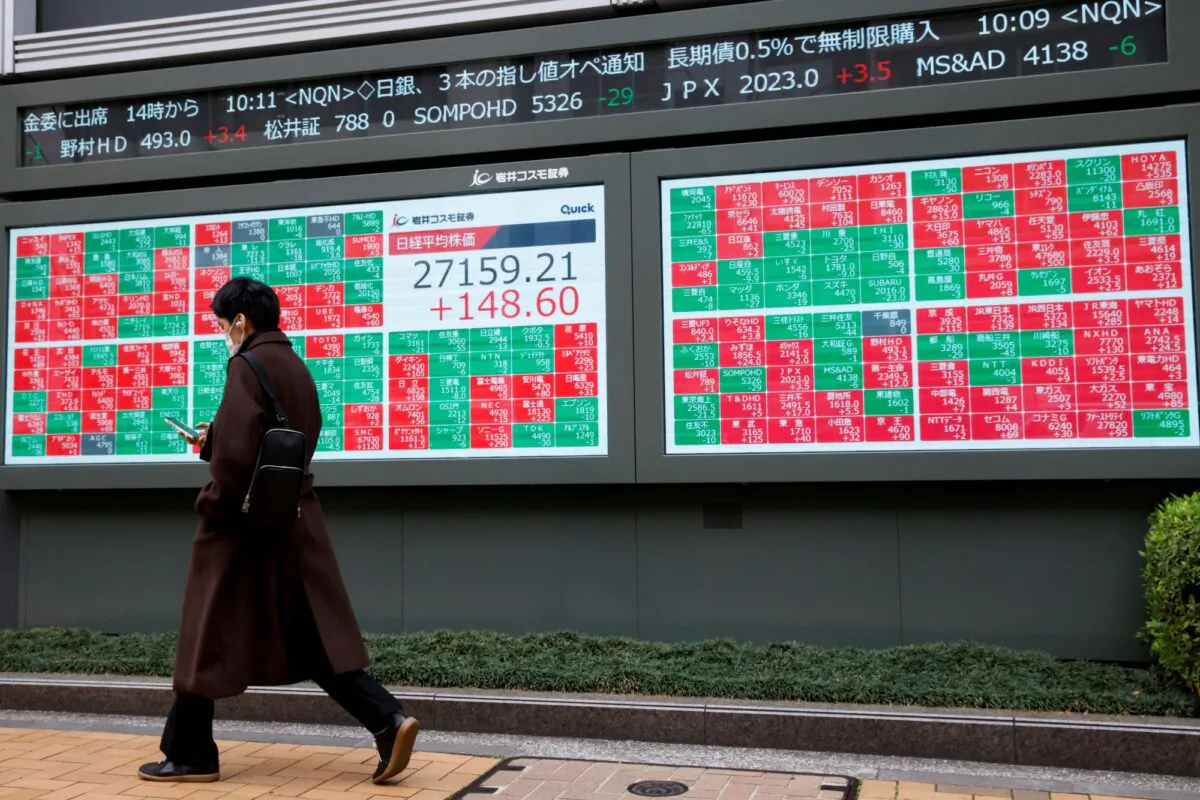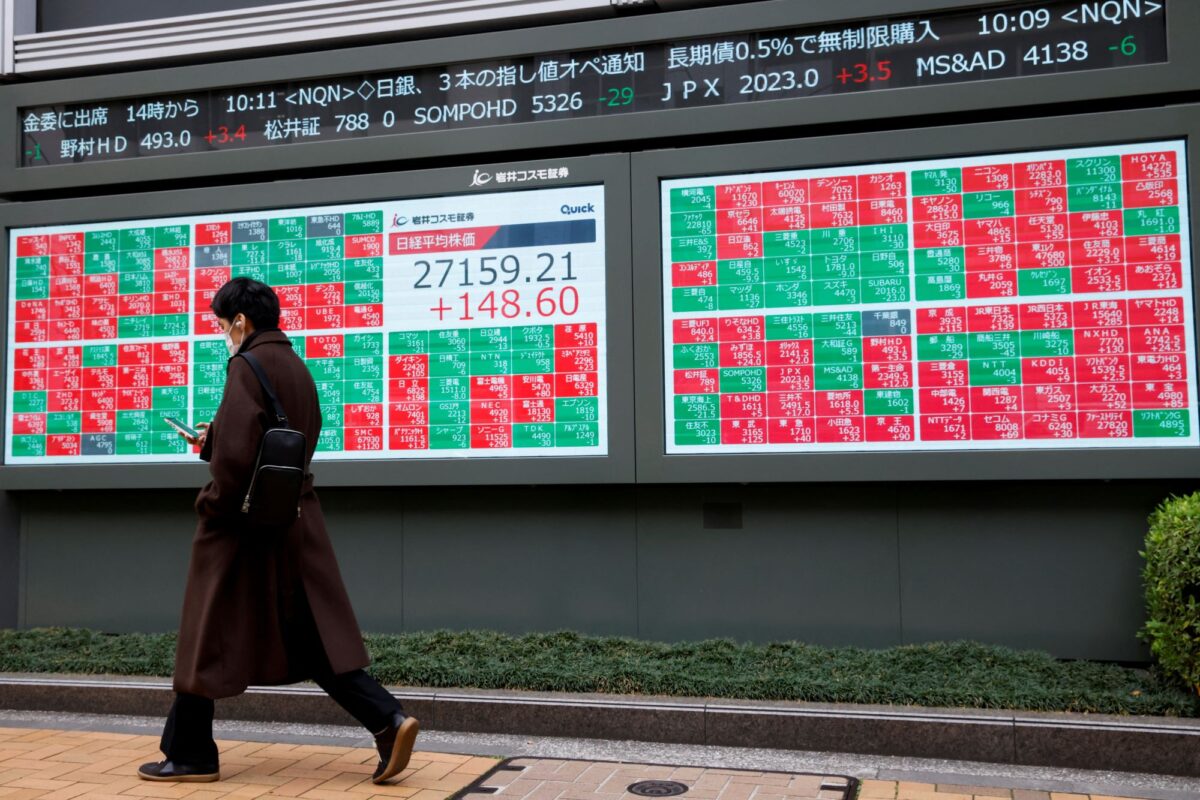

LONDON/SYDNEY—Global stocks ticked lower on Tuesday and bond yields dropped as investors assessed the latest weak economic data out of China and looked ahead to a key inflation reading from the U.S. on Thursday.
Meanwhile, eurozone bank stocks fell sharply after Italy approved a 40 percent windfall tax on lenders for 2023 and Moody’s cut the credit ratings of several small and mid-sized U.S. lenders.
MSCI’s index of global stocks edged 0.23 percent lower after climbing 0.5 percent on Monday. The MSCI Asia index, which excludes Japan, fell 1.11 percent.
Data showed China’s imports contracted by 12.4 percent in July, far more than forecasts for a 5 percent drop. Exports fell by 14.5 percent, compared with a fall of 12.5 percent tipped by economists.
European stock indexes opened lower, with the pan-European STOXX 600 down 0.26 percent and Germany’s DAX falling 0.33 percent. Britain’s FTSE 100 slipped 0.29 percent in early trading.
“It’s a bit of a mild, classic, risk-off type of day where you’ve got equity futures, led by Asia, heading lower and rates heading lower,” said Timothy Graf, head of macro strategy for EMEA at State Street. “The trade figures are absolutely terrible.”
Futures on the U.S. S&P 500 were down 0.29 percent after the stock index climbed 0.9 percent on Monday. Nasdaq futures were 0.39 percent lower.
Graf said more worrying news out of China’s enormous and shaky property sector was also likely weighing on markets.
Country Garden, China’s biggest privately owned property developer, said on Tuesday it had not paid two dollar bond coupons due on Aug. 6, adding to signs of severe stress in the sector.
U.S. and European bond yields fell, reversing some of the increases seen over the last week.
The U.S. 10-year Treasury yield was down 7 basis points to 4.012 percent, after touching its highest level since November on Friday at 4.206 percent. Yields move inversely to prices.
The dollar picked up against its major trading partners as investors shifted towards safer assets and was last 0.29 percent higher at 102.38.
Banks were the biggest fallers in the eurozone on Tuesday after Italy approved a 40 percent tax on lenders’ net interest margin, a measure of income derived from the gap between lending and deposit rates.
The eurozone bank index was down 2.67 percent and on track for its biggest daily fall since the financial turmoil of March.
Italy’s BPER banking group dropped 8.27 percent, while Intesa Sanpaolo fell 7.32 percent. Germany’s Commerzbank was 3.48 percent lower.
Adding to the gloomy mood in the financial sector was a report by Moody’s that cut the credit ratings of 10 banks by one notch. It also placed six banking giants, including Bank of New York Mellon, on review for potential downgrades.
Global investors are keenly awaiting Thursday’s U.S. inflation figures for July, which will be a key input into the Federal Reserve’s next interest rate decision in September.
U.S. inflation likely accelerated slightly in July to 3.3 percent year on year, while the core rate was likely unchanged at 4.8 percent, according to a Reuters poll of economists.
Headline inflation peaked at 9.1 percent in June 2022 but stood at 3 percent in June 2023.
Chinese inflation data is due on Wednesday, with economists predicting that the July figure will come in at minus 0.4 percent year on year.
The prospect of economic stimulus from China to reinvigorate a soft economy is still being contemplated by investors. Minor measures to help property markets have been delivered in the past fortnight, but no broad stimulus has been outlined.
U.S. crude oil fell 0.87 percent to $81.24 a barrel on Tuesday. Brent crude was 0.86 percent lower at $84.60 per barrel.
By Harry Robertson and Scott Murdoch
 Friends Read Free
Copy
Facebook
Tweet
Friends Read Free
Copy
Facebook
Tweet