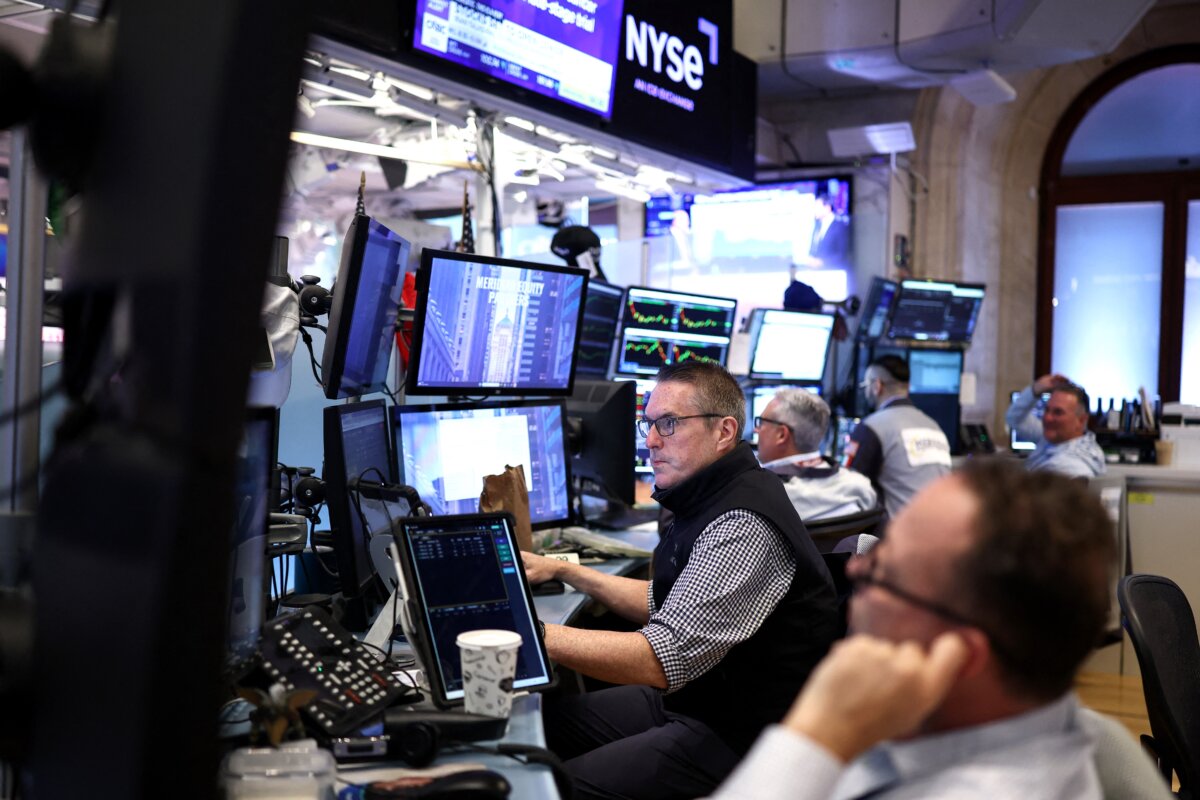

U.S. stocks keep flirting with record highs as investors shrug off headwinds, whether rising inflation or the United States and Iran seemingly stuck in a stalemate situation.
The tech-heavy Nasdaq Composite Index and broad-market S&P 500 returned from the Memorial Day long weekend and touched new highs.
The Nasdaq rose about 360 points, or 1.4 percent, to above 26,700 at 10:46 a.m. EDT on May 26.
It has climbed more than 17 percent this year and surged 41 percent over the past 12 months.
The broad-market S&P 500 has also added to its rebound since the March selloff and extended its eight-week winning streak.
The index rose more than 60 points, or 0.9 percent, to firmly above 7,500. Year-to-date, the S&P 500 is up almost 10 percent.
The blue-chip Dow Jones Industrial Average continues to eye 51,000, rising nearly 100 points, or almost 0.2 percent.
Despite a rough start to 2026, the popular index of 30 large-cap stocks is up more than 6 percent this year.
Investors are weighing the prospects of a possible peace deal between Washington and Tehran.
President Donald Trump said on May 25 that negotiations with Iran to resolve the conflict were “proceeding nicely.” He also outlined three potential paths to deal with Tehran’s uranium stockpile.
“The Enriched Uranium (Nuclear Dust!) will either be immediately turned over to the United States to be brought home and destroyed or, preferably, in conjunction and coordination with the Islamic Republic of Iran, destroyed in place or, at another acceptable location,” Trump wrote in a post on Truth Social.
He added that the destruction process would occur with the “Atomic Energy Commission, or its equivalent, being witness to this process and event.”
On Monday, the U.S. military conducted strikes on missile launch sites and Iranian boats attempting to place mines.
Oil, Inflation, and Rates
The latest development eased domestic energy prices.
A barrel of West Texas Intermediate—the U.S. benchmark for prices—declined nearly $4, or 4 percent, to below $93 on the New York Mercantile Exchange.
“Moving forward, and given the chaotic track record of negotiations throughout this Iranian conflict, I would say that we could easily see US crude return above $100 [per barrel] if peace talks fail to move in the right direction and traffic through the Strait of Hormuz is not quickly restored,” Ipek Ozkardeskaya, senior analyst at Swissquote, said in a note emailed to The Epoch Times.
Yields on U.S. Treasury securities were red across the board.
The main benchmark 10-year declined below 4.49 percent. The 30-year continued to recede after touching its highest level since the global financial crisis, sliding below 5.02 percent.
The two-year, which tracks expectations for Federal Reserve policy, slipped below 4.06 percent.
Investors have made the Fed’s raising interest rates later this year as their base case. Traders are betting on a 53 percent chance of a rate hike at the December Federal Open Market Committee policy meeting, amid rising inflation risks.
Markets will get another look at inflation this week when the April Personal Consumption Expenditures (PCE) Price Index is published on May 28. Estimates suggest the annual rate will rise to 3.8 percent.
But Andrew Dubinsky, senior economist at UBS, says it is unlikely that the Fed will raise rates.
“Despite inflation risk that reduces the likelihood for near-term easing, we believe the bar for a Federal Reserve interest rate hike is high,” Dubinsky said in a May 26 note.
“The Fed is likely to hold rates steady in the near term.”
The challenge for monetary policymakers will be determining whether the oil price shock will filter through the broader U.S. economy. The Fed playbook is typically to look past these events and examine structural inflation trends.
Excluding energy and food categories, inflation is tamer, though recent data indicate that pressures are building.
Still, financial markets appear content with a Fed potentially maintaining elevated interest rates, says Gina Bolvin, president of Bolvin Wealth Management Group.
“Investors had grown comfortable expecting eventual cuts, but today’s release reinforced the Fed’s ‘higher for longer’ stance,” Bolvin said in a note to The Epoch Times.
“The challenge for the Fed is that the economy remains surprisingly resilient, fueled by AI spending, solid earnings, and a still-healthy labor market.”
The central bank will receive another tranche of inflation and employment data before it convenes its two-day policy meeting on June 16 and 17.
‘Due for a Correction’
Whether U.S. stocks can sustain momentum heading into the summer has been the subject of debate.
A key contributor to the rally has been solid S&P earnings this year.
All members of the “Magnificent 7” and everyone else in the S&P 500 have registered the strongest earnings growth since 2021, according to data from FactSet Insights.
“As long as S&P 500 earnings growth has the potential to rise at a respectable clip over the next 12 months or more, we think the bull market can persist, notwithstanding some turbulence along the way,” Kelly Bodanova, portfolio analyst at RBC Wealth Management, said in a May 21 note.
One top market watcher thinks a pullback is on the horizon.
“We’re due for a correction. Historically, the market likes to test a new Fed chair, and we think that may be in the offing,” Nancy Tengler, CEO and CIO at Laffer Tengler Investments, said in an emailed note to The Epoch Times.
Tom Ozimek contributed to this report.
 Friends Read Free
Copy
Facebook
Tweet
Friends Read Free
Copy
Facebook
Tweet