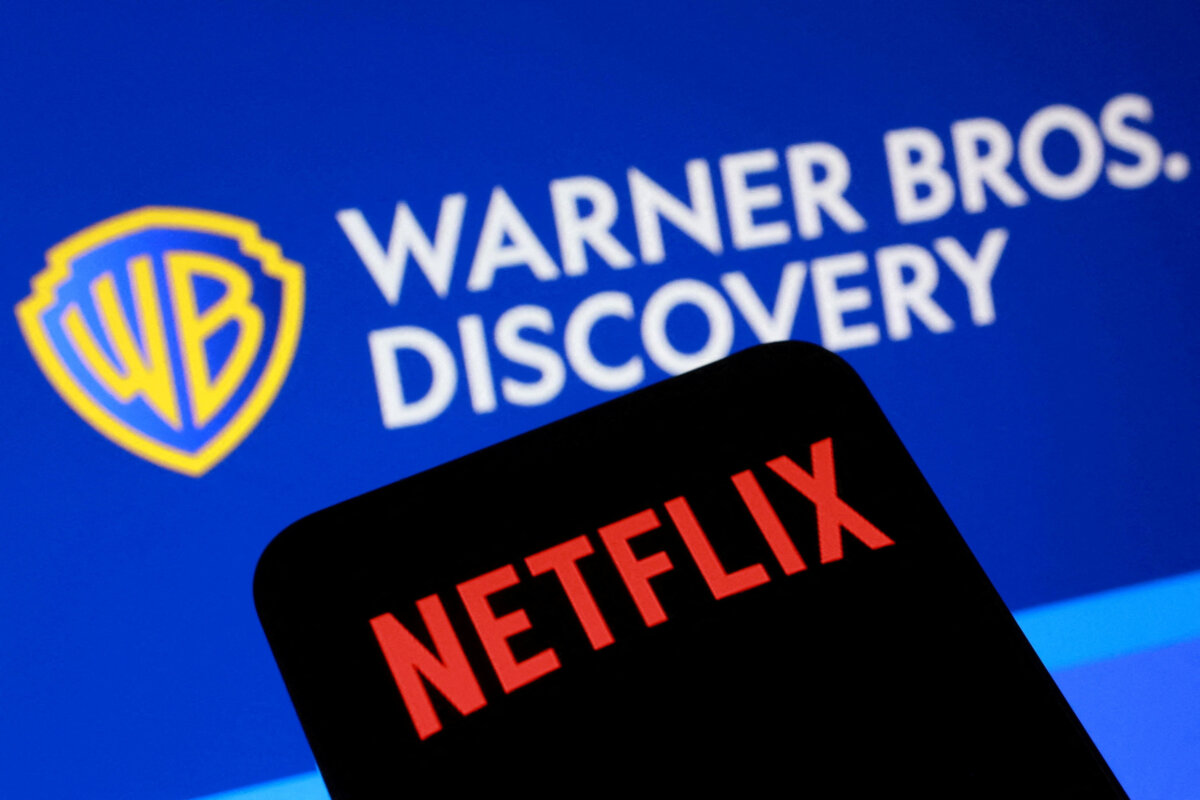

As Netflix works to acquire essential content by merging with Warner Bros., many conservatives are demanding that the company face up to the risks of targeting children with adult-themed content on its platform.
“I think Netflix has a problem, and that they have a creative class that just loves to push the envelope with programming, including children’s programming, and they don’t seem to be satisfied unless they’re subverting the moral order with sexual content,” Jerry Bowyer, asset manager and Netflix shareholder, told The Epoch Times.
“Companies that do that eventually lose their ‘social license,’” he said. “Eventually, parents and the social order reasserts itself, and there’s blowback.”
Bowyer’s company, Bowyer Research, has filed a shareholder resolution with the Securities and Exchange Commission proposing that shareholders vote against the election of Netflix’s current board of directors for “failing to compete effectively with industry peers and tying the Netflix brand to divisive social policies rather than business fundamentals.”
Netflix’s sexualized children’s content has also drawn criticism and calls for a boycott from public figures such as Elon Musk and sparked the ire of members of Congress.
“Cancel Netflix for the health of your kids,” Musk stated on X in September. Netflix’s shares, which traded around $125 per share in September, have since fallen to $94 per share at year-end, though much of that decline is likely due to the company’s intention to take on substantial new debt to acquire Warner Bros.
In October, Rep. Tim Burchett (R-Tenn.) accused Netflix of targeting children with pro-transgender content, calling the company “demonic” during a Fox News interview, and demanding that company executives testify before Congress regarding their programming.
Controversial Content
Netflix’s kids shows that are alleged to be promoting sexualized content to children, in some cases as young as 7, include “Dead End Paranormal Park,” “Strawberry Shortcake: Berry in the Big City,” “The Baby-Sitters Club,” “Transformers: Earthspark,” and “Monster High: The Movie.”
According to Bowyer’s shareholder resolution, Netflix was indicted by a Texas county and charged with promoting lewd material depicting a child, a state jail felony, for streaming the 2020 film “Cuties” about an 11-year-old dancer. In addition, the report states, the 2018 Netflix film, “Baby,” portrays teenagers entering into prostitution “as a glamorized ‘coming-of-age’ story.”
“Netflix is notorious for injecting far-left politics and LGBTQ ideology into their programming, even when the content is targeting children,” Will Hild, executive director of Consumers’ Research, told The Epoch Times. “It comes as no surprise that shareholders are increasingly upset with management’s performance.”
Many conservative fund managers have also been critical of Netflix’s programming.
“When a company like Netflix produces harmful material for children, to say nothing of adults, Christian investors should not remain silent,” Robert Netzly, CEO of Inspire Investing, told The Epoch Times.
“They have a responsibility to speak truth to corporate power—by raising concerns at shareholder meetings and by voting with their dollars,” he said. “Investors are not obligated to participate in the profits of content that hurts children and families; in fact our obligation is to oppose it.”
Conflict regarding Netflix’s programming is not new to the company. While much of the current criticism comes from conservatives, Netflix previously had drawn criticism from progressives for airing a stand-up comedy special by Dave Chappelle called “The Closer,” which featured jokes about transgender people.
Defending the company’s decision not to remove the program, Netflix co-CEO Ted Sarandos stated during a 2021 interview with online newsite Deadline that “it’s impossible to please everybody but we are trying to please a world that is made of people of different tastes, sensibilities and beliefs, and it becomes very difficult to do that for everybody.”
Adding that “there are some things on Netflix that may be harmful to you, your colleagues and your friends,” Sarandos said that it was necessary to protect artistic freedom and a “respectful, safe workplace.” One significant difference between that instance and the current controversy, however, is that Chapelle’s show was not directed at children.
Pursuing the Warner Library
Netflix’s attempt to acquire Warner Bros. library of content fills a critical hole in Netflix’s offering of content. Originally started as a DVD rental company, Netflix initially had access to any films and shows that were available on disc.
Once Netflix switched to a primarily streaming platform, however, studios were much less willing to allow access to their content, compelling the company to become a studio in its own right and produce its own shows for streaming. While Netflix has had success with shows such as “House of Cards” and “Stranger Things,” it is increasingly finding itself with a paucity of shows to offer its subscribers as competing studios now offer their own streaming services, analysts say.
“Netflix is trying to acquire Warner Bros. because they need content,” Bowyer said. “I can’t think of any content that people are saying, ‘Hey, I need to sign up for Netflix to get that,’” he said.
The acquisition of Warner Bros. brings a number of high-value franchises, such as “Harry Potter,” “DC Comics,” and “Game of Thrones,” according to Jacob Hiler, a business professor and director of Ohio University’s Center for Consumer Research & Analytics. But a merger of this magnitude at a time when Hollywood has already undergone significant consolidation could threaten an existing protocol, supported by court decisions such as United States v. Paramount Pictures Inc. in 1948, that there should be competition among studios.
Given this context, analysts say that Netflix should avoid provoking regulators by attaching its brand to adult-themed content targeted at children.
“They’re out there doing this extreme, offensive stuff that saps the political goodwill when you’ve got to be a good corporate citizen to get the regulators to sign off,” Bowyer said. “This merger could be an existential issue for them, and if all this awful content they’ve been putting out—ignoring warnings from conservatives, ignoring warnings from parents, ignoring warnings from faith groups—ends up killing the merger, as a shareholder, I don’t like that, although as a citizen I think it’s well deserved.”
On Dec. 7, President Donald Trump indicated that he would be involved in regulators’ decision whether or not to approve the Netflix merger. While praising Netflix as a great company and Sarandos as “a fantastic man,” Trump noted that the combination of Netflix and Warner Bros. would result in “a big market share,” which he said “could be a problem.”
Bowyer said he has not received a response from Netflix regarding his proposal. The Epoch Times reached out to Netflix for comment but did not receive a response.
 Friends Read Free
Copy
Facebook
Tweet
Friends Read Free
Copy
Facebook
Tweet