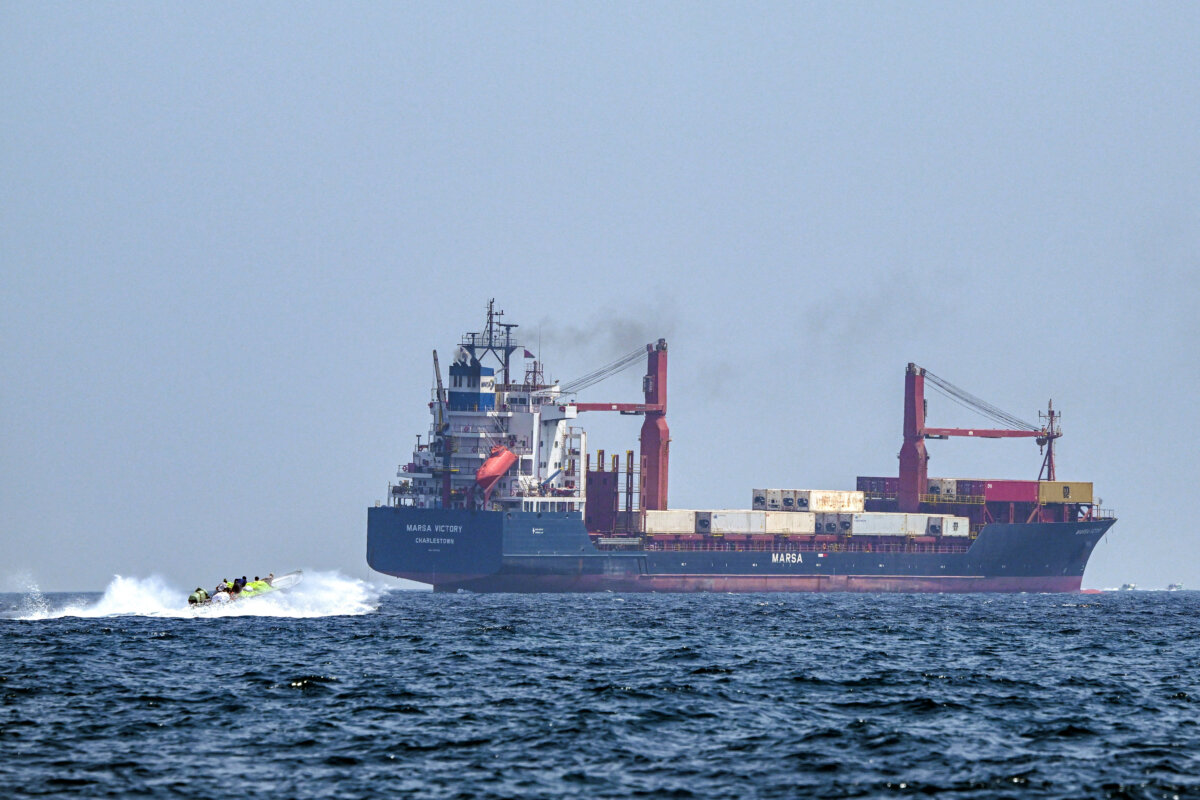

Crude oil and gasoline prices are expected to spike when trading resumes on March 2 as Strait of Hormuz tanker traffic slows to a trickle amid warnings from the Islamic Revolutionary Guard Corps (IRGC) that the vital waterway, through which more than 20 percent of the world’s oil is exported from the Persian Gulf, is “effectively closed.”
“Due to the insecure conditions around the strait resulting from the U.S. and Israeli military aggression and Iran’s responses, passage through the strait is currently unsafe,” the IRGC stated on Feb. 28.
As of 1 p.m. ET on March 1—9:30 p.m. in Iran—at least two oil tankers and a port in Oman had been attacked, prompting ships to stack in the Arabian Sea rather than risk transiting the narrow 100-mile waterway and entering the Persian Gulf.
The state-run Oman News Agency said on March 1 that the Palau-flagged tanker Skylight was struck by a missile or drone near Khasab in the strait, wounding four of its crew and forcing the ship to be evacuated. It also said that the port of Duqm, a logistical hub for the U.S. and UK navies, was struck by two drones, causing little damage and no injuries.
The UK’s Maritime Trade Operations later reported that an unnamed tanker off the United Arab Emirates in the Gulf caught fire after being struck by a projectile. The fire was extinguished, and no casualties were reported.
Iran exports between 1.5 million and 1.6 million barrels of crude oil a day, most to privately owned refineries in China. The longer the strait remains under attack, the more Iran’s customers will need to obtain crude from other sources, potentially causing global market prices to rise.
Chinese refiners purchase more than 80 percent of Iran’s exported oil, according to data compiled by analytics firm Kpler, defying sanctions imposed by the United States.
Representatives from eight of the 12 member countries of OPEC+ met virtually on March 1 and agreed to modestly increase oil production, by 206,000 barrels per day, to cushion the impact of an anticipated halt in Iranian production.
Iran is a member of the cartel but is not part of the tentative agreement among Saudi Arabia, Russia, Iraq, the United Arab Emirates, Kuwait, Kazakhstan, Algeria, and Oman to boost production until the conflict is resolved.
In the days before the Feb. 28 outbreak of hostilities, Brent crude prices increased by nearly 3 percent, closing above $72.80 a barrel on Feb. 27. Some analysts speculate that global oil prices could increase by $10 to $20 per barrel, to more than $90 a barrel.
A Feb. 18 Center for Strategic & International Studies analysis laid out four “oil supply disruption scenarios” that could unfold in the case of a U.S. attack on Iran.
In a case in which Iran targets Strait of Hormuz tanker traffic, the analysis states, “oil prices would initially spike with surging freight and insurance rates, and with some ship operators likely fleeing the region, further diminishing export capacity.”
How much prices will increase and for how long is a matter of “volume and duration of a physical disruption,” the center stated.
“Crude prices could climb past $90 per barrel, pushing U.S. retail gasoline prices well above $3 per gallon on a national average basis (some regions higher),” the analysis reads.
U.S. gas prices averaged $2.98 per gallon as of Feb. 26, according to AAA.
 Friends Read Free
Copy
Facebook
Tweet
Friends Read Free
Copy
Facebook
Tweet