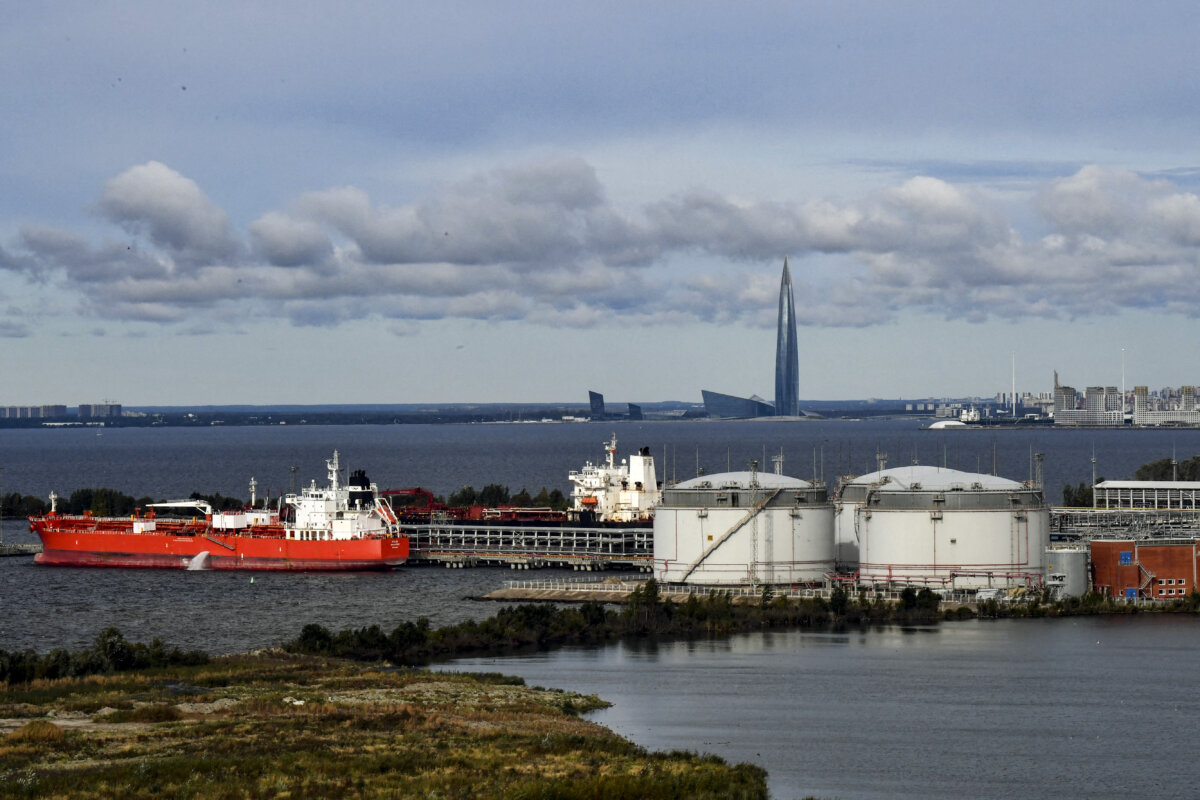

Russia will be able to return diesel exports to levels above those U.S. President Donald Trump has outlined under a deal with Moscow, Russian Deputy Prime Minister Alexander Novak claimed on Monday.
“We will see how the situation develops further, but Russia has the capacity to increase diesel fuel exports,” Novak said on state TV channel Rossiya-24.
“By the end of the year, exports could reach 3 million to 3.5 million metric tons per month, returning to the levels seen before the crisis.”
Russia is expected to immediately begin shipping diesel to the strained global market, with the United States temporarily removing sanctions placed on the country over its war with Ukraine to try to ease prices for Americans, Trump announced on Oct. 9.
The agreement was reached after speaking with Russian President Vladimir Putin on Oct. 9, Trump said in a Truth Social post.
More than 300,000 tons of diesel will be shipped immediately, the U.S. president said.
Another 500,000 tons of diesel are expected in November, followed by a million tons in December, to help make up for the supply lost due to the conflicts in Ukraine and Iran.
Novak also said that under the deal with Trump, Russian diesel supplies will partially balance global supply and demand.
“We are already seeing this effect, including in global diesel markets, where prices have fallen by around five to six percent,” Novak said.
Novak also said that U.S. figures, putting at $250 billion the value of Russian resources sold to Europe, were “significantly” understated.
“The figure for the period from 2022 to the present day is $320.7 billion,” Novak told Rossiya-24. “This is the volume of energy resources supplied to European Union countries.”
Ukrainian President Volodymyr Zelenskyy questioned the deal’s potential impact on fuel prices on Oct. 12.
“If Russia accounts for 2.2 percent of global diesel supplies, what impact can it have on the price?” he said.
“That’s how negligible it is. And if we don’t give Putin opportunities, his influence in other areas will be just as negligible. He is simply taking advantage of the fact that others want dialogue with him, even though there is no equality and no fairness in it.”
In an Oct. 11 Truth Social post, Trump said that Ukraine and Russia had agreed to what he described as an “energy ceasefire.”
“Effective immediately, there is an energy ceasefire in the War between Russia and Ukraine. Both parties have agreed. Do not break it! Thank you for your attention to this matter,” he said.
There is still no publicly confirmed agreement or detailed set of terms involved in the energy truce as of Oct. 13.
Ukraine will continue its long-range strikes against Russia if Moscow doesn’t accept the energy truce, Zelenskyy said on Monday.
Speaking via a video link at the Warsaw Security Forum, Zelenskyy said that since he learned about the truce, Ukrainian energy infrastructure has been hit by Moscow’s air strikes.
“This winter, if Russia does not agree to an energy ceasefire, we will respond,” he said.
Ukraine has not carried out strikes on Russian oil refineries or the energy sector in general for the two days “since the American President announced an energy ceasefire,” Zelenskyy said in a Tuesday post on X.
But he said that Russia “did not heed the American President” and that during this time, the Russians have “attacked both our energy facilities and our critical infrastructure, sending absolutely clear signals that they have no intention of refraining from strikes on Ukraine.”
“Our position remains unchanged: Ukraine is ready for reciprocal steps toward de-escalation, and effective pressure on Russia is needed to make de-escalation happen,” he added.
Reuters and Jill McLaughlin contributed to this report.
 Friends Read Free
Copy
Facebook
Tweet
Friends Read Free
Copy
Facebook
Tweet