News Analysis
Following the capture of Venezuelan leader Nicolás Maduro on Jan. 3, President Donald Trump said that U.S. oil companies would help to rebuild the country’s crumbling oil industry.
Many impediments, however, remain in the way of major investments in a country that remains under authoritarian rule.
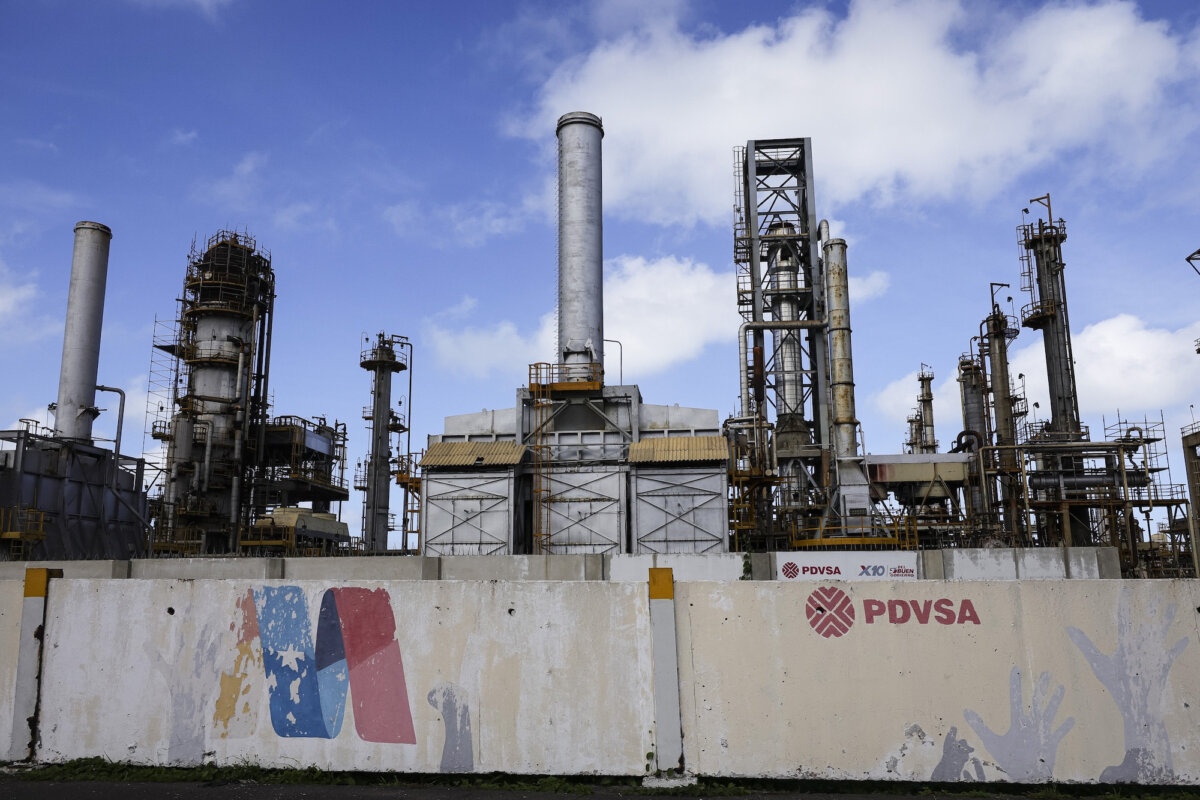
The first hurdle is the degree to which Venezuela’s oil infrastructure has fallen into disrepair under Maduro’s rule.
“The infrastructure is rusty, rotten, most of it unusable,” Trump told reporters on Air Force One on Sunday. “It’s old. It’s broken. You see pipes laying all over the ground. Nothing’s been invested for years.”
At its peak, with capital and technology from U.S. oil majors Exxon Mobil, ConocoPhillips, and Chevron; the UK’s BP; France’s Total; and Norway’s Statoil, Venezuela produced more than 3 million barrels of oil per day. The country once supplied about one-fifth of all the oil imported into the United States.
Since the authoritarian regime of Hugo Chavez expropriated the assets of private oil companies in 2007, however, output has fallen to the current level of 700,000 barrels per day. The country’s crumbling infrastructure stifled output, while a U.S. embargo curtailed demand for Venezuelan exports.
Nonetheless, what remained of the company’s oil industry generated enough cash to finance the regimes of Chavez and Maduro, his successor, supplying about two-thirds of the government’s budget today. Meanwhile, China replaced the United States as Venezuela’s largest buyer, circumventing the embargo and taking about 80 percent of its oil exports, though at a discounted price.
Between $180 billion and $200 billion in capital expenditures would now be required to rebuild Venezuela’s energy infrastructure, with returns on that investment coming years or decades down the road, according to a Jan 5 report by Morningstar, a financial research company.
A second major impediment is Venezuela’s history of twice seizing foreign assets.
While many countries, including Saudi Arabia, Kuwait, Nigeria, Iran, Iraq, Libya, Algeria, and Venezuela, nationalized oil production in the 1970s, they generally offered compensation to the oil companies that supplied capital and technology to build the industry. When Venezuela expropriated foreign assets in 2007, it did not pay compensation.
As a result, several U.S. companies have sued Venezuela for approximately $60 billion in damages, and both U.S. and international courts have sided with the companies. In January 2025, the World Bank’s International Centre for the Settlement of Investment Disputes upheld a 2022 decision by a U.S. federal court that Venezuela must pay $8.5 billion to ConocoPhillips.
The third major impediment is the lack of a stable government and legal system under which companies can operate.
“U.S. companies will not commit serious capital to Venezuela without a credible reset on the rule of law,” Jason Isaac, CEO of American Energy Institute, told The Epoch Times. “That means binding contract protections, enforceable dispute resolution, and a settlement framework for legacy expropriation and unpaid joint-venture debts.”
Since electing Chavez’s socialist regime in 1998, Venezuela declined from what was once the wealthiest country in South America and one of the 2o richest in the world to “the archetype of a failed petrostate,” according to a 2024 report by the Council on Foreign Relations. Venezuela’s gross domestic product (GDP) shrank by roughly three-quarters between 2014 and 2021, rebounding slightly in 2023 as the Biden administration loosened existing sanctions on the country’s oil exports.
Under a socialist regime, the country has experienced hyperinflation, shortages of essential items including food and medicine, an influx of drug cartels, and an outflow of refugees. Venezuela has also been accused by the Trump administration of acting in concert with America’s adversaries and harboring foreign terrorist groups.
During an NBC interview, Secretary of State Marco Rubio called Venezuela “a crossroads for the activities of all of our adversaries around the world.”
Trump has stated that his goal is to stabilize the political situation in Venezuela so that private companies can bring capital and technology to Venezuela’s oil reserves.
The U.S. government, Trump stated on Sunday, is “not going to invest anything.”
“We’re going to just take care of the country,” he said. “We’re going to take care of, more importantly, the people, including Venezuelans that are living in our country, that were forced to leave their country. They’re going to be taken very good care of.”
Reuters contributed to the report.
 Friends Read Free
Copy
Facebook
Tweet
Friends Read Free
Copy
Facebook
Tweet