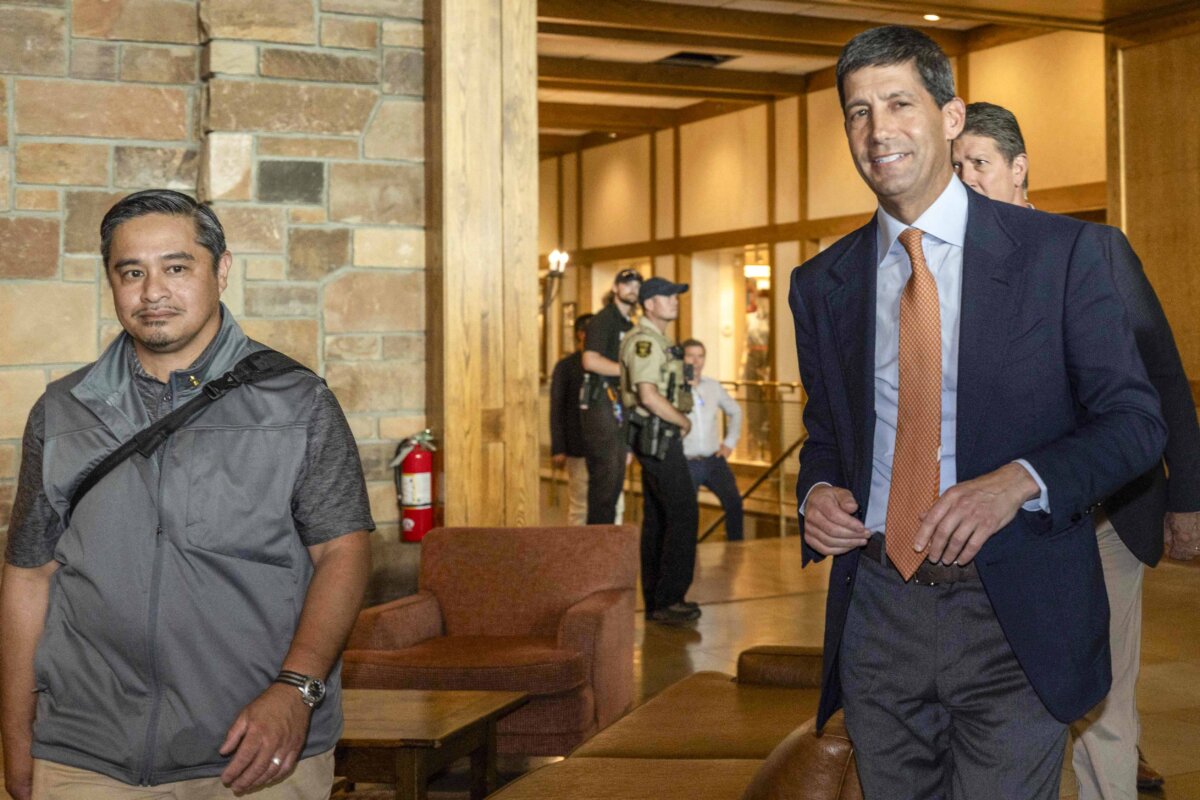

Federal Reserve Chairman Kevin Warsh reaffirmed his commitment to stopping inflation, telling an audience of economists and policymakers that underlying trends have not “meaningfully improved” this summer.
Warsh delivered his first keynote address—titled “In Our Time”—at the central bank’s annual Jackson Hole Economic Symposium on Aug. 28. He used the 30-minute speech to lay the groundwork for what lies ahead at the Federal Reserve in the coming year.
Inflation was the centerpiece of his approximately 3,500-word oration.
While the summer’s headline inflation readings—the Consumer Price Index and the Personal Consumption Expenditures Price Index—have been better than expected, Warsh expressed concern that structural trends have not improved.
“They do not tell me that underlying trends have meaningfully improved,” the Fed chief said in his highly anticipated prepared remarks.
“We must be confident that underlying inflation is moving to our objective, clearly and at sufficient speed,” Warsh later added. “Otherwise, we have work to do. That’s our job … our mandate … and our charge to keep.”
July’s annual PCE price index was unchanged at a higher-than-expected 3.7 percent. Excluding food and energy, core PCE inflation was also flat at 3.3 percent—in line with economists’ expectations.
The Fed places more weight on PCE than on CPI because it reflects a broader basket of goods and services, accounts for real-time consumer substitutions, and updates its component weights more frequently.
Early estimates suggest little improvement in the August numbers, leaving policymakers in a precarious position as they assess whether elevated energy costs are seeping into the broader economy.
Because inflation has been above the Fed’s 2 percent target for 65 months, Cleveland Fed President Beth Hammack believes “now is the time to act” on interest rates.
“I don’t want to prejudge anything. But I believe now is the time to act,” Hammack said in an Aug. 27 interview with CNBC’s “Squawk Box.”
“The longer inflation stays above our objective, the harder it will be for us to bring it back down, and the more pain that individuals and businesses are going to be experiencing.”
‘Hall of Mirrors’
U.S. stocks were little changed after his speech, but short- and medium-term Treasury yields were sharply higher at the end of the trading week.
The 2-year yield, which generally tracks Fed policy expectations, surged 7 basis points to 4.3 percent following his remarks.
Futures markets are now split on whether the 19-member Federal Open Market Committee will follow through on an interest rate hike at next month’s meeting.
But Wall Street’s reaction might be what Warsh aims to achieve, says Larry Holzenthaler, senior portfolio manager at Catalyst Funds.
“I would say Warsh was successful in reestablishing confidence,” Holzenthaler told The Epoch Times in an emailed note.
“The market seems to be reacting exactly the way the Fed wants; short-term rates are higher while long-term rates are marginally lower following his comments. Investors should clearly expect that the Fed is going to raise rates if it needs to.”
The 30-year Treasury yield was little changed at around 5.18 percent and has hovered around this level for much of the week.
Warsh acknowledged that markets have relied too heavily on the Fed’s forward guidance for too long—and the central bank has depended on markets for information.
This, he says, requires the Fed and the financial markets to recalibrate their relationship.
Monetary officials require clear, unfiltered market signals that track real-time economic information. If markets lean heavily on the Fed’s signals and the institution, in turn, leans on market pricing, risks form and vulnerabilities emerge.
This situation leads to policy errors, Warsh noted.
“We should not indulge a regime in which market participants are looking primarily to the Fed for their next trade,” he stated.
“The economic literature has long described the distorting effects: a hall-of-mirrors problem. If markets rely materially on the Fed’s guidance and the Fed relies on market prices, we are all more likely to be blinded to new developments … more likely to be caught unprepared for a turn of events … and more likely to commit errors in policymaking.”
Economic Summary
But while Warsh espoused tough talk on inflation, he was ebullient regarding economic conditions.
The Fed leader, who has been on the job for three months, touted robust business and consumer spending, solid financial conditions, and the benefits from artificial intelligence filtering through the broader economy. Although he recognized a slowing labor market, Warsh pointed to shrinking labor supply.
At the time of his 10 a.m. speech, the Bureau of Labor Statistics released its annual preliminary benchmark revisions for the 12 months ending in March 2026. Job growth was overstated by just 79,000, a sharp deceleration from the previous year’s 898,000.
Next week will feature the August jobs report.
The consensus estimate, as of Aug. 28, suggests the economy created 45,000 jobs this month, and the unemployment rate ticked up to 4.2 percent.
 Friends Read Free
Copy
Facebook
Tweet
Friends Read Free
Copy
Facebook
Tweet