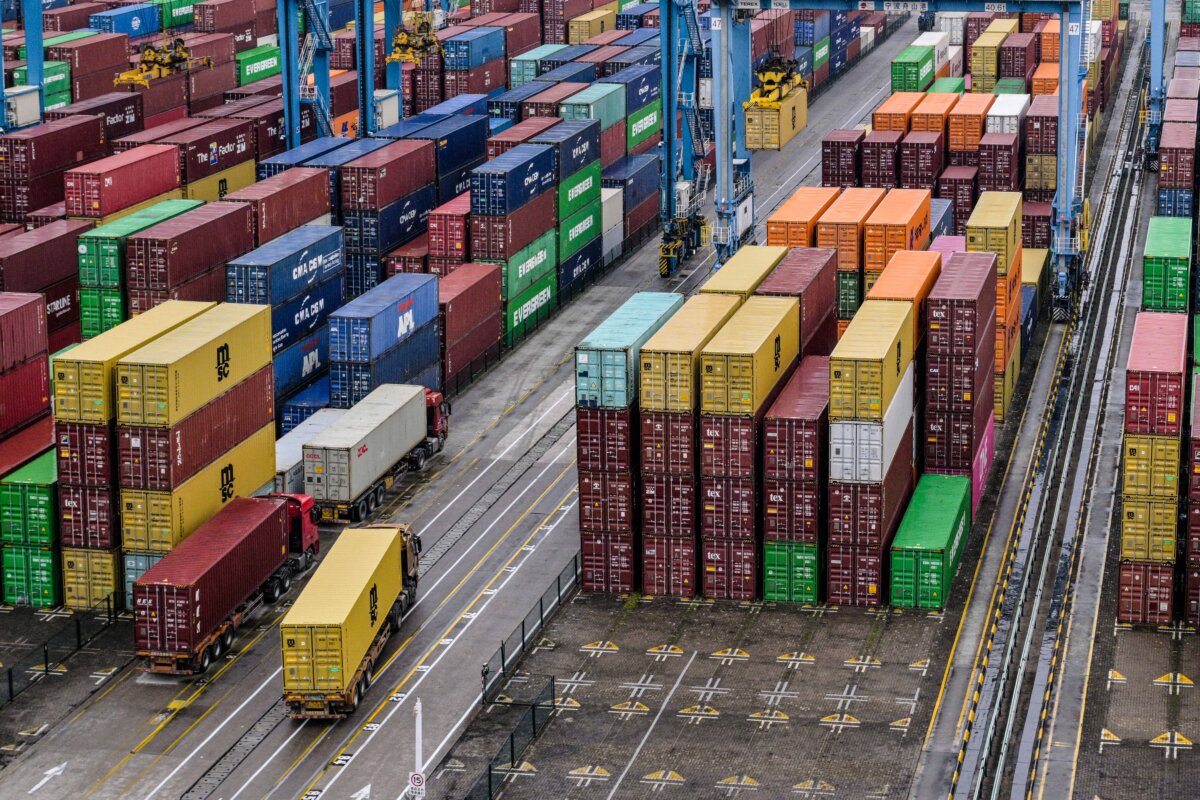

A record-high proportion of U.S. companies in China have frozen new investment plans, with tariffs and U.S.–China relations among their top concerns, a new survey has found.
Other top concerns include the tight regulatory controls of the ruling Chinese Communist Party (CCP), such as export restrictions, sanctions, and investment screenings; Chinese industrial policies that favor domestic companies; China’s slowing economic growth and lack of domestic demand; the CCP’s opaque business environment; and industrial overcapacity that is affecting a broader range of sectors.
According to the annual survey, published on July 16 by the Washington-based U.S.-China Business Council (USCBC), 52 percent of U.S. companies in China have no plans to invest in China this year, up from 20 percent in 2024.
Kyle Sullivan, vice president of business advisory services at the USCBC, said 52 percent is “a record high.”
A third of companies (34 percent) said they have reduced or stopped planned investment in the country in the past year—up from a quarter (26 percent ) in 2024.
The proportion of companies making a profit in China remained stable in the past three years, with 82 percent reporting profits in 2024 but only 25 percent expecting better profit margins in the future.
The level of pessimism regarding companies’ five-year outlook remains unchanged from a record-high 29 percent reported in 2024.
“Businesses in China are less profitable now than they were years ago but risks, including reputational risk, regulatory risk, and political risk, are increasing,” USCBC President Sean Stein said.
Top Concerns
The USCBC surveyed 130 of its member companies—of which 43 percent reported China revenue exceeding $1 billion—between March and May, at the height of the U.S.–China tariff war that saw triple-digit reciprocal tariffs.
According to the results, 88 percent of companies reported being affected by geopolitical tensions between China and the United States.
More than two-thirds of the companies (68 percent) said they were affected by tariffs. The USCBC said the full impact could be larger because several companies responded to the survey before the Trump administration announced reciprocal tariffs in April.
Some 43 percent of the companies said they were affected by export controls and sanctions, the same level as in the previous year. The proportion of companies unaffected decreased from 44 percent to 41 percent, while 17 percent said they were unsure, up from 13 percent in 2024.
The USCBC said the results suggest the impact of export controls is expanding beyond the semiconductor industry.
Almost all companies (88 percent) said they were concerned about the Chinese economy. About three-quarters (74 percent) reported concerns over the lack of domestic demand and overcapacity issues, which mainly affected upstream industrial sectors that have spilled over into sectors including consumer goods and health care.
Of those affected by overcapacity, 81 reported deflation in their sector, the USCBC said.
About 80 percent of the companies said they know or suspect that their Chinese competitors are receiving benefits or subsidies.
Advantages for Chinese companies include preferential treatment in government financing and subsidies, tax benefits, access to government contracts, licensing and approvals, policy enforcement, and lower land and utility costs, according to the survey.
Companies reported slight improvement in the protection of intellectual property; 52 percent said the environment remains unchanged, and 36 percent said it was somewhat improved.
About one in eight (12 percent) of the companies said they had been under pressure to disclose or transfer their intellectual property to China in order to gain market access.
Eighty-two percent of the companies surveyed have been doing business in China for more than 20 years, and almost all (91 percent) said their China operations remain important for global competitiveness.
The Associated Press contributed to this report.
 Friends Read Free
Copy
Facebook
Tweet
Friends Read Free
Copy
Facebook
Tweet