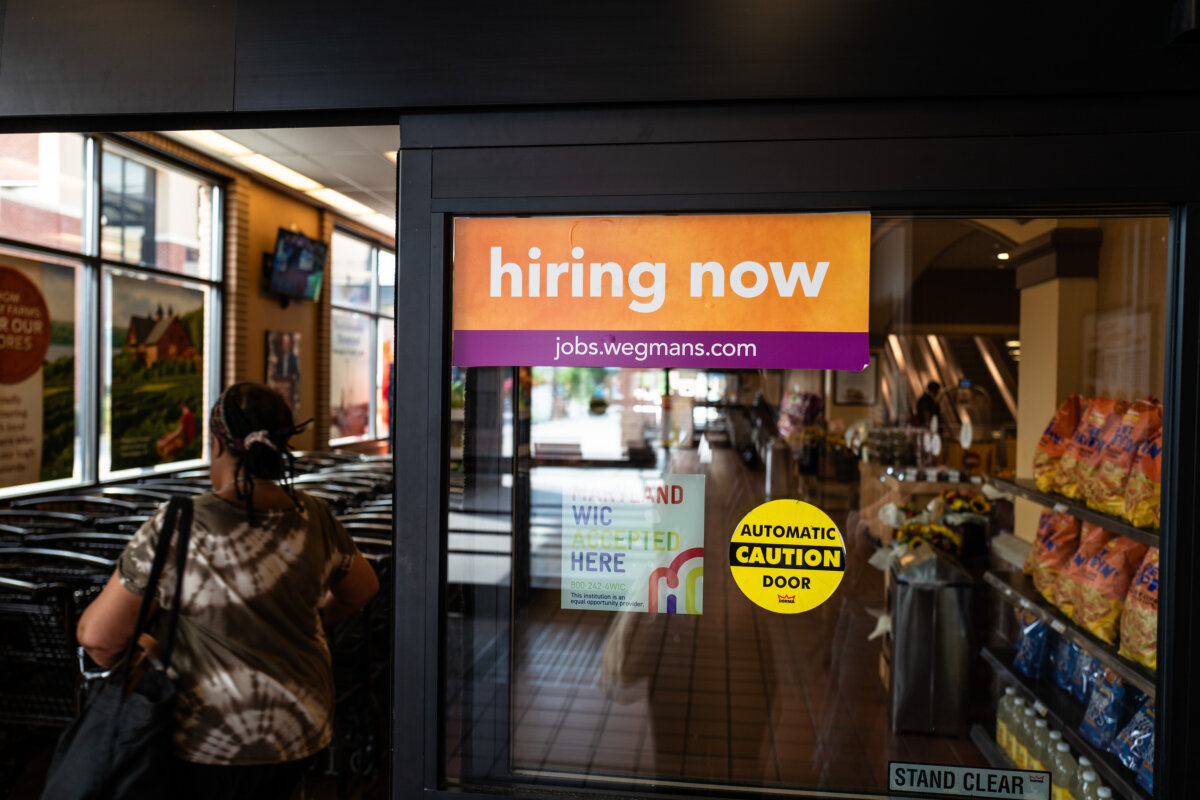

The number of Americans filing for unemployment benefits declined for the sixth consecutive week.
For the week ending July 19, initial jobless claims fell by 4,000 to 217,000, the lowest level in three months, according to Department of Labor data released on July 24.
This is down from last week’s reading of 221,000 and came in below the consensus estimate of 227,000.
Claims have been pulling back after reaching an eight-month high in June, with employers hesitant to trim their personnel. At the same time, recent data indicate that companies are not laying off staff in large numbers.
A program for federal workers filing jobless claims, which economists are closely watching, registered a sizable increase of 193, reaching 789. This is a 66 percent increase from a year ago.
The four-week average, which strips out week-to-week volatility, dropped to 224,500 from 229,500.
Continuing jobless claims—a measure of the number of out-of-work individuals currently receiving unemployment benefits—ticked up to a lower-than-expected 1.955 million from a downwardly revised 1.951 million. This was the ninth consecutive week that recurring claims remained above 1.9 million, hovering around a four-year high.
Economic observers say that the elevated continuing jobless claims figures suggest that it is more challenging for unemployed people to find work.
Still, the latest drop in initial jobless claims signals resilient employment conditions as fewer individuals are losing their jobs.
Next week will offer fresh insights into the state of the job market.
In addition to job openings, layoffs, and private sector hiring, the July jobs report will be released. Early estimates indicate that the U.S. economy added 110,000 new jobs and the unemployment rate rose slightly to 4.2 percent.
Softening Ahead
Despite solid employment data, a wide array of experts argue that the labor market is softening.
Because private payrolls grew by 74,000 in June, less than expected, and half of the employment gains emanated from state and local governments, JPMorgan Chase economists say the job market is weakening slowly.
“This report confirms our view that the economy and labor market are gradually softening, but not too dramatically,” they said in a note.
Federal Reserve Gov. Chris Waller has said he believes that the headline numbers offer a positive outlook for the U.S. labor market. However, a closer examination reveals a different assessment of employment conditions.

And this would support an interest rate cut at next week’s Federal Open Market Committee policy meeting, Waller said.
“While the labor market looks fine on the surface, once we account for expected data revisions, private-sector payroll growth is near stall speed, and other data suggest that the downside risks to the labor market have increased,” he said in a July 17 speech.
“With inflation near target and the upside risks to inflation limited, we should not wait until the labor market deteriorates before we cut the policy rate.”
According to the CME FedWatch Tool, the U.S. central bank is expected to leave interest rates unchanged, in a range of 4.25 percent to 4.5 percent. Investors are anticipating that the monetary authorities will follow through on a quarter-point rate cut in September.
Policymakers have been awaiting further clarity from President Donald Trump’s global tariff plans and their impact on the economy, particularly regarding inflation and labor.
Since the economy is growing and the country is still adding jobs, the Fed believes it can wait before restarting its rate-cutting cycle.
Meanwhile, fresh Bureau of Labor Statistics data convey a labor market holding steady.
In June, unemployment rates were lower than in the previous month in two states, higher in one state, and stable in 47 states and the District of Columbia.
 Friends Read Free
Copy
Facebook
Tweet
Friends Read Free
Copy
Facebook
Tweet