
Wall Street ended the week and the month of February on a weaker note, as mounting concerns over artificial intelligence (AI) and renewed strains in private credit markets pressured equities. Technology and financial shares led the declines.
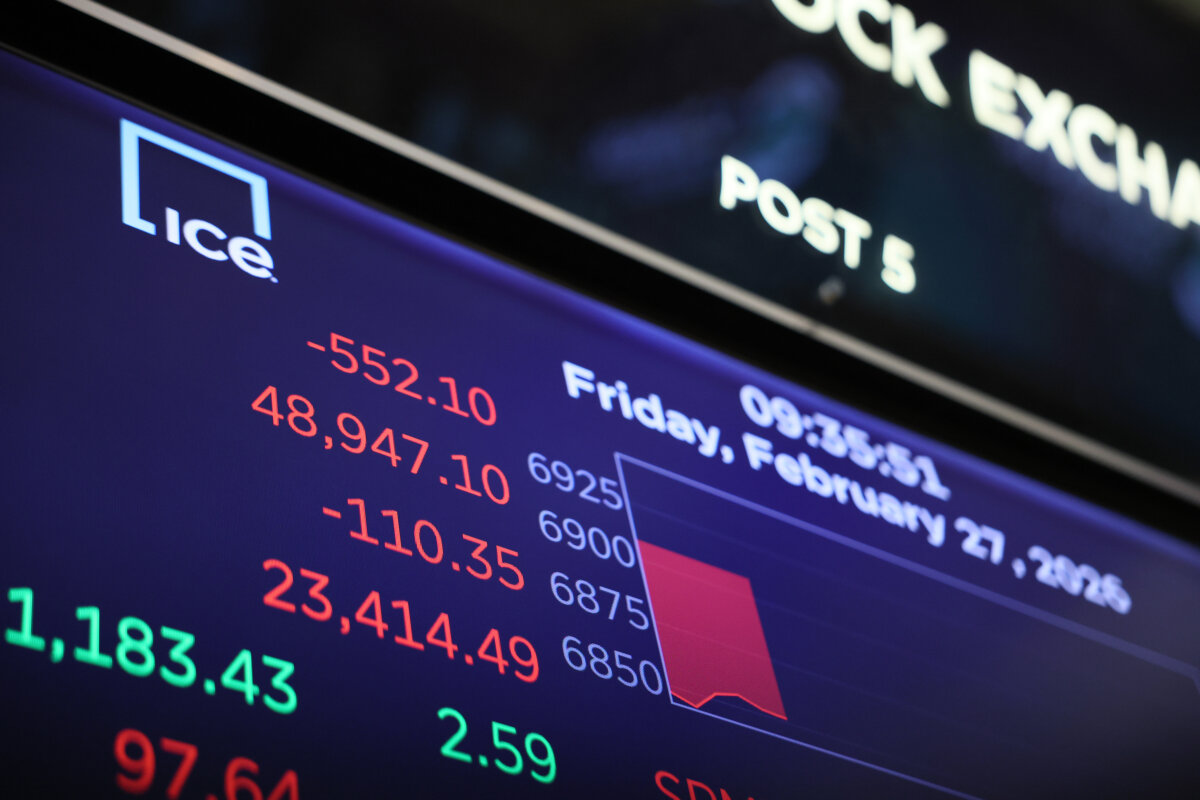
For the week, the Dow Jones Industrial Average fell by 1.31 percent to 48,977, hovering near its Feb. 24 low and finishing nearly flat for the month. The S&P 500 slipped by 0.44 percent to 6,878, remaining above its weekly low but down by 1.43 percent for February. The Nasdaq Composite dropped by 0.95 percent for the week and 4.82 percent for the month. The Russell 2000 lost 1.18 percent for the week and 1.03 percent for the month.
Volatility was elevated throughout the week. The Chicago Board Options Exchange Volatility Index briefly approached 22 on Feb. 23, fluctuated midweek, and settled at 19.86 on Feb. 27, up by 4.03 percent for the week.
Markets opened sharply lower on Feb. 23 as jitters over AI disruption, credit stress, tariffs, and geopolitical tensions pushed investors to the sidelines. Major indexes closed near their session lows.
Enterprise software stocks were among the hardest hit. The iShares Expanded Tech-Software Sector ETF (IGV) fell by 4.75 percent for the day, led by losses in Oracle, Microsoft, and Palantir, its three largest holdings. Investors continued selling shares of enterprise software amid concerns that AI models could threaten industry growth and margins.
Those fears intensified following the release of Anthropic Claude Code Security late the prior week, with cybersecurity software stocks extending their losses.
Financial stocks also declined as private credit concerns resurfaced. Shares of JPMorgan Chase and American Express, along with the State Street SPDR S&P Regional Banking ETF, closed with sizable losses.
Geopolitical tensions added to the negative tone. Rising anxiety over escalating conflict between Iran and the United States drove investors toward safe-haven assets such as gold and U.S. treasuries.
At the same time, President Donald Trump’s 10 percent global tariff on nearly all imports, implemented under Section 122 of the Trade Act of 1974, introduced a new layer of uncertainty to the trade outlook.
“The big question for the economy is what happens after this window, and if the tariff policy stays down this path, we may very well be back at the Supreme Court later this year,” Michael Landsberg, chief investment officer at Punta Gorda, Florida-based Landsberg Bennett Private Wealth Management, told The Epoch Times.
Landsberg said equity markets have not fully priced in the risk of conflict with Iran, though oil markets appear more sensitive.
“Oil has moved up considerably so far this year, which gives us some concern that an Iran conflict is imminent. In early 2022, oil prices made new highs prior to Russia invading Ukraine, so the price action in the commodity is something we pay close attention to,” he added.
Stocks rebounded sharply on Feb. 24, led by small caps and technology shares. The Russell 2000 gained 1.20 percent, and the Nasdaq rose by 1.04 percent. The Dow and S&P 500 advanced by 0.76 percent and 0.77 percent, respectively.
Advanced Micro Devices (AMD) was among the session’s top performers, surging by 8.77 percent after announcing a multiyear deal with Meta to supply AI chips.
PayPal also gained by 6.74 percent on reports that Stripe is considering acquiring all or part of the company.
Health care stocks, however, struggled ahead of Trump’s State of the Union address, an event that often includes policy proposals affecting heavily regulated sectors.
Markets strengthened on Feb. 25 following the address, aided by upbeat comments from Trump about the economy. The return of dip buyers in technology shares helped lift the Nasdaq by 1.26 percent for the session.
The iShares Expanded Tech-Software Sector ETF rose by 3.11 percent, continuing its rebound from the prior week’s steep losses. Microsoft and Palantir gained by 2.98 percent and 4.15 percent, respectively. Semiconductor stocks remained firm ahead of Nvidia’s earnings, with Applied Materials and Broadcom rising by 4.50 percent and 2.10 percent, respectively.
Homebuilders lagged after a disappointing earnings report from Lowe’s, which fell by 5.59 percent.
The Feb. 26 session saw renewed pressure on technology stocks. The Nasdaq fell by nearly 2 percent in late morning trading before trimming losses to close down by 1.18 percent. The S&P 500 slipped by 0.54 percent, while the Dow and Russell 2000 ended slightly higher as funds rotated into other sectors.
The sell-off followed Nvidia’s earnings release after the market closed on Feb. 25, as the company’s results fell short of Wall Street’s most bullish expectations. Nvidia’s shares dropped by 5.49 percent, pulling down the broader semiconductor sector. The VanEck Semiconductor ETF fell by 3.68 percent.
James Demmert, chief investment officer at Main Street Research in New York City, said Nvidia’s results came at a critical time.
“We believe that the positive force that AI is sparking in Nvidia’s earnings will overpower the negative force that AI is causing in the software space,” Demmert told The Epoch Times.
“Expectations for Nvidia’s earnings were high, and the stock handily cleared those expectations, showing that it remains the dominant player in the AI ecosystem, even as competition is heating up,” he added.
Selling pressure continued into Feb. 27, spreading across the broader market. All major indexes closed lower, with the Russell 2000 falling by 1.84 percent, the Dow by 1.05 percent, and the Nasdaq by 0.92 percent. The S&P 500 declined by 0.43 percent.
Higher-than-expected wholesale inflation data contributed to the decline. U.S. producer prices rose by 2.9 percent annually in January, exceeding expectations of 2.6 percent.
Private equity concerns also resurfaced following a new credit event in London, weighing on financial stocks. The State Street Financial Select Sector SPDR ETF fell by 2.10 percent.
Landsberg warned about crowded positioning in AI-related trades, particularly concentrated exposure to chip designers such as Nvidia and Broadcom.
“Diversifying across multiple industries that are in the AI ecosystem, such as data centers, power generation, and HVAC, and even countries, such as Europe and Japan, is a safer and smarter way to invest in the theme.”
 Friends Read Free
Copy
Facebook
Tweet
Friends Read Free
Copy
Facebook
Tweet