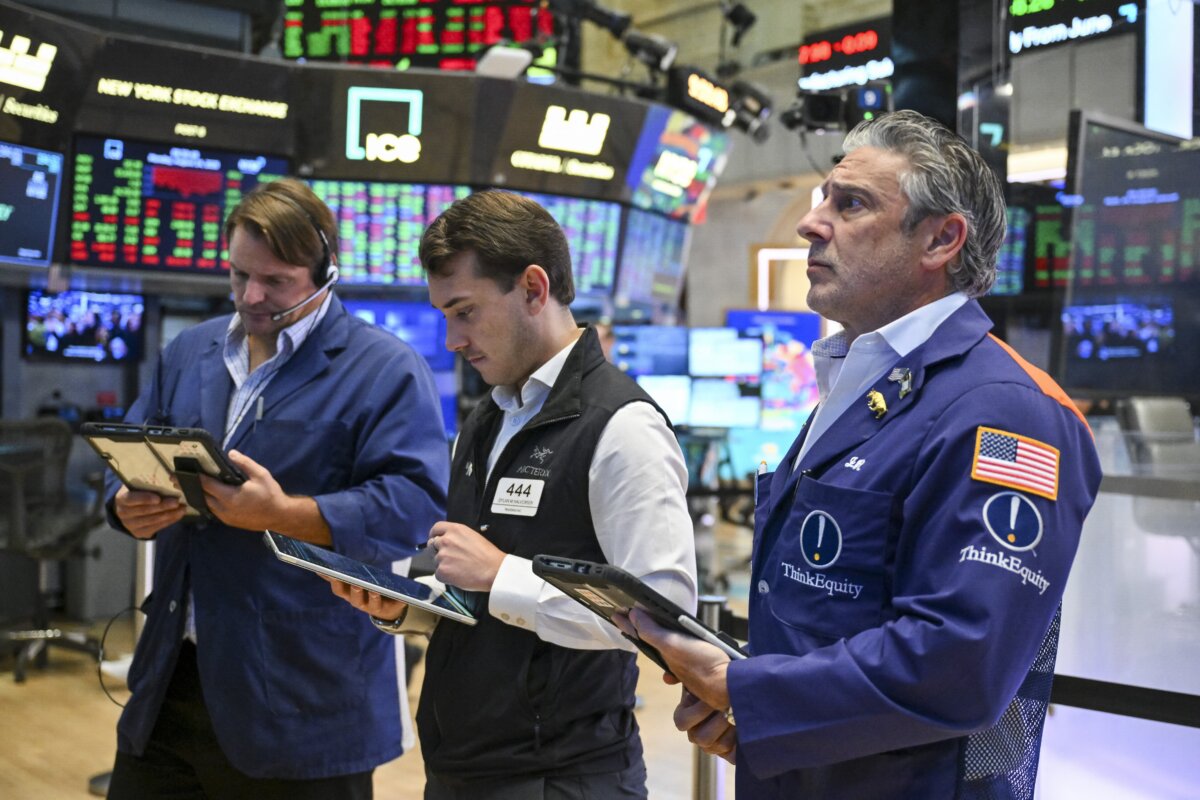

Wall Street closed a volatile week mixed, caught between two competing forces: strong earnings reports led by Nvidia that reignited AI investor sentiment, and a hawkish Jackson Hole speech from Federal Reserve Chair Kevin Warsh that reminded investors inflation remains elevated.
Nvidia on Aug. 26 posted $96 billion in revenue for the quarter ending July 26, comfortably exceeding the $92 billion analysts had forecast, and its shares gained 8.74 percent on Aug. 27 as the report rippled through the broader tech sector.
“I would not exaggerate if I said that Nvidia’s report is more important than most others. Because its chips are at the heart of AI development, the company has become a barometer for the entire AI rally,” Arthur Azizov, CEO and founder of B2BROKER Group, told The Epoch Times.
Salesforce and CrowdStrike also topped expectations, with shares surging 22.58 percent and 20.58 percent, respectively, during the Aug. 27 session.
Nasdaq gained 1.57 percent that day, though the rally stayed largely confined to the tech sector. The S&P 500, Dow Jones, and Russell 2000 posted more modest gains of 0.72 percent, 0.20 percent, and 0.28 percent, respectively.
However, not all chip stocks performed well. Marvell fell close to 10 percent on Aug. 28 after its earnings report failed to meet the inflated expectations of tech bulls, and a broad semiconductor sell-off earlier in the week—sparked by weak SK Hynix and Samsung results—had already hit Intel, Broadcom, and Micron Technology, dragging the iShares Semiconductor ETF down 2.67 percent in a single session.
Meanwhile, the Federal Reserve’s preferred inflation gauge, the personal consumption expenditures price index, released on Aug. 26, rose at an annual rate of 3.7 percent in July, matching June’s pace and coming in above the consensus estimate of 3.6 percent. This reading also weighed on investor mood.
“Inflation remains well above the Fed’s 2 percent target, and a hotter-than-expected reading could renew pressure on policymakers to keep interest rates higher for longer,” Bret Kenwell, eToro U.S. investment analyst, told The Epoch Times.
“The challenge is becoming increasingly clear: Inflation is still too high for comfort, and investors will be watching to see whether Fed Chair Kevin Warsh uses Friday’s Jackson Hole speech to address how policymakers plan to bring it back toward the Fed’s long-term target.”
Warsh emphasized the central bank’s commitment to controlling inflation on Aug. 28 during the annual Jackson Hole Economic Symposium, but did not offer specifics on further rate hikes.
“His acknowledgment that current inflation is too high slightly boosts odds of a September hike,” David Russell, head of market strategy at TradeStation, told The Epoch Times.
Angelo Kourkafas, senior global strategist at Edward Jones, said Warsh’s Jackson Hole remarks offered greater clarity on the central bank’s priorities.
“The Fed Chair reaffirmed the Fed’s commitment to its 2 percent inflation target and made clear that restoring price stability remains the central objective, leaving the door open to additional rate hikes if inflation remains elevated,” he said in an Aug. 28 company post.
Short- and medium-term Treasury yields, which generally track Fed policy expectations, went sharply higher following Warsh’s remarks, with the yield on the 2-year Treasury note up to 4.36 percent, a 0.12 percentage point jump from the previous session.
Higher yields weighed on equities into the close, hitting the most rate-sensitive corner of the market hardest: Small caps fell about 1.4 percent on Aug. 28, followed by Nasdaq, down 0.52 percent, while the S&P 500 slipped 0.25 percent and the Dow Jones dipped fractionally.
For the week, the Dow Jones Industrial Average closed at 53,559, up 0.53 percent; the S&P 500 gained 0.49 percent to finish at 7,711; and the Nasdaq led major indexes with a 0.85 percent advance.
The small-cap Russell 2000 lagged, closing 1.51 percent lower on rate sensitivity, while the CBOE Volatility Index dropped 4.63 percent to settle at 14.43, a sign that fear was easing even as the rate outlook became less favorable.
Looking ahead, Richard Reyle, chief investment officer of Paramus, New Jersey-based Questar Capital Partners, pointed to seasonality as a fresh headwind.
“September is historically the poorest-performing month on the calendar for stocks, and the current setup this year really calls that out: extended valuations, rising rates, a hyper-contentious election season, and a continued Iran conflict,” he told The Epoch Times.
But Kourkafas said September seasonality may be less challenging than usual.
“While seasonal headwinds warrant monitoring, supportive fundamentals suggest the broader market trend remains intact. As a result, we continue to favor a combination of AI-related and cyclical exposures,” he said.
 Friends Read Free
Copy
Facebook
Tweet
Friends Read Free
Copy
Facebook
Tweet