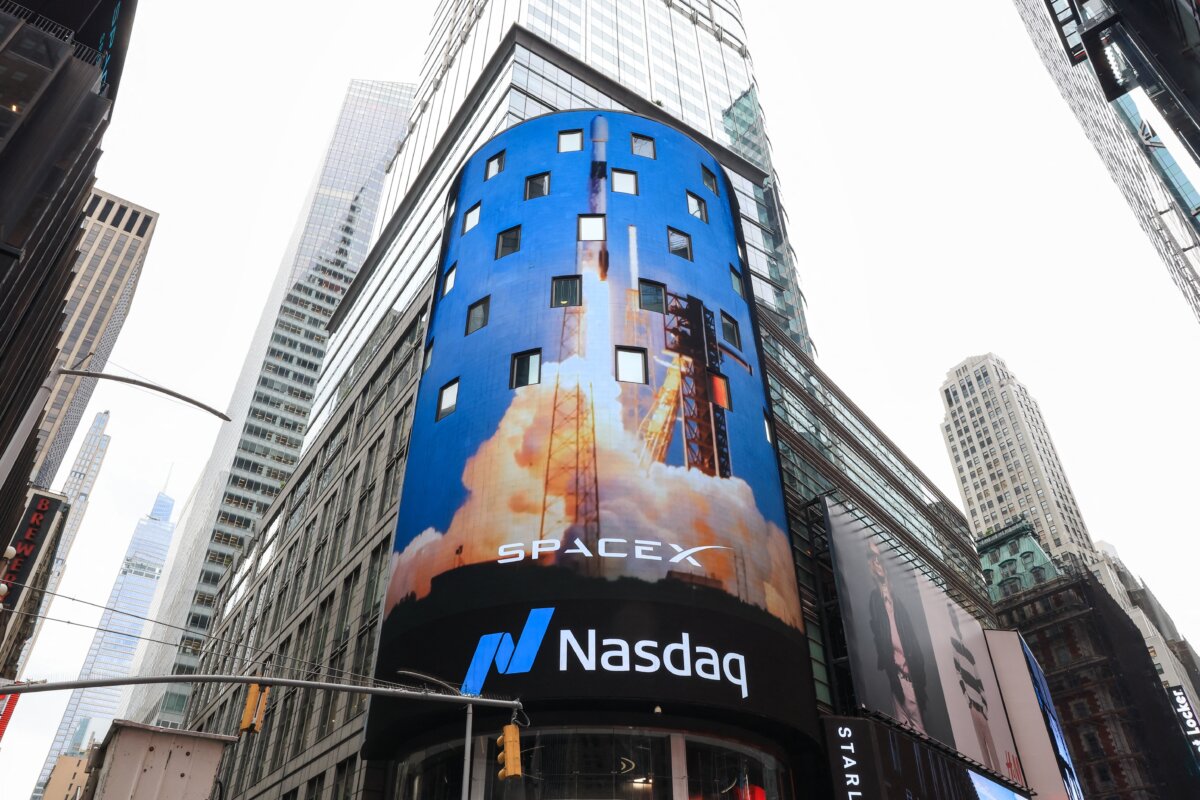

U.S. stocks rebounded this week, led by a rally in small caps and the SpaceX initial public offering (IPO), which revived investor enthusiasm for equities. The rebound came despite a parade of hot inflation numbers that raised the prospect of the Federal Reserve hiking interest rates soon.
For the week, the Dow Jones Industrial Average edged 0.66 percent higher to close at 51,202, slightly below the June 12 high. The S&P 500 gained 0.65 percent to 7,431, close to the high reached earlier in the week. The Nasdaq Composite posted similar gains, while small-cap stocks were the standout for the week, with the Russell 2000 up by 3.90 percent.
The Chicago Board Options Exchange Volatility Index closed the week at 17.68, down by 17.81 percent.
Stocks opened the week on June 8 sharply higher as bargain hunters returned to the market after the June 5 sell-off, but they trimmed their gains by the market close, ending the day mixed. Techs and small caps that led the June 5 rout led the rebound, with the Nasdaq and Russell 2000 gaining 0.86 percent and 0.87 percent, respectively. The S&P 500 gained 0.3 percent, while the Dow Jones Industrial Average closed 0.10 percent lower.
The market rebound came despite higher oil prices and bond yields, with the 10-year U.S. Treasury note bouncing back to 4.46 percent on June 8, reflecting growing concerns among traders over the impact of the recent string of strong jobs reports on monetary policy, ahead of a couple of inflation reports scheduled for release later in the week.
Intel and Marvell were among the day’s big winners, up by 12 percent and 2.5 percent, respectively. Intel was boosted by news that Google chose the company to make in-house chips, while Marvell rallied on news of its inclusion in the S&P 500.
“A pause in the stock market’s nine-week positive run off the March lows is entirely understandable. We believe [the June 5] pullback was a healthy reset for stocks and is not the start of something more worrisome, especially since fundamentals continue to strengthen from better-than-expected earnings and economic data,” Carol Schleif, chief market strategist, BMO Wealth Management, told The Epoch Times.
Profit-taking returned to equity markets on June 9, with the tech-heavy Nasdaq hit hardest, as investors sold the big winners of the recent rally.
The sell-off in tech stocks came despite lower oil prices, with West Texas Intermediate dropping by 3 percent, helping push the benchmark 10-year Treasury note closer to the 4.5 percent mark.
One of the major factors weighing on investor sentiment was the IPO pipeline, including SpaceX.
These mega new stock offerings are threatening to drain liquidity from the rest of the market at a time when monetary policy is expected to remain tight, as investors would have to sell some of their current holdings to pay for them.
Still, the buy-the-dip crowd returned in the afternoon, helping the Nasdaq, which was down by 3.5 percent at the lows during the sell-off, trim its losses to 0.97 percent. The S&P 500 fared better, shedding 0.26 percent, while the Dow and the Russell 2000 edged up by 0.17 percent and 0.41 percent, respectively.
“The tech stock pullback was a gift for investors, and we remain buyers on the dips. The market volatility we have seen in recent days is consistent with a sawtooth pattern,” Robert Edwards, chief investment officer of Naples, Florida-based Edwards Asset Management, told The Epoch Times.
“Sharp pullbacks have been met with aggressive buying because investors, despite the noise, know that strong fundamentals, including strong revenue and earnings growth, remain in place.”
Selling in equities resumed on the morning of June 10, following another hot inflation reading. U.S. headline consumer inflation rose at an annual rate of 4.2 percent in May, up from 3.8 percent in April, led by energy prices, with gasoline prices soaring by 40.5 percent.
The May consumer inflation reading marks the third consecutive month of acceleration, and the highest level since April 2023, a worrisome development for credit markets and the Federal Reserve.
“While Wednesday’s CPI was in line with expectations, inflation is still elevated and far from the Federal Reserve’s 2 percent target. Once consumer prices rise, it takes time for this trend to reverse,” Skyler Weinand, chief investment officer of Dallas-based Regan Capital, told The Epoch Times.
Adding to investor anxiety were higher oil prices, with West Texas Intermediate crude rising by more than 2 percent to approach $91 a barrel amid a resumption of tensions in the Middle East.
Rising oil prices are a dual negative for equities. On one side, they feed into headline inflation, as energy is a sizable component of various measures of consumer inflation. On the other, higher oil prices pressure consumer spending and economic growth, leaving little room for them to buy nondiscretionary items.
The sell-off in equities was steady and extended across the entire market, with all indexes falling by more than 1 percent, led by the Nasdaq and the Dow Jones, down by 1.98 percent and 1.87 percent, respectively. The S&P 500 and the Russell 2000 lost 1.62 percent and 1.10 percent, respectively.
Equities turned around on June 11, opening higher across the board as bargain hunters emerged once again, buying up shares of the tech sector. This came despite the release of another hot inflation number before the market opened.
The U.S. Producer Price Index (PPI), a measure of inflation at the wholesale level, accelerated for a fourth consecutive month to 6.5 percent in May, up from a downwardly revised 5.7 percent in April and above forecasts of 6.4 percent.
The May reading is the highest since November 2022, a sign that inflation remains a widespread problem ahead of the Fed’s monetary policy meeting next week.
“Thursday’s elevated PPI print is yet another data point that could push the Federal Reserve to hike interest rates, as it’s clear that all of the main measures of inflation are flashing red,” Clark Bellin, president and chief investment officer of Lincoln, Nebraska-based Bellwether Wealth, told The Epoch Times.
Still, Bellin said this inflationary spike is likely temporary and will subside once the war in Iran ends, a view that spread across Wall Street in early afternoon trade after President Donald Trump indicated that an Iran deal was near.
Oil prices and bond yields headed south, providing a tailwind for equities, which staged a strong rally into the close. Tech and small-cap stocks led the gains, with the Nasdaq and the Russell 2000 up by 2.54 percent and 3 percent, respectively. The Dow and the S&P 500 gained 1.86 percent and 1.75 percent, respectively.
Still, there was a notable loser among the tech stocks: Oracle Corporation. After reporting weak cloud sales, the company’s shares were down by 8.53 percent during the regular session.
Stocks opened mixed on June 12, but they eventually turned around, pulled up by the SpaceX IPO, which opened at $150, above its IPO price of $135 set on the previous day, reached $176 at the high of the day, and closed at $160.5, up by 19.2 percent for the day.
Another catalyst behind the trading session was the release of the University of Michigan’s Consumer Sentiment Index for early June, which came at 48.9, up from May’s all-time low of 44.8 and above market expectations of 46.
Still, trade was range-bound, with the S&P 500, the Dow, and the Nasdaq closing 0.50 percent, 0.70 percent, and 0.31 percent higher, while the Russell 2000 fared the best, up by 0.76 percent.
Bellin said the negative effects of rising oil prices and high inflation were outweighed by the earnings power and AI productivity gains that were pushing stocks higher.
“This is why it’s important to remain invested, because the fundamentals of the stock market are still intact,” Bellin said.
“The stock market’s next catalyst shifts to Kevin Warsh’s first meeting as Federal Reserve Chair on June 17, where investors will not only get a sense of his tone and communication style, but also his reaction to the market’s increasing expectation of a rate hike later this year,” he said, referring to the Federal Reserve chair.
 Friends Read Free
Copy
Facebook
Tweet
Friends Read Free
Copy
Facebook
Tweet