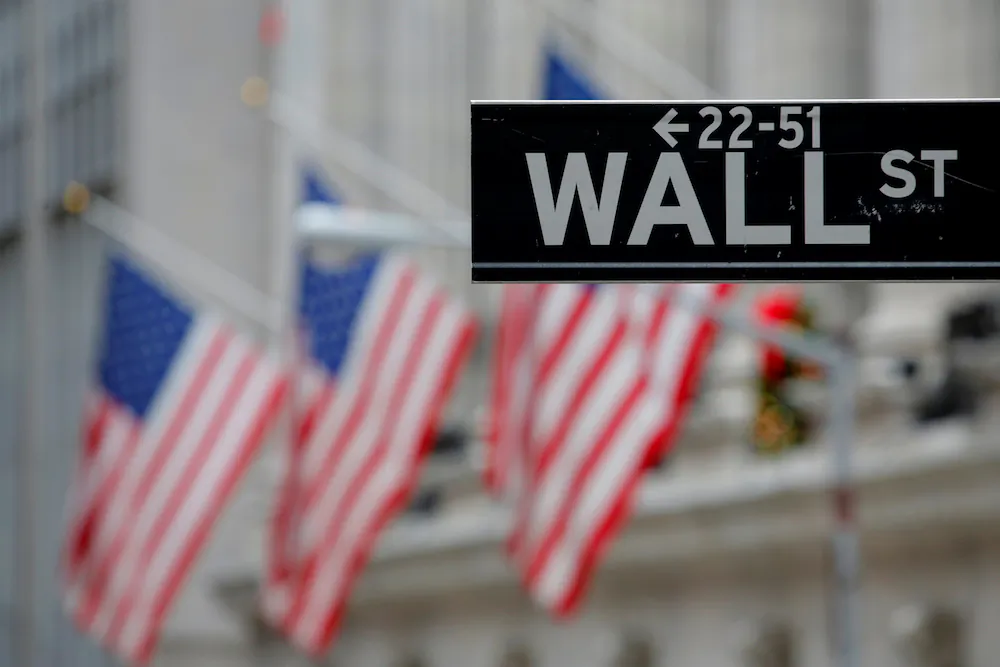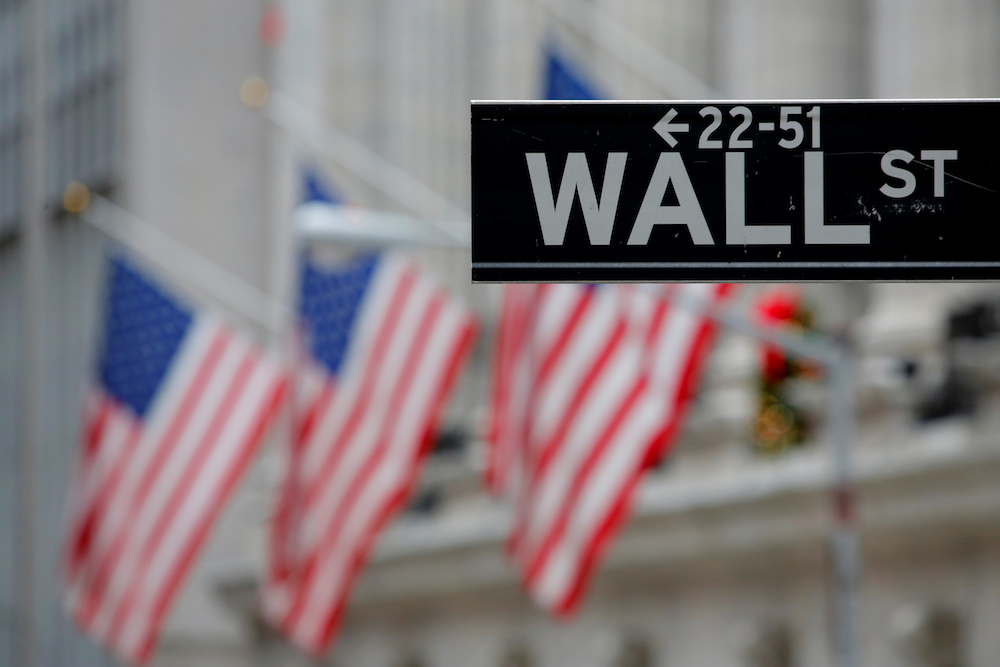

Wall Street’s main indexes fell on Friday amid fears that the Middle East conflict could reignite inflation, threatening to stall the AI-driven rally that has powered U.S. stocks.
At 10 a.m. ET, technology was the biggest drag on the S&P 500, as eight of the index’s 11 major sectors traded lower.
Chipmaker giant Nvidia and American multinational semiconductor AMD each fell more than 4 percent, while Intel dropped 6.8 percent. The Philadelphia SE Semiconductor Index slid 4 percent.
Semiconductor equipment maker Applied Materials fell 2.3 percent, despite forecasting third-quarter revenue and adjusted profit above Wall Street estimates.
The Dow Jones Industrial Average fell 436.84 points, or 0.87 percent, to 49,626.62, the S&P 500 lost 84.88 points, or 1.13 percent, to 7,416.36, and the Nasdaq Composite lost 433.36 points, or 1.63 percent, to 26,201.86.
The CBOE Volatility Index, known as Wall Street’s “fear gauge,” which measures the market’s expectation of 30-day forward volatility of the S&P 500 Index, rose 1.5 points to 18.8.
The odds of the U.S. Federal Reserve hiking interest rates by 25 basis points in December have more than doubled over the past week to about 40 percent, according to CME Group’s FedWatch tool on May 15.
“Markets are reacting to some of the recent inflation data, which has maybe been a bit higher than expected, and continued relative robustness in the economy,” said Kiran Ganesh, multi-asset strategist at UBS Global Wealth Management.
“And so markets are pricing in some risk that central banks might feel the need to hike interest rates.”
Investors also closely watched the U.S.–China summit, which wrapped up on Friday.
President Donald Trump said on May 14 that China has agreed to buy soybeans, oil, and Boeing jets from the United States following his meeting with Chinese leader Xi Jinping in Beijing.
Trump told Fox’s Sean Hannity that China agreed to make major purchases of U.S. agricultural products, particularly soybeans, which are the top U.S. export to the Chinese market.
“Last time we signed like 36 deals. This time it’s much bigger than that,” he said. “They are going to do a lot of soybeans for our farmers; they are going to be buying a lot of our farm products, which is great.”
Global bond yields also jumped as mounting evidence of economic damage from the Iran war prompted investors to assume interest rates will rise faster than expected and that growth will suffer.
On Wednesday, the U.S. federal government sold 30-year debt at auction at a yield above 5 percent for the first time since 2007.
The Treasury Department sold $25 billion of new 30-year bonds on May 13, with the auction yield reaching 5.046 percent.
Treasury bond yields represent the return investors receive for lending to the U.S. government over different periods. They move in the opposite direction to prices, meaning higher yields usually reflect falling bond prices or investors demanding a better return to buy the debt.
The auction was part of the Treasury’s wider May refunding plan. On May 6, the Treasury said it would sell $58 billion in three-year notes, $42 billion in 10-year notes, and $25 billion in 30-year bonds, while raising $41.7 billion in new cash from private investors.
The rise in borrowing costs has been driven partly by an energy shock linked to the Iran war, which has lifted inflation and reduced expectations that the Federal Reserve will soon be able to cut interest rates.
On May 11, a host of global brokerages recast their projections for U.S. rate cuts in 2026, as the 10-week-old Middle East war has pushed energy prices higher.
“Global yields have probably come to the point where they are high enough to hurt sentiment. Between a resilient global economy powered by AI build-out and elevated energy prices, central banks are probably more worried about inflation,” DBS Bank senior rates strategist Eugene Leow said on May 15.
Daniel von Ahlen, senior macro strategist at GlobalData TS Lombard, said on May 15 that we are seeing “a reset of this global bond risk premium because the market is just realizing we’re living in a much more volatile inflation climate.”
The pressure spread beyond the United States, with bond yields rising in Japan, Germany, Italy, and the UK.
Japan’s 10-year yield hit its highest since 1997, while UK gilt yields reached their highest level since July 2008.
Tom Gantert, Aldgra Fredly, and Reuters contributed to this report.
 Friends Read Free
Copy
Facebook
Tweet
Friends Read Free
Copy
Facebook
Tweet