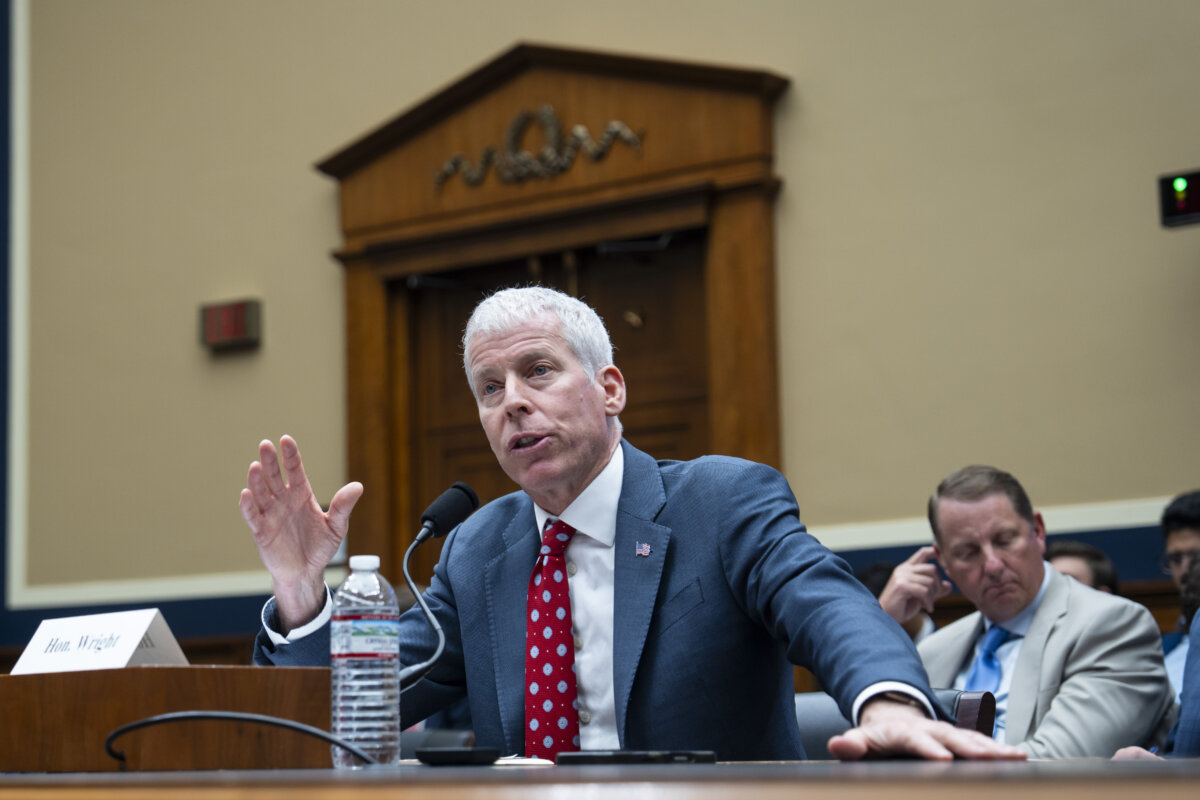

U.S. Energy Secretary Chris Wright said gasoline and diesel prices are heading lower as crude flows out of the Strait of Hormuz, with shipping data showing Middle East exports are back above pre-war levels despite attacks on vessels.
Wright told CBS’s “Face the Nation” on Sunday that “we’ve got increasing supplies coming out of the Strait of Hormuz, and they’ve continued to rise over the last months, over the last recent weeks.”
“We’ve got U.S. gasoline production today at record high. We have demand for gasoline, as we come out of the summer driving season, starting to go down. Similar stories with diesel,” he said.
Asked whether diesel prices would fall, he said: “Absolutely. Diesel prices have been going down. Gasoline prices have been going down. I expect that to continue.”
He added that he expected diesel to go below $6 soon but wasn’t sure exactly when.
He said diesel has mostly been affected by the Russia–Ukraine war and China’s decision not to export diesel or gasoline.
Last month, President Donald Trump told reporters at a White House event that he was considering a federal ban on diesel exports.
Wright has opposed a potential diesel export ban.
“The blunt tool of banning diesel exports definitely doesn’t work,” he said at a Sept. 23 event hosted by the Economist in New York.
He said that if U.S.-produced diesel could not be shipped, few places would be able to store it. As a result, domestic refining would decline, lifting prices for gas and jet fuel.
The White House has said it plans to announce measures to ease diesel price pressures. Europe is also expected to outline efforts to bring more diesel supply to global markets.
Crude oil exports from the Middle East rose above pre-war levels despite attacks on vessels passing through the Strait of Hormuz, shipping data showed last week.
Excluding Iran, Middle East oil shipments reached at least 16.5 million barrels per day in September, according to data from marine tracking firm Kpler released on Sept. 30.
The resurgence is being driven primarily by regional energy producers shifting their oil logistics. About 40 percent of crude now leaves the Gulf without transiting the Strait of Hormuz, up from 17 percent before the conflict began in late February.
The recovery in Gulf shipments is also beginning to weigh on market expectations.
ING analysts said on Oct. 5 that Saudi Arabia had been shipping larger volumes through the Strait of Hormuz in recent weeks because of an outage on its East-West pipeline.
The analysts said reports indicate that “flows are back to more than 80 percent of capacity,” which will allow crude exports from Yanbu, Saudi Arabia, to also recover.
 Two youths sit on the shoreline as ships are anchored in the Strait of Hormuz off the coast of Bandar Abbas, Iran, on August 10, 2026. (Ali Saeedi/Getty Images)
Intelligence firm Marisks said the recent incidents “may not necessarily represent deliberate targeting of individually selected merchant vessels.”
“Instead, available information indicates the possibility that Iranian forces are launching missiles into a predetermined engagement area or ‘kill box’, with weapons potentially acquiring and locking onto available radar signatures within that area,” it said.
Jason Bordoff, founding director of Columbia University’s Center on Global Energy Policy, said in an interview published by Goldman Sachs Global Institute on Oct. 1 that the closure of Hormuz has long been the “nightmare scenario of energy security planning.”
Bordoff said Saudi and Emirati pipelines have been moving more than 5 million additional barrels per day around Hormuz, reducing the Gulf export shortfall from about 20 million barrels per day to roughly 13 million bpd.
Around one-fifth of global oil and liquefied natural gas supplies passed through the strait before the Iran conflict, according to Bordoff.
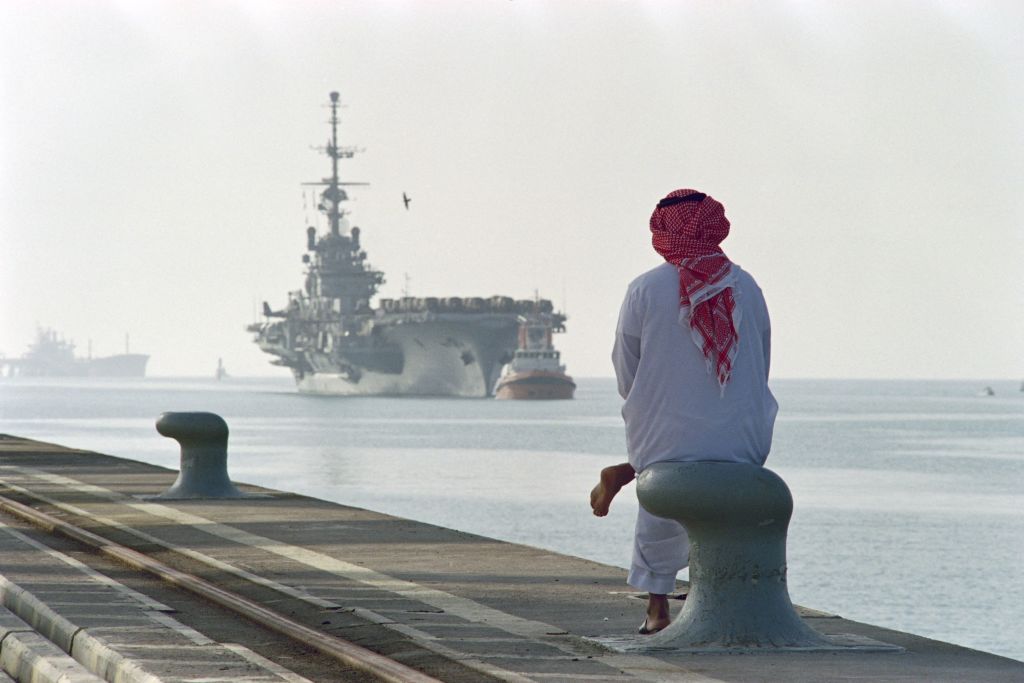 A Saudi man looks at the French aircraft carrier Clemenceau arriving at the port of Yanbu, on Sept. 24, 1990. (Pascal Guyot/AFP via Getty Images)
Saudi Arabia and the United Arab Emirates are consequently planning to expand pipeline capacity that bypasses the strait, while Iraq and Kuwait are exploring alternative export routes, he added.
He said that the United States “should appropriate funds to refill and modernize a strategic petroleum reserve (SPR), now at its lowest level in nearly five decades.”
Reuters, Andrew Moran, and Emel Akan contributed to this report.
 Friends Read Free
Copy
Facebook
Tweet
Friends Read Free
Copy
Facebook
Tweet