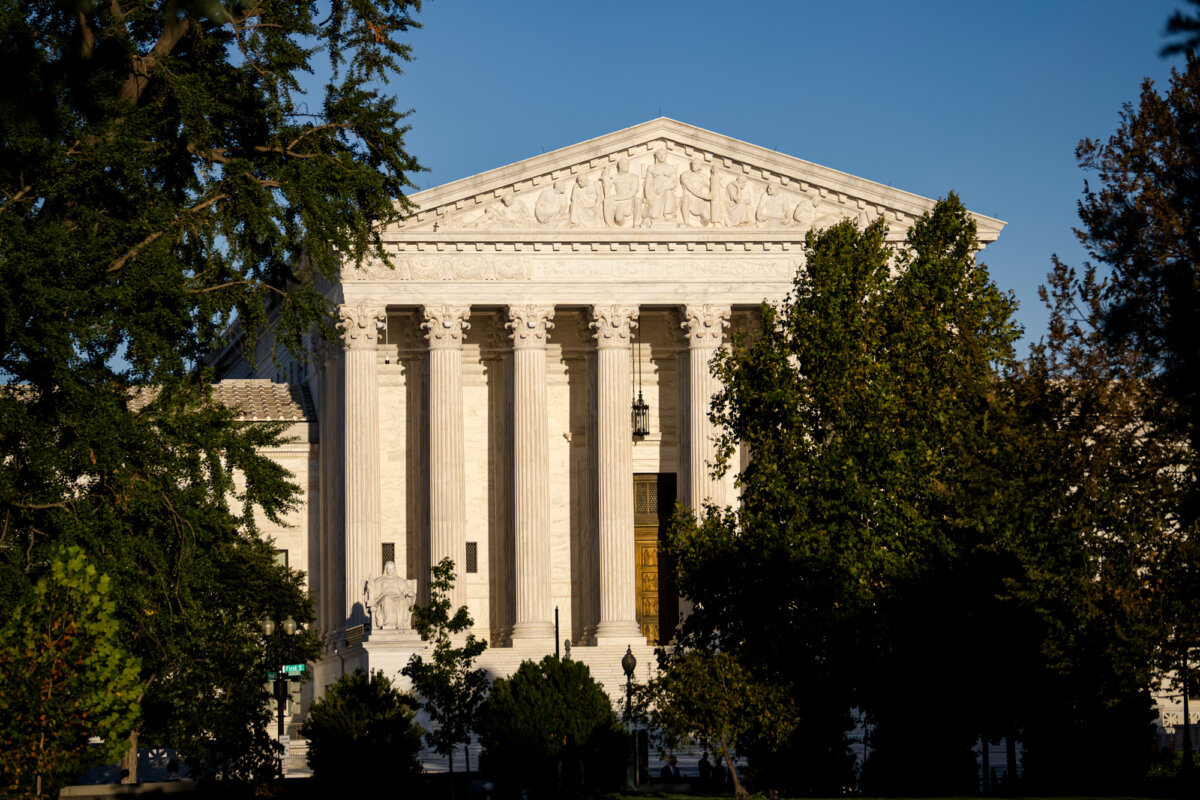





The Supreme Court’s new term places some of the country’s most contested legal issues back before the justices, including gun rights, religion, and immigration.
Starting on Oct. 5, the justices will hear a dispute over how far local governments can go in suing energy companies over the purported effects of “climate change.” In the proceeding months, the court is expected to revisit major precedents when it weighs the constitutionality of assault weapons bans and Catholic schools’ participation in a Colorado preschool program.
Those cases sit among fights over parental rights and so-called gender-affirming care, sex discrimination lawsuits, whether asylees can obtain lawful permanent residence, and what proof of citizenship states may demand of voters.
Some of these arguments focus on federal laws while others center on how courts interpret the Constitution. In December, for example, the court will consider whether Alaska would be violating the Eighth Amendment’s ban on excessive fines if it seized a bush pilot’s plane over a six-pack of beer.
Here are the top cases to watch and what’s at stake in each one.
1. ‘Assault Weapons’ Bans
The justices on Dec. 2 will consider whether Connecticut’s and an Illinois county’s bans on so-called assault weapons violate the Second and 14th Amendments.
Oral argument in the cases, known as Viramontes v. Cook County and Grant v. Higgins, is expected to address whether the laws comply with the Supreme Court’s decision in New York State Rifle and Pistol Association v. Bruen. In that case, the court said gun restrictions must be consistent with how the country historically regulated firearms.
Two federal appeals courts upheld the laws, treating AR-15-style rifles as akin to military weapons that governments historically may prohibit.
Challengers, including activist groups and the Justice Department, say Americans now own an estimated 20 million to 30 million AR-15-style rifles, making them among the most commonly owned long guns in the country. They pointed to the Supreme Court’s 2008 decision in District of Columbia v. Heller, which said the lawful use of commonly owned firearms is protected by the Constitution.
Illinois’s Cook County, which includes Chicago, has said the rifles are the type of “dangerous and unusual” weapons for which the Supreme Court allowed restrictions.
Its October 2025 brief to the court opened with the Uvalde, Texas, school massacre of 2022 and listed other attacks involving AR-style weapons such as the Sandy Hook school shooting in Newtown, Connecticut, in 2012.
2. Catholics Sue Over Colorado Preschool Funding
Catholics are asking the Supreme Court in St. Mary’s Parish v. Roy to revisit one of its more controversial principles on religious neutrality.
For years, the Supreme Court has said that state laws can be constitutional even if they incidentally infringe on someone’s religious exercise. In Employment Division v. Smith, the court said that could be the case if the law was “neutral” and “generally applicable.”
What that means has been debated in multiple cases. During oral argument on Nov. 3, the court is expected to consider whether Colorado betrayed this principle with its universal preschool program, which requires recipients to enroll children regardless of race, sexual orientation, and other factors.
Some Catholic schools in the state are ineligible since they refuse to admit children of same-sex couples, something they say would confuse children and compromise their mission. The Archdiocese of Denver told the Supreme Court that excluding those schools was biased or lacked neutrality.
Colorado and a federal appeals court disagreed, arguing that the funding conditions didn’t target Catholics but were based on the state’s broader anti-discrimination practices.
3. Climate-Related Lawsuits
In Suncor Energy v. Commissioners of Boulder County, the Supreme Court will consider whether local governments can use state laws to sue fossil fuel companies over the effects of so-called climate change.
The Colorado City of Boulder and Boulder County alleged that companies such as Suncor and Exxon violated multiple state laws by worsening residents’ lives while knowing about climate-related effects.
Suncor and Exxon told the Supreme Court the case was flawed because it relied on state law surrounding things such as public nuisances and consumer protection. Applying those laws to “climate change” would allow Colorado to step on the federal government’s power to regulate emissions, they argued.
They pointed to the Clean Air Act, arguing that the federal government set up a uniform regulatory arrangement nationwide that would be disrupted by state-level differences. In a decision last year, the Colorado Supreme Court said the companies were wrong. It held that Boulder was not seeking to regulate emissions but even if it were, Congress allowed states some leeway in doing so.
Oral arguments are scheduled for Oct. 5. The justices are expected to not only interpret the Clean Air Act but also decide whether they should wait for a more final decision from a state district court, which received the case after the state supreme court’s ruling, before intervening.
4. Citizenship Proof in Elections
The Supreme Court on Dec. 8 will consider whether Arizona can require proof of citizenship from voters and remove noncitizens from voter rolls before an election.
The U.S. Court of Appeals for the Ninth Circuit said those two measures conflicted with federal law. More specifically, it pointed to the National Voter Registration Act (NVRA), which directs states to treat its voter registration form as equivalent to a federal mail form. Rather than requiring proof of citizenship, the federal form merely requires people to attest to their citizenship under penalty of perjury
Separately, the court said Arizona violated a 90-day preelection “quiet period” set up by the NVRA. That quiet period prohibits the type of “systematic” cancellation of voter registrations that Arizona sought, the court said.
Arizona, the Republican National Committee, and Justice Department are all asking the Supreme Court to rule differently in the case, known as Republican National Committee v. Mi Familia Vota.
They argue the NVRA does not strip states of authority to police who may vote, that a consent decree cannot freeze outdated procedures after the Legislature changes state law, and that the quiet period was meant to stop last-minute, error-prone purges—not the removal of people already identified as noncitizens.
5. Detention and Third-Country Removal
Two immigration cases will test how far the government can go in holding people during removal proceedings and in choosing where to send them once an order is final.
In Rhoney v. Da Cunha, granted on Oct. 1, the Supreme Court will consider whether the Immigration and Nationality Act requires detention, without a bond hearing, of noncitizens who are present in the United States after entering unlawfully.
Ricardo Aparecido Barbosa Da Cunha, a Brazilian national who has lived here for about two decades, was arrested in Massachusetts in September 2025 and informed that he would remain in custody for the duration of his case. The case was transferred to New York, where a federal judge ordered a bond hearing, and the Second Circuit affirmed.
The Trump administration says the detention statute covers anyone present without being formally admitted to the country. Da Cunha’s attorneys argue that people arrested in the interior years after entry are governed by ordinary bond rules. Only the Fifth and Eighth Circuits have sided with the government. Oral argument is expected in early 2027. The justices agreed to decide only what the Immigration and Nationality Act requires, not the separate constitutional claims.
Separately, on Dec. 9, the justices will take up Department of Homeland Security v. D.V.D., a challenge to removals to countries never named in the removal order. A federal judge in Massachusetts required written notice and a meaningful chance to raise persecution or torture claims before such a removal. The Fifth Circuit largely agreed.
On Sept. 29, the justices stayed that judgment—over the dissent of Justices Sonia Sotomayor, Elena Kagan, and Ketanji Brown Jackson—and agreed to formally consider the case. They asked the litigants to address jurisdiction, class-wide relief, and whether the department’s third-country removal guidance violates the Immigration and Nationality Act, due process, or the torture protections.
This is the high court’s second look at the dispute. In June 2025, the justices paused an order by the same Massachusetts judge that blocked removals unless the government first gave notice and a chance to raise a fear of torture. The justices’ unsigned order did not decide whether the policy was legal. Sotomayor, Kagan, and Jackson dissented. The pause let the removals resume while the appeal went forward.
Together, the cases ask how much notice and how many chances to be heard the law requires before the government can lock someone up while a deportation case is underway, and before it can put that person on an airplane bound for a country that was never named in the deportation order.
6. Parents Challenge Washington’s Runaway Policy
When a child wants to undergo gender-based medical interventions, can parents sue to stop the state from providing those treatments?
That’s the question the Supreme Court is considering in International Partners for Ethical Care v. Ferguson, which is being heard on Dec. 7.
If a runaway arrives at a youth shelter, Washington state’s policy requires parents be notified within 72 hours—except when there is a “compelling reason.” In 2023, the state updated its policy to say that a child “seeking or receiving protected healthcare services” is a compelling reason, and that “gender-affirming” care is protected healthcare.
Parents of children with gender dysphoria sued, arguing that policy allows the state to refer runaway kids for gender treatment without parental notification. That threat has forced them to parent differently; they are hesitant to discipline their kids because they may run away to seek treatment.
An appeals court rejected the parents’ arguments, saying any change in parenting style was a “self-inflicted” injury on their part. It said they failed to demonstrate “standing,” or the type of injury that gave them a legal basis to sue.
7. Sex Discrimination Claims
Two professors in an upcoming case—Crowther v. Board of Regents of the University System of Georgia—are asking the Supreme Court to assist their attempts to sue their universities over alleged sex-based discrimination.
Thomas Crowther, a former Augusta University art professor, alleges he was removed after a sexual harassment investigation that was biased against him because he is a man. MaChelle Joseph, formerly a women’s basketball coach at Georgia Institute of Technology, says she was fired after she complained that the women’s program received inferior resources compared to the men’s team.
Both say that they should be able to sue under Title IX of the federal Education Amendments of 1972, which bars sex-based discrimination in schools. They point to the Supreme Court’s decision in Jackson v. Birmingham Board of Education, which allowed a private right of action under Title IX.
The U.S. Court of Appeals for the 11th Circuit disagreed, stating that the private right of action the Supreme Court recognized was limited; specifically to when the school retaliates against an employee’s discrimination complaint.
The university system also said that Congress made Title VII the exclusive legal avenue for employees to challenge workplace sex discrimination claims. Oral argument on Nov. 30 will likely focus on Congress’ intent with the laws.
8. Former Asylees Seek Lawful Permanent Residency
For foreign nationals who were granted asylum when entering the United States, immigration law provides a pathway to obtaining lawful permanent resident status.
But is a non-citizen whose asylum status was terminated still be eligible to become a lawful permanent resident?
The justices are expected to answer this question in a case known as Wassily v. Blanche, which is being heard on Nov. 30.
Tamer Wassily, an Egyptian convicted for child stalking, and Byron Velasquez Arreaga, a Guatemalan convicted twice for driving while intoxicated, are asking the Supreme Court to intervene after they lost their asylum statuses.
Immigration judges terminated those statuses based on their convictions representing “partially serious crimes.” Each man attempted to obtain long-term residence status but was denied based on language in the Immigration and Nationality Act.
They focused on a section of the act that allows permanent residence to be granted to “any alien granted asylum,” who “continues to be a refugee.”
Lawyers for Wassily and Abbreaga argue that nowhere in the Immigration and Nationality Act does it require an alien’s asylum privilege to still be in effect when they apply for lawful permanent resident status.
The federal government, in its filing to the high court, argues that “only an alien who currently possesses asylum status” is eligible for adjustment to lawful permanent resident status.
9. Eminent Domain Compensation
The Supreme Court will also take up the case of a family ranch enterprise that had its land seized as part of a natural gas development arrangement between a private company and the federal government.
WBI Energy Transmission had been authorized by the federal government to use eminent domain to build and operate a natural gas pipeline. Under the Fifth Amendment, eminent domain allows the state or its authorized agents to seize property “for public use” as long as the owner receives “just compensation.”
For roughly three years, WBI battled with Leonard Hoffman and other ranchers over the value of the seized property before ultimately reaching an agreement. That decision came only after the ranchers had spent nearly $400,000 in court and legal fees.
Under North Dakota law, which the ranchers cited, they are entitled to have these fees reimbursed by the opposing party. WBI argued that because the issue was handled under federal authorities and the Natural Gas Act, the state law is irrelevant in this matter.
Oral argument on Nov. 9 is expected to address an appeals court decision against the ranchers. The U.S. Court of Appeals for the Eighth Circuit said WBI merely owed “just compensation,” which excludes attorneys’ fees, for the seized land.
10. Fines for Labor Protection Violations
In Dept. of Labor v. Sun Valley Orchards, the Supreme Court is set to consider the extent of the Labor Department’s authority to impose administrative fines on employers who violate federal worker protections and labor contracts.
An administrative law judge found Sun Valley Orchards, a family-owned farm that employed farm workers under the H-2A guest-worker visa program, violated multiple worker protection laws and contractual obligations. The farm was ordered to pay $550,000 in back wages and monetary penalties.
However, oral argument on Nov. 10 isn’t expected to relitigate that fee. Instead, the Supreme Court is taking up the question of the administrative law judge’s authority.
A federal appeals court held last year that Sun Valley should have received a jury trial, rather than an administrative proceeding, under Article III of the Constitution and the Seventh Amendment. It pointed to the Supreme Court’s 2024 decision in SEC v. Jarkesy, which held that a similar administrative court operated by the SEC could not replace a federal trial under the Seventh Amendment.
By contrast, the Labor Department argued that the case was different than the one in Jarkesy because it involved immigration. Immigration, it said, was a type of issue that the Supreme Court said could be handled by executive officers.
11. Alaskan Plane, Excessive Fines
A bush pilot is asking the Supreme Court to say that Alaska is attempting to violate the Constitution’s prohibition on “excessive fines” by seeking to take his $100,000 plane.
The case, Jouppi v. Alaska, centers on the state’s claim that it can seize the plane over a six pack of beer that pilot Kenneth Jouppi had on board in 2012. The six-pack, along with other beer on the plane, was brought by a passenger and not Jouppi, who denied knowing about beer in the passenger’s luggage. Officers, however, said that the six-pack was visible in a shopping bag.
Jouppi was found guilty under a state law that prohibits the transport of alcohol to dry communities. It also allows potential seizure of aircraft involved, something the state has been pursuing in a lengthy legal battle with the pilot.
The state and Jouppi have been in a long legal struggle over the 1969 Cesna, which is worth about $95,000. On a per-unit basis, that works out to more than $15,800 per beer can. The two sides, set for oral argument on Dec. 1, disagree over whether that penalty is proportionate to Jouppi’s offense.
The Alaska Supreme Court said it was, noting that there were 72 beers on the plane in total. It also deferred to the state legislature in determining that forfeiture was appropriate. Jouppi told the U.S. Supreme Court that the state court failed to properly weigh his alleged wrongdoing and therefore violated the Eighth Amendment.
 Friends Read Free
Copy
Facebook
Tweet
Friends Read Free
Copy
Facebook
Tweet