

Iran has “lost control” of the Strait of Hormuz as Persian Gulf exports inch closer to pre-conflict levels, analysts say.
Excluding Iran, Middle East oil shipments reached at least 16.5 million barrels per day in September, according to data from marine tracking firm Kpler released on Sept. 30.
The resurgence is being driven primarily by regional energy producers shifting their oil logistics. About 40 percent of crude now leaves the Gulf without transiting the Strait of Hormuz, up from 17 percent before the conflict began in late February.
“The barrels are back, but the export system moving them is fundamentally different,” Kpler said in a report.
Goldman Sachs estimates, meanwhile, are more bullish. Analysts say that Persian Gulf exports returned to 23.3 million barrels per day, roughly mirroring 2025 averages.
The bank observed a divergence between the decline in Iranian crude exports and the increase in shipments by Gulf producers.
Saudi exports were about 5.2 million barrels per day, up from 2.9 million in August, and firmly above last year’s average. Iraq’s oil exports totaled about 2.5 million barrels per day, up from close to zero in April and May.
As for the critical global choke point, oil and petroleum product flows averaged more than 13 million barrels per day last week, Kpler said.
This is about 80 percent of what traveled the narrow waterway each day before the joint U.S.–Israeli operation.
“Tremendous oil is coming out of the Hormuz Strait now. We’re running it. We have total control,” U.S. President Donald Trump told reporters at an Oval Office event.
But while global energy markets are still focused on the Gulf channel, the long-term outlook suggests a future in which oil exporters pay little attention to the strait.
“Iran’s regime has lost control of the Strait of Hormuz,” Alexander Stahel, founder of Burggraben Holding, said in a post on X.
Saudi Arabia has been expanding its pipeline capacity to the Red Sea, aiming to bring total flows to about 7 million barrels per day.
The United Arab Emirates is lifting its export capacity by accelerating the construction of new ports, container terminals, and pipelines. Abu Dhabi also finished a second pipeline to the Port of Fujairah on the Gulf of Oman.
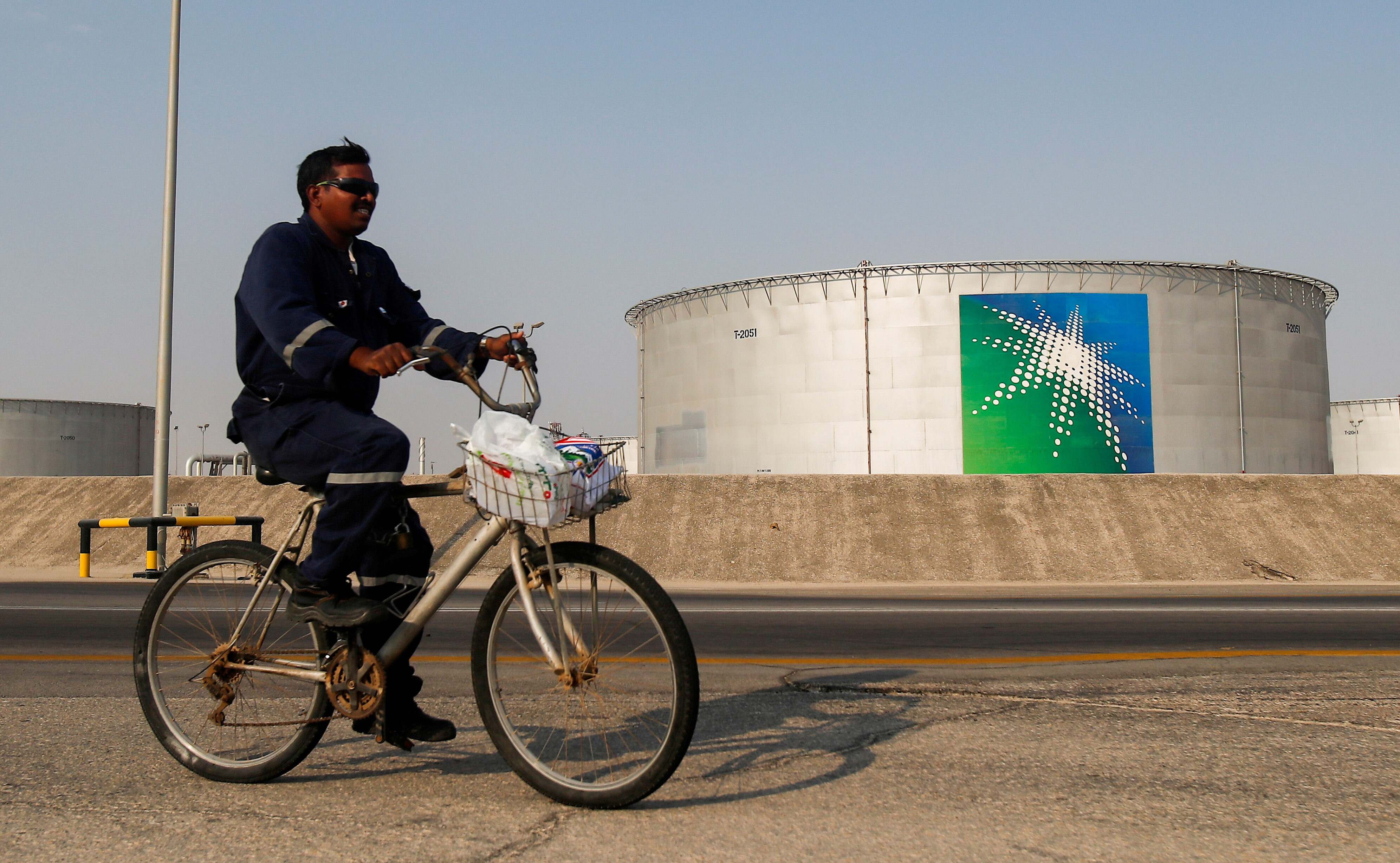 An employee rides a bicycle next to oil tanks at Saudi Aramco oil facility in Abqaiq, Saudi Arabia, on Oct. 12, 2019. (Maxim Shemetov/Reuters)
Meanwhile, ship-to-ship transfers have become increasingly common. These shuttle tankers ship oil through the Strait of Hormuz to the Gulf of Oman. They then load the crude onto another tanker that travels to Asia.
“It is unable to stop the Hormuz Shuttle,” Stahel said.
The setup lets shuttle tankers quickly offload, loop back into the Persian Gulf, and keep exporting on repeat, he added.
“Iran has failed to shut the Strait, the shuttle system is scaling, and time is increasingly working against Tehran,” he said.
Despite the improving shipping situation, global crude prices are still quite high.
A barrel of Brent—the seaborne international benchmark for oil prices—is still above $100 per barrel in overseas trading. Other petroleum products also remain elevated.
Iran Will Have ‘Nothing’ Left: Bessent
Whether it’s improving oil flows or Gulf producers diversifying oil routes, the situation in the Middle East is exacerbating Iran’s already collapsing economy.
“The devastation to the economy will now get much worse quickly. Imaginations will be running wild in Tehran,” Robin Brooks, senior fellow at the Brookings Institution, said in a Sept. 30 post on X.
U.S. Treasury Secretary Scott Bessent said he thinks that Iran will have “nothing” left to offer the world before October is finished.
“I am confident, given that there’s only 15 million more barrels of Iranian oil on the water, that Iran will have nothing left to trade for anything,” Bessent said on the Fox News program “Sunday Morning Futures” on Sept. 27.
“Probably within the next two weeks, they are going to make their final deliveries of oil to China, and then they will have nothing.
“It is an empty set. And I believe that they are feeling the pressure here, and that’s why they want a deal.”
From America’s naval blockade to Operation Economic Outcast, Iran’s economy is facing maximum pressure.
The Iranian currency has collapsed, trading at more than 2.5 million rials to the U.S. dollar. Food prices are spiraling out of control, and the nation is facing an energy crisis.
Tehran’s leadership may no longer be able to wait out U.S.-led tactics, but experts say it may not give up without securing anything after months of fighting.
“For Tehran, simply giving in after months of fighting could itself create problems inside the regime,” Yagiz Sullu, founder and lead analyst at Sullu Strategic Advisory, told The Epoch Times.
“After absorbing enormous military and economic costs, backing down without something it can present as a victory could frustrate political officials and, more importantly, the security apparatus.”
Defeat in wars can be especially destabilizing for authoritarian governments because it casts doubt on the leadership’s competence and undermines its claims to legitimacy, he noted.
What will happen next between the United States and Iran is unclear, but Trump said he will decide “very soon” whether to “blow them up or make a deal.”
Refined Products More Complicated
Goldman Sachs estimated that diesel and gasoline exports have recovered to only about 3 million barrels per day, or about 58 percent of their pre-conflict levels.
While the war in Iran—approaching the eight-month mark—has contributed to the volatility in diesel markets, the escalation in the Ukraine-Russia conflict has been a key factor.
Moscow—the world’s second- or third-largest diesel exporter—has seen its refining infrastructure damaged. Additionally, the Kremlin extended the export ban it implemented this past summer.
Diesel has increasingly drawn the attention of global markets as prices hover near record highs.
On Sept. 22, the U.S. average for a gallon of diesel topped $6.52 for the first time, creating concerns that the spike will filter through the broader economy.
“That means the rise in diesel prices does not stay in the energy line of the [consumer price index] but migrates with a lag into core goods and services,” Torsten Slok, chief economist at Apollo, said in a note emailed to The Epoch Times.
The situation has put a possible federal ban on diesel exports on the table.
“I’m thinking about it,” Trump told reporters at a White House event on Sept. 30.
“I speak to [Energy Secretary] Chris [Wright] and [Interior Secretary] Doug [Burgum] about it a lot. They sort of think it’ll help diesel, but it might raise the price of other things.”
Wright has opposed a potential diesel export ban.
“The blunt tool of banning diesel exports definitely doesn’t work,” he said.
The administration official argues that if U.S.-produced diesel could not be shipped, there would be few places to store it. As a result, domestic refining would decline, lifting prices for gas and jet fuel.
But the White House says it plans to announce measures to ease diesel price pressures. Europe is also expected to outline efforts to bring more diesel supply to global markets.
Still, any initiative that includes restrictions is bound to backfire, said Simon Lack, portfolio manager at the Catalyst Energy Infrastructure Fund.
“There’s a lot of unintended consequences to a diesel export ban,” Lack told The Epoch Times in an emailed note.
“We produce diesel and gasoline together. If we’re exporting less, we’re going to be producing less diesel, which means less gasoline, and you could see gasoline prices go up. Some parts of the country import diesel.”
Reuters contributed to this report.
 Friends Read Free
Copy
Facebook
Tweet
Friends Read Free
Copy
Facebook
Tweet