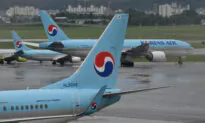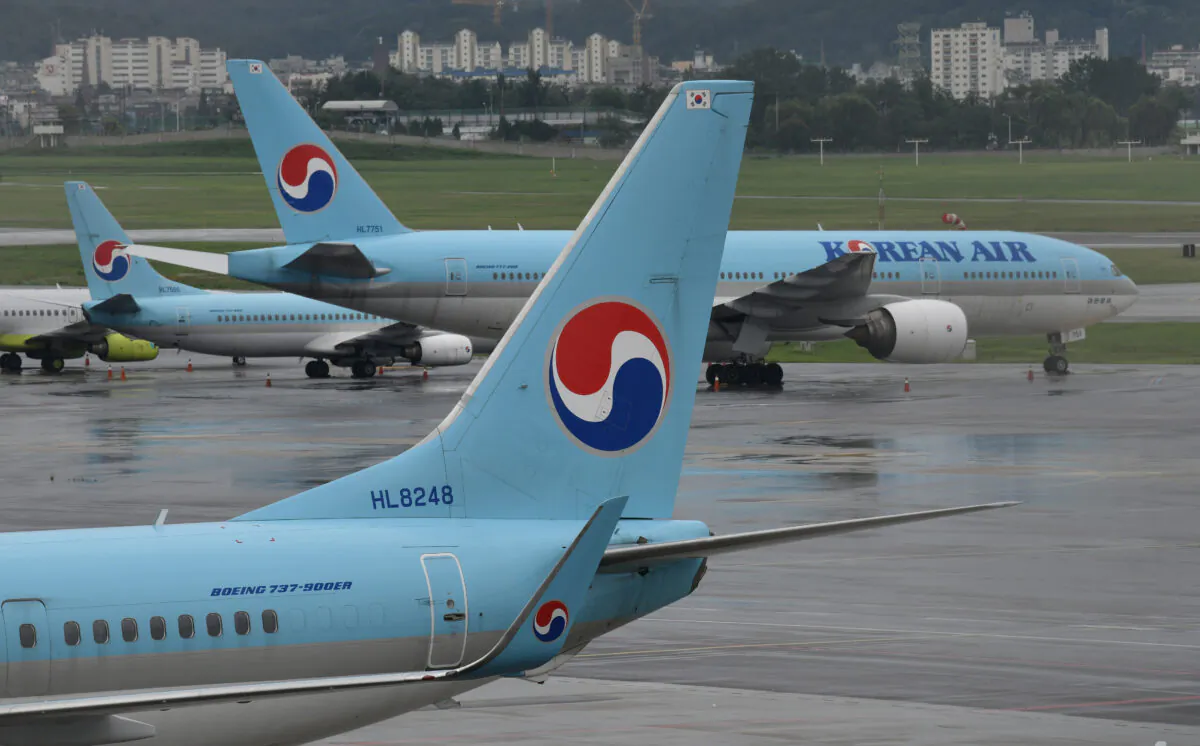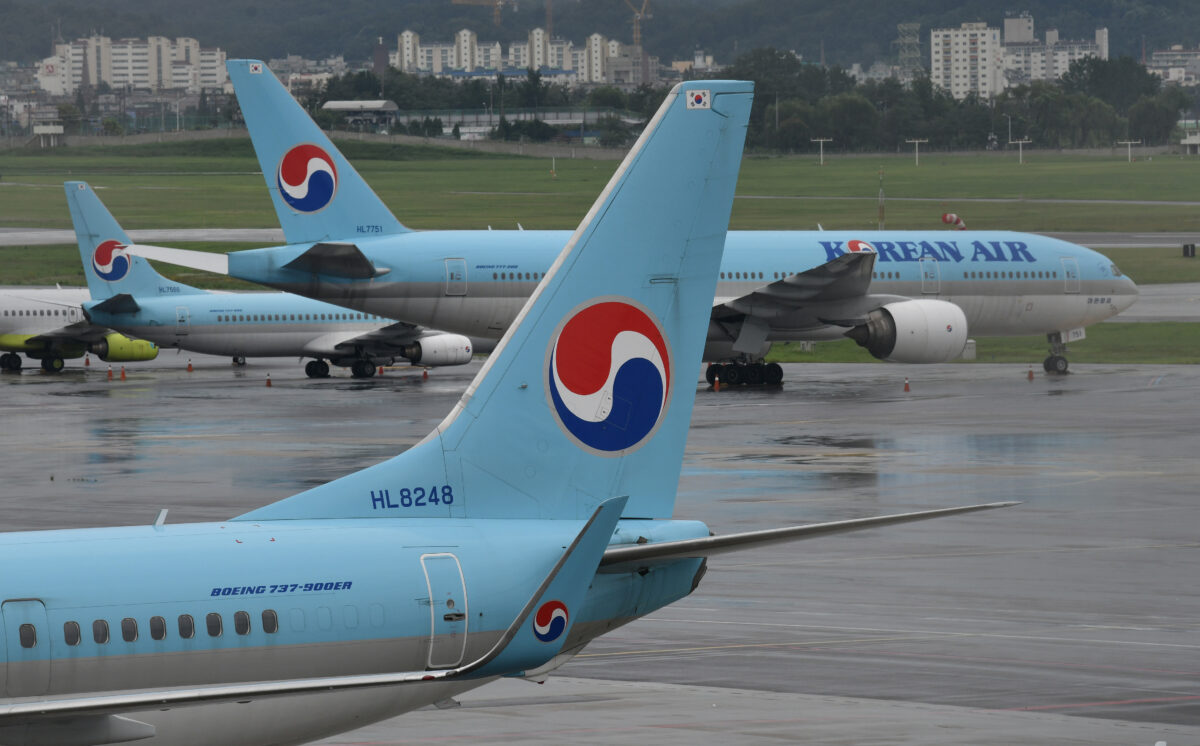

South Korea and China have agreed to expand weekly scheduled flights between the two countries for the first time in seven years, Seoul announced on June 4.
Meanwhile, China’s ruling Communist Party (CCP) announced that its leader Xi Jinping will visit North Korea on June 8, his first visit there in nearly seven years.
Analysts told The Epoch Times that China is trying to exert influence on both North Korea and South Korea, and Seoul could be a weak link in the first island chain if it doesn’t get adequate economic and security support from the United States.
The China-South Korean flight agreement was reached during bilateral aviation talks held in Seoul from May 27 to 28, according to Seoul’s Transport Ministry.
China and South Korea will add 70 round-trip flights per week, including both passenger and cargo flights.
The South Korean ministry said the agreement will increase flight frequencies on high-demand routes such as those between Incheon and Shanghai, and Incheon and Guangzhou. Currently, the flight rights for these routes have been fully utilized by airlines from both countries.
The new agreement will also expand routes from South Korean regional airports to China, enabling flights from airports such as Busan and Cheongju to 10 Chinese cities, including Guangzhou, Chengdu, Shenzhen, Chongqing, and Xi’an.
The ministry said it plans to allocate the newly secured flight rights to South Korean airlines in the second half of the year.
Lee So-young, the ministry’s aviation policy chief, said it was encouraging that exchanges between the two countries were increasing.
“We expect this agreement to help promote visits to South Korea by Chinese tourists, improve convenience for our citizens traveling to China and for import-export companies, and contribute to revitalizing the economy by further boosting Korean airlines’ entry into the Chinese market,” Lee said.
Passenger traffic between South Korea and China reached approximately 4.39 million in the first quarter of this year, exceeding the pre-COVID pandemic level of 4.14 million.
In contrast, flights between China and Japan have been significantly reduced.
Meanwhile, according to a report by Chinese state-owned financial media outlet Yicai, the latest statistics from Flight Manager DAST regarding China-Japan routes indicate that in May, all scheduled flights on a total of 31 such routes were canceled—an increase from the number of cancellations recorded in April. Throughout May, a total of 1,592 flights from mainland China to Japan were canceled, reaching a cancellation rate of 37.6 percent.
While relations between Japan and China are currently in a deep freeze, South Korea under the stance of the Lee Jae Myung administration has deliberately expanded cooperation with mainland China in areas such as trade, the economy, and tourism, said Su Tzu-yun, researcher and director of the Division of Defense Strategy and Resources at Taiwan’s Institute for National Defense and Security Research.
“Beijing has steered airline routes toward South Korea. This serves a dual purpose: expanding bilateral cooperation with Seoul on the one hand, and acting as a symbolic punishment for Japan on the other,” Su told The Epoch Times.
In the past, South Korea and Japan faced so-called sanctions and punitive measures from Beijing over the deployment of a U.S. anti-ballistic missile system on their soil, Su said. Now, Beijing is deliberately extending certain benefits because the current South Korean government is more friendly to Beijing.
“This amounts to an exercise of influence operations. If a country opposes Beijing or holds a conflicting stance, it faces punishment; if it is relatively cooperative, it receives these benefits,” Su said.
However, such benefits usually do not yield long-term gains, he said.
“Because if any friction arises with Beijing, South Korea’s tourism industry, if reliant on Beijing, risks falling into a ‘fatten, trap, and slaughter’ cycle,” Su said.
With South Korea’s economic growth slowing, the country hopes to attract Chinese tourists by capitalizing on China’s sanctions against Japan, said Ding Shuh-fan, professor emeritus of the Graduate Institute of East Asian Studies at National Chengchi University in Taiwan.
However, relations between South Korea and China are unlikely to return to the close state they were in nearly a decade ago during the Moon Jae In administration, Ding said, as “economically, Chinese electronics and IT products have already surpassed their South Korean counterparts. Furthermore, the anti-China sentiment within South Korea is prevailing.”
The CCP is expanding its geopolitical influence through economic enticement, Su said. “Beyond military power, geopolitics encompasses economic and trade relations. This represents an exercise of influence that aligns with a nation’s overall power.”
Japan is actually quite fortunate in terms of resisting the CCP’s influence operations, Su said.
“On one hand, Japan has plenty of visitors from other countries to fill the gap left by Chinese tourists; on the other, the Sanae Takaichi administration saw through the CCP’s ‘fatten, trap, and slaughter’ strategy and is therefore striving to break free from its dependence on Beijing,” he said.
Geopolitical Dynamics in Northeast Asia
Meanwhile, Xi is scheduled to visit North Korea on June 8 on a two-day trip to meet Kim Jong Un. In recent months, there have been signs of warming up in relations between China and the North Korean regime.
A passenger train connecting Beijing and Pyongyang resumed service in March after a six-year halt, while Air China also resumed weekly flights from Beijing to Pyongyang in the same month. Cross-border flights and train service between the two countries were suspended during the COVID-19 pandemic in 2020.
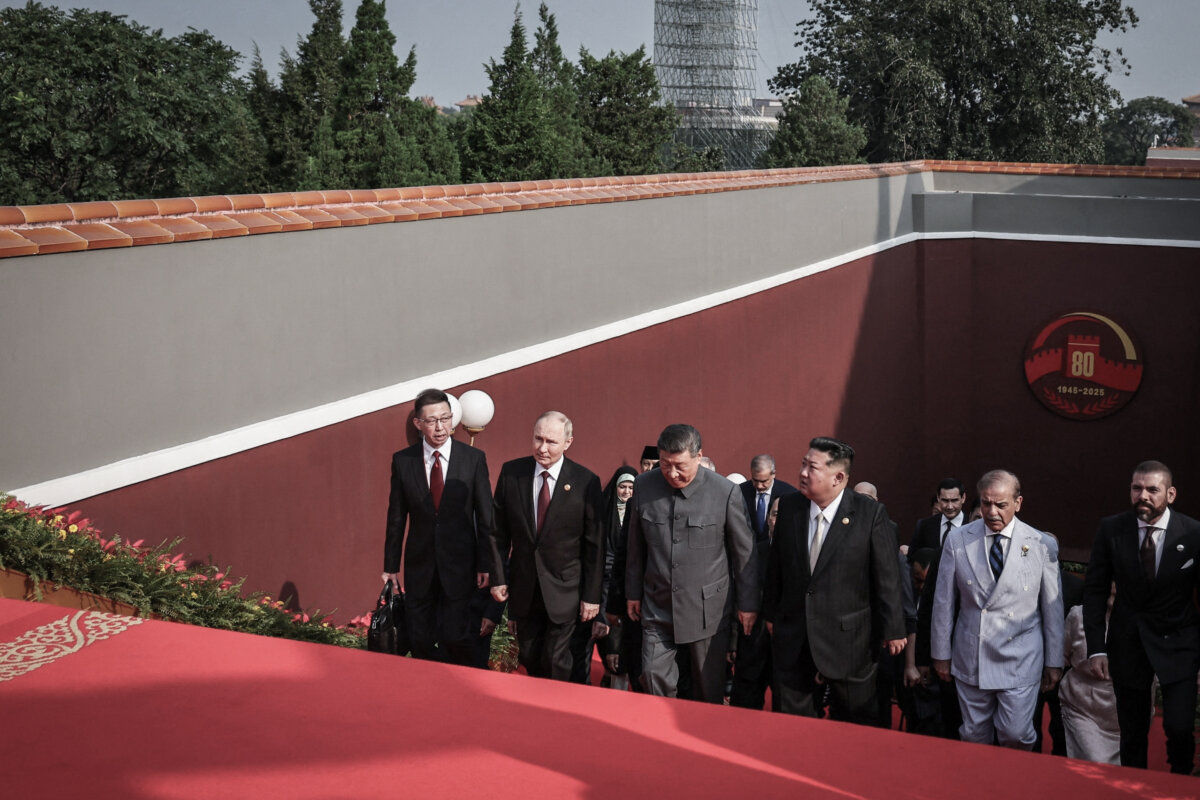
The relationship between Xi Jinping and Kim Jong Un is not very good to begin with, Shen Ming-shih, research fellow at the Division of National Security Research at Taiwan’s Institute for National Defense and Security Research, noted.
“Kim does not want to be the younger brother of the CCP and believes that he can negotiate with or compete with the United States alone,” he told The Epoch Times.
But they realize that the two countries may well strengthen their interactions due to strategic interests, Shen said. “After all, if the Iranian regime were to suffer defeat in the war with the United States or lose its ability to counter the United States, only China, Russia, and North Korea would remain. Consequently, the three nations would need to further strengthen their cooperation.”
North Korea has sent troops to assist Russia in the war against Ukraine, while Russia has provided North Korea with missile and nuclear technology, leading to a significant improvement in their bilateral relations in recent years.
“Xi’s visit is likely intended to reverse North Korea’s pro-Russia stance. With Russia suffering setbacks on the battlefield, this presents a prime opportunity for China to pull Kim Jong Un closer,” Ding said.
Su shares a similar assessment that since North Korea currently maintains close ties with Russia, Beijing has deliberately sought to strengthen its own relationship with North Korea.
“Although there may not be significant substantive benefits for either Beijing or Pyongyang, from a geopolitical perspective, this effectively places additional pressure on Japan,” Su said.
With their shared need to counterbalance the United States, relations between North Korea and China are likely to remain stable, though they will certainly lack the frequent, close interactions of the past, said Lin Chih-Hao, assistant research fellow at the Institute for National Defense and Security Research in Taiwan.
“Furthermore, given the potential for the North Korean nuclear issue to become linked with the Taiwan Strait issue, North Korea may leverage its strategic value to engage in more substantive negotiations with China,” Lin said. “This represents the most significant shift in the current bilateral relationship.”
South Korea in First Island Chain
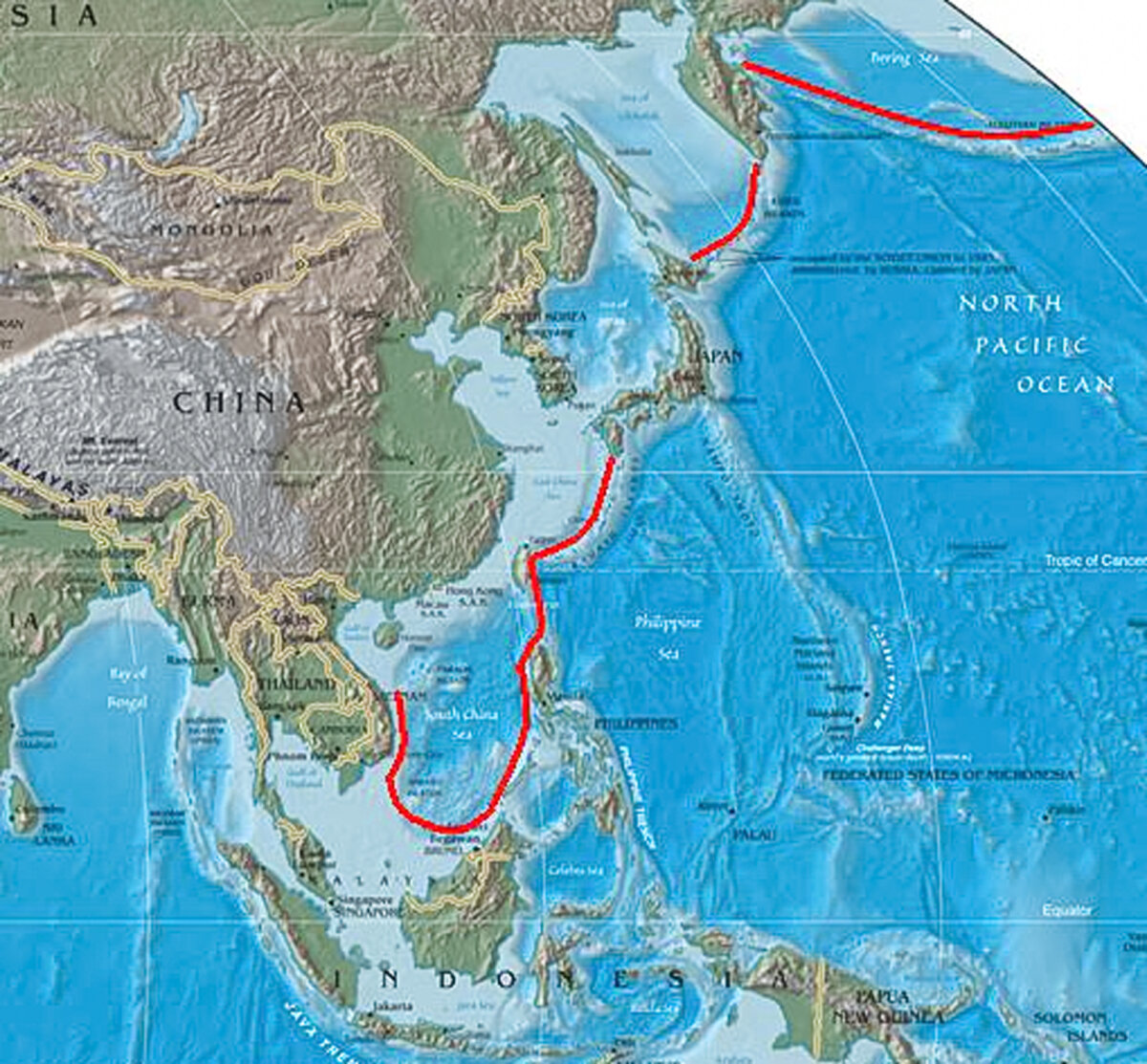
South Korea is a crucial strategic anchor for the “First Island Chain,” a strategic line made up of a string of major Pacific archipelagos in the Asia-Pacific, including Japan, Taiwan, and the Philippines, designed by the U.S. military to contain the maritime expansion of the Chinese regime and its allies.
South Korea, at the moment, does appear to be relatively vulnerable to being swayed by Beijing, Su said. Whether Seoul becomes a weak link in the first island chain depends on the Lee Jae Myung administration, Su said, “specifically, on how it goes about repairing or strengthening relations with the United States.”
Relations between Seoul and Washington have cooled due to increased U.S. tariffs on Korean goods, higher burden-sharing for security, the Lee Jae Myung administration’s left-leaning stance, and its closer relations with Beijing.
As to whether the expansion of the CCP’s influence on the Korean Peninsula can be curbed, Su said that it depends on the interactions among the United States, Japan, and South Korea. “And in this regard, the biggest variable likely lies with South Korea,” he said.
Ding said that right now it largely depends on whether the Trump administration can pull Seoul closer after “Trump’s high tariffs and the scaling back of security commitments have compelled South Korea to improve relations with China as a hedging strategy.”
Luo Ya and Reuters contributed to this report.
 Friends Read Free
Copy
Facebook
Tweet
Friends Read Free
Copy
Facebook
Tweet