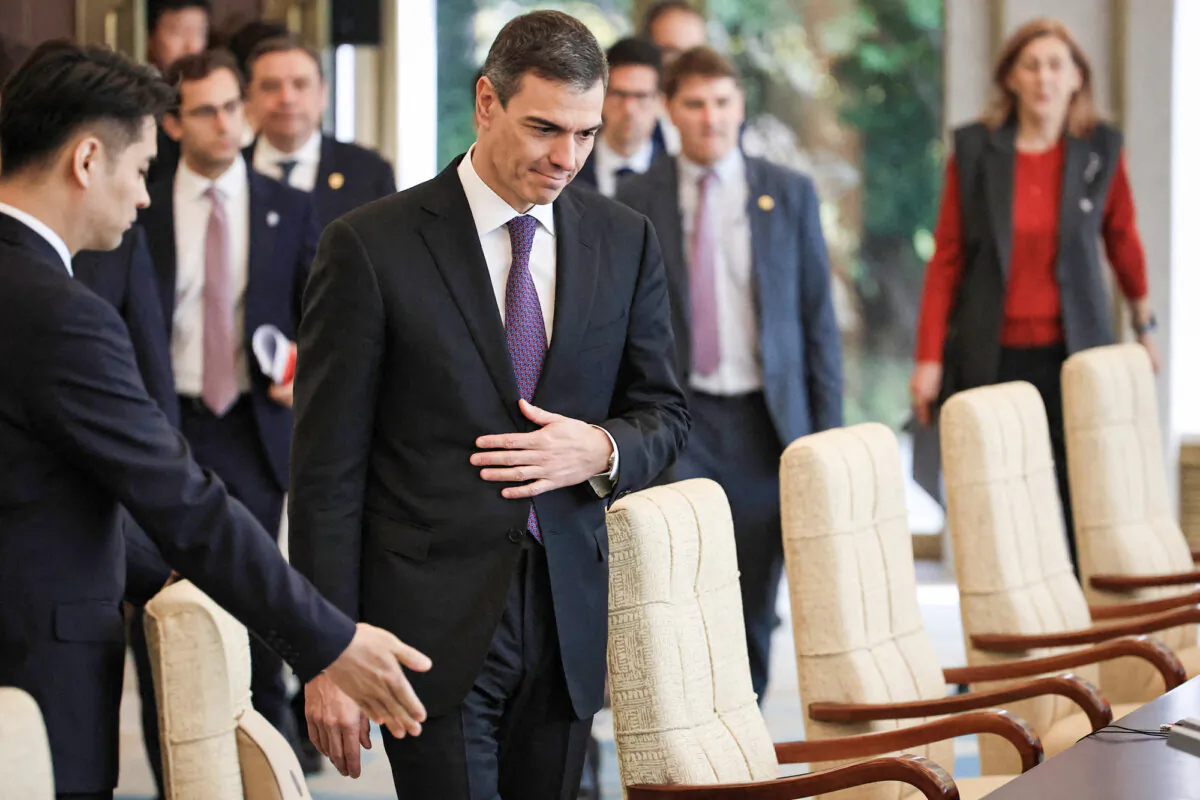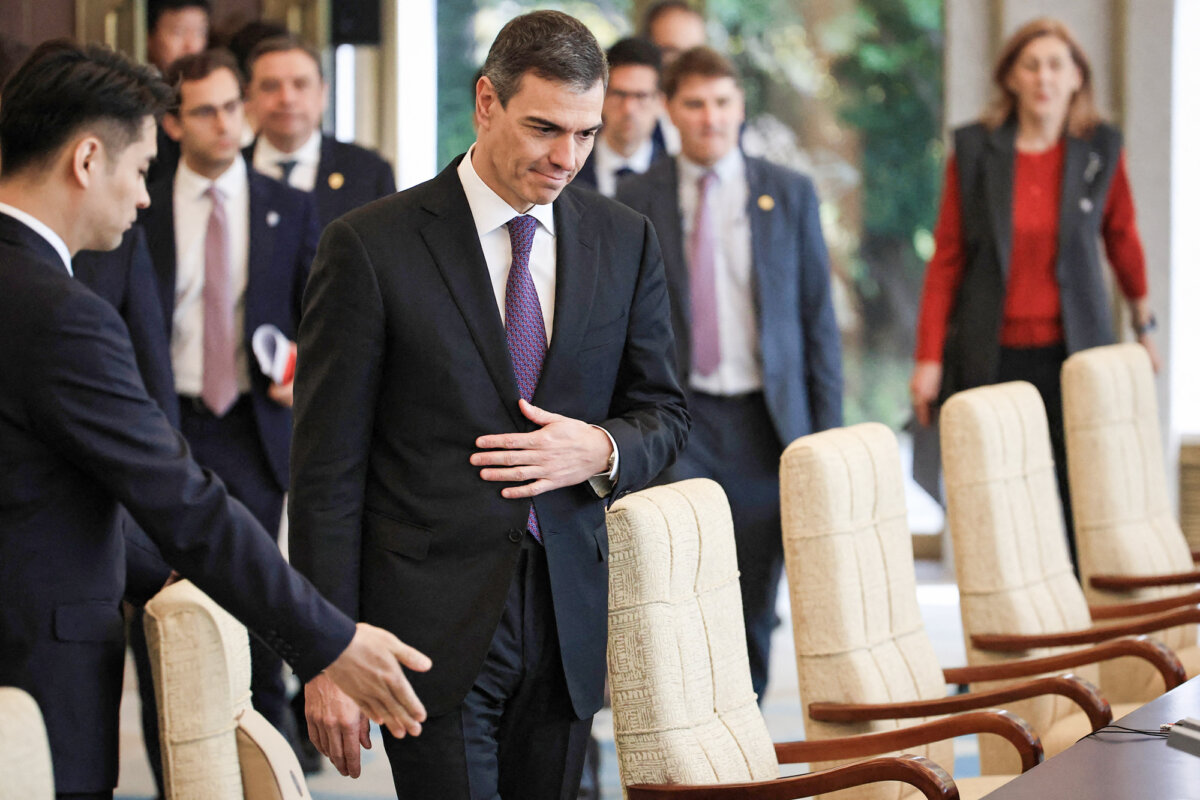

In his recent visit to Beijing, Spanish Prime Minister Pedro Sánchez urged the Chinese communist regime to play a bigger role in global issues such as security, inequality, and climate action.
Analysts told The Epoch Times that although Sánchez’s call doesn’t represent the European Union’s stance, it does represent a dangerous trend in Europe.
Visiting China from April 11 to April 15, Sánchez gave a speech at Tsinghua University in Beijing, calling upon the Chinese regime to assume more substantial global leadership responsibilities.
“Europe will also have to redouble its efforts, especially now that the United States has decided to withdraw from many of these fronts,” he said.
After an April 14 meeting with Chinese Communist Party (CCP) leader Xi Jinping, who said the international order is “crumbling,” Sánchez said Europe and China must forge closer ties to counter threats to multilateralism.
China and Spain also signed deals on agricultural products and transport.
The visit came as disagreements arose between some European countries and the United States over U.S. policies, the Iran war, and NATO budgets and responsibilities.
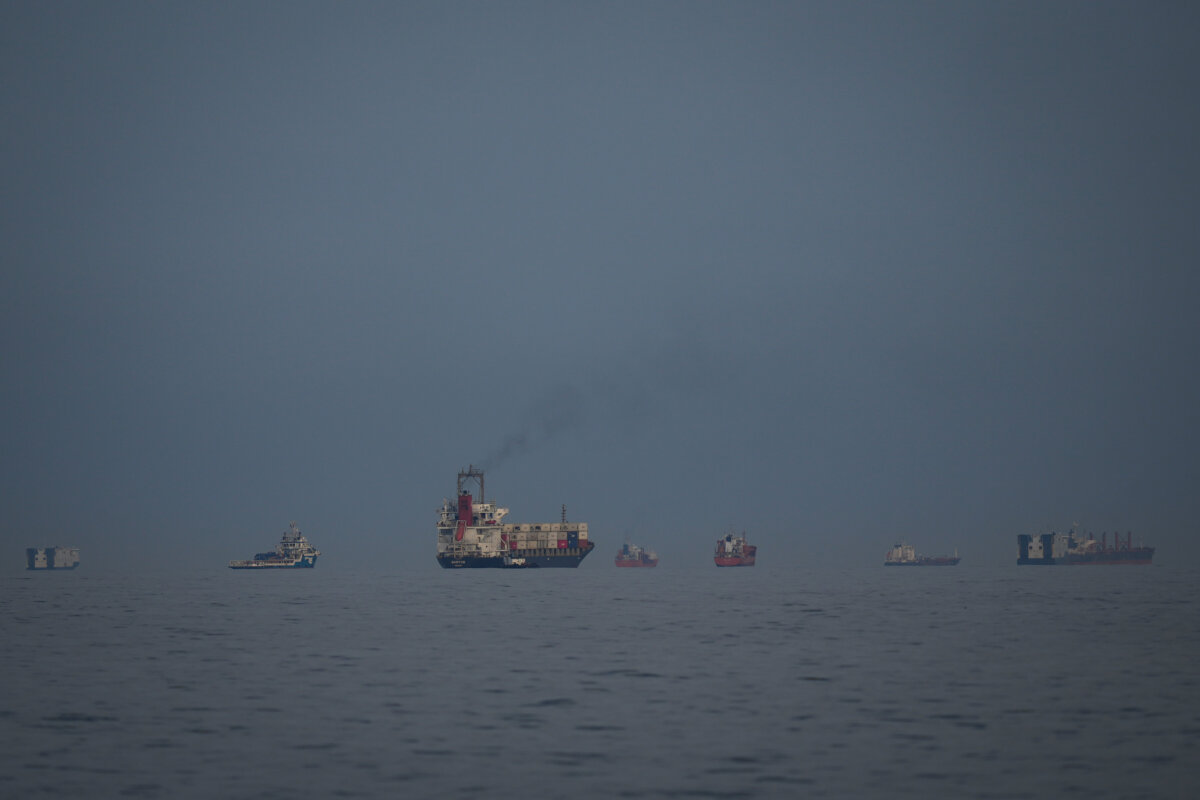
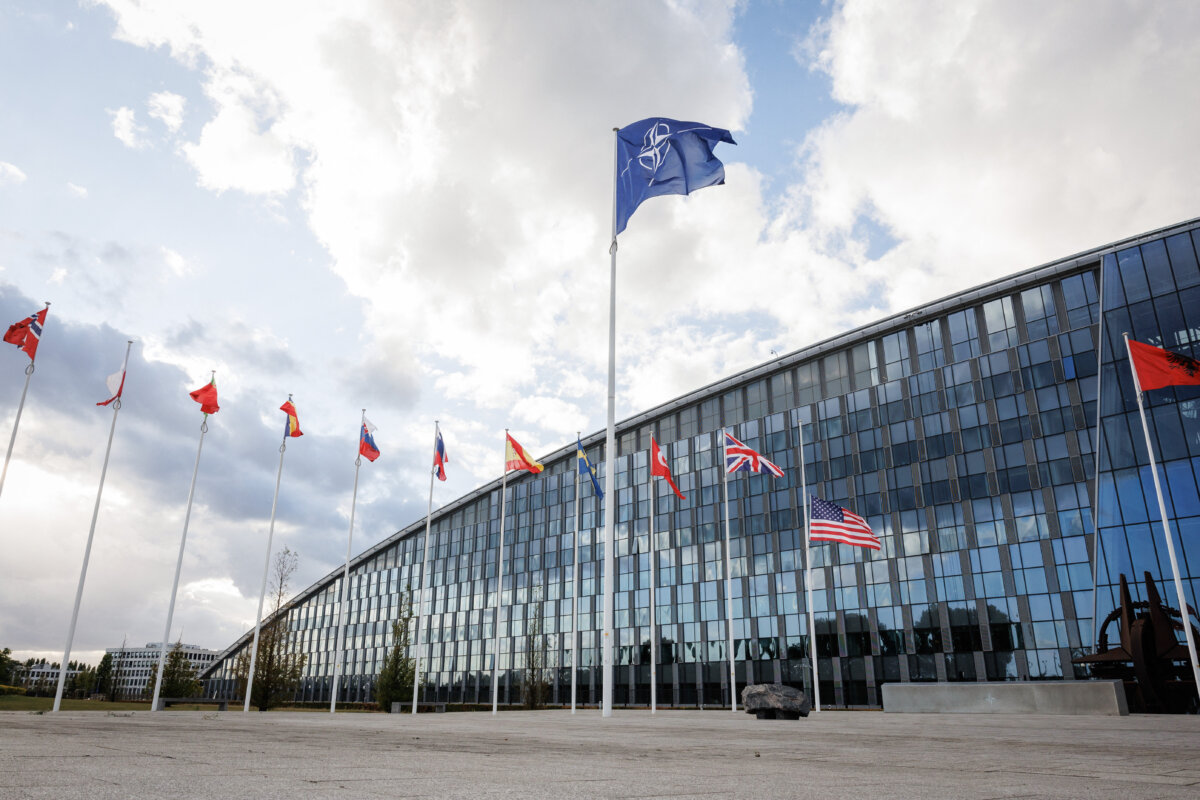
U.S. President Donald Trump has threatened to withdraw from NATO because of a lack of support from other members to safeguard freedom of navigation in the Strait of Hormuz during the Iran conflict. NATO is made up mostly of European countries.
Previously, Spain refused to join other NATO allies in a new commitment to raise their defense budgets to 5 percent of gross domestic product by 2035. Most of the 32 member nations agreed to the increase.
In early March, Trump threatened to cut off all trade and potentially all relations with Spain because of its low defense spending and its refusal to let the United States use its air bases for military operations against Iran.
Shen Ming-shih, research fellow at Taiwan’s Institute for National Defense and Security Research, said Sánchez’s stance stemmed from his left-wing political orientation.
“This may be compounded by a personal antipathy toward Trump, particularly given that Trump had even raised the possibility of severing diplomatic ties with Spain. Spain is the least cooperative member of NATO,” Shen told The Epoch Times.
Instigator Instead of Peacemaker
The issue is not whether China should shoulder more international responsibilities; rather, China itself is the key instigator behind many of today’s international crises, said U.S.-based political commentator Cai Shenkun, who has connections with CCP insiders.
“The Iranian regime has long supported terrorist organizations, developed missiles, and even secretly pursued nuclear weapons; meanwhile, Russia relies on Chinese markets, financial channels, and dual-use goods to keep its war machine against Ukraine running. Far from genuinely restraining these regimes, Beijing has instead consistently provided them with economic and supply chain support, and diplomatic cover—even serving as their most critical external backer during pivotal moments,” Cai told The Epoch Times.
Sánchez’s rhetoric in Beijing is helping the CCP cultivate a highly deceptive international image—one in which the CCP is not part of the crisis, but rather a “responsible major power” essential to resolving it, he said.
“This is precisely what Beijing most wants to hear, and what it most needs European politicians to articulate on its behalf,” Cai said.
The most shameful part of Sánchez’s visit is not what he said, but the fact that, at a critical juncture, he helped Beijing whitewash its international image, Cai said.
“Sánchez surely cannot be unaware of the actual relationship between China, Iran, and Russia. It is not a matter of a lack of understanding, but rather a deliberate choice to sidestep the issue—for doing so serves his practical interests,” he said.
When Sánchez met with Xi, economic and trade issues were a top priority. Sánchez noted that China accounts for 74 percent of Spain’s total trade deficit, which poses a challenge to Spain’s economic stability.
Spain had a trade deficit of 42.3 billion euros (about $49.8 billion) with China in 2025, Sánchez told his audience at Beijing’s Tsinghua University on April 13.
At a Beijing press conference, Sánchez said the Chinese regime has agreed to measures to narrow Spain’s trade deficit. Sánchez also signed several agreements with Chinese Premier Li Qiang, including those on importing more Spanish agricultural products and improving Spain’s transport and infrastructure.
On the one hand, Sánchez needs the Chinese market and Chinese investment while seeking to play a role within Europe that is “independent of the United States,” Cai said.
“On the other hand, he is pandering to certain leftist factions and the anti-American political climate within Europe, packaging ‘multipolar order’ as a moral imperative, framing the distancing of the United States as ‘strategic autonomy,’ and portraying the appeasement of Beijing as ‘international mediation,’” he said.
A Dangerous Trend
Once the Chinese regime’s values or “the China model” supplant the United States’, democratic and liberal values will also be compromised, Shen warned.
“Furthermore, allowing such an authoritarian and autocratic state to dominate the global order is an extremely dangerous proposition,” he said.
Sánchez does not represent the entire EU, Cai said.
“Within the EU, there is no consensus favoring the idea of ‘letting Beijing replace Washington’; on the contrary, many European nations are becoming increasingly wary of the CCP,” he said.
The EU has raised its guard against the Chinese regime’s infiltration and expansion on many fronts, including security, trade, and energy, as Brussels has gradually realized that Beijing is a threat to the EU’s values and way of life.
Still, Sánchez embodies a dangerous trend emerging within Europe, Cai said.
“They are becoming increasingly critical of the United States while growing more lenient toward the CCP,” he said. “They emphasize principles when dealing with Western allies, yet preach ‘understanding’ when engaging with authoritarian regimes; they demand restraint from democratic nations, while placing their hopes on autocratic powers to maintain global peace.”
If the United States ceases its aid to NATO, the alliance’s overall military strength and influence will inevitably diminish, Shen said.
“Such a decline in influence would, of course, be advantageous to Russia; and under such circumstances, NATO would no longer be able to play a significant role in European geopolitics and security. Then, it may well mark the point at which NATO is poised for collapse or on the verge of terminal decline,” he said.
Luo Ya and Reuters contributed to this report.
 Friends Read Free
Copy
Facebook
Tweet
Friends Read Free
Copy
Facebook
Tweet