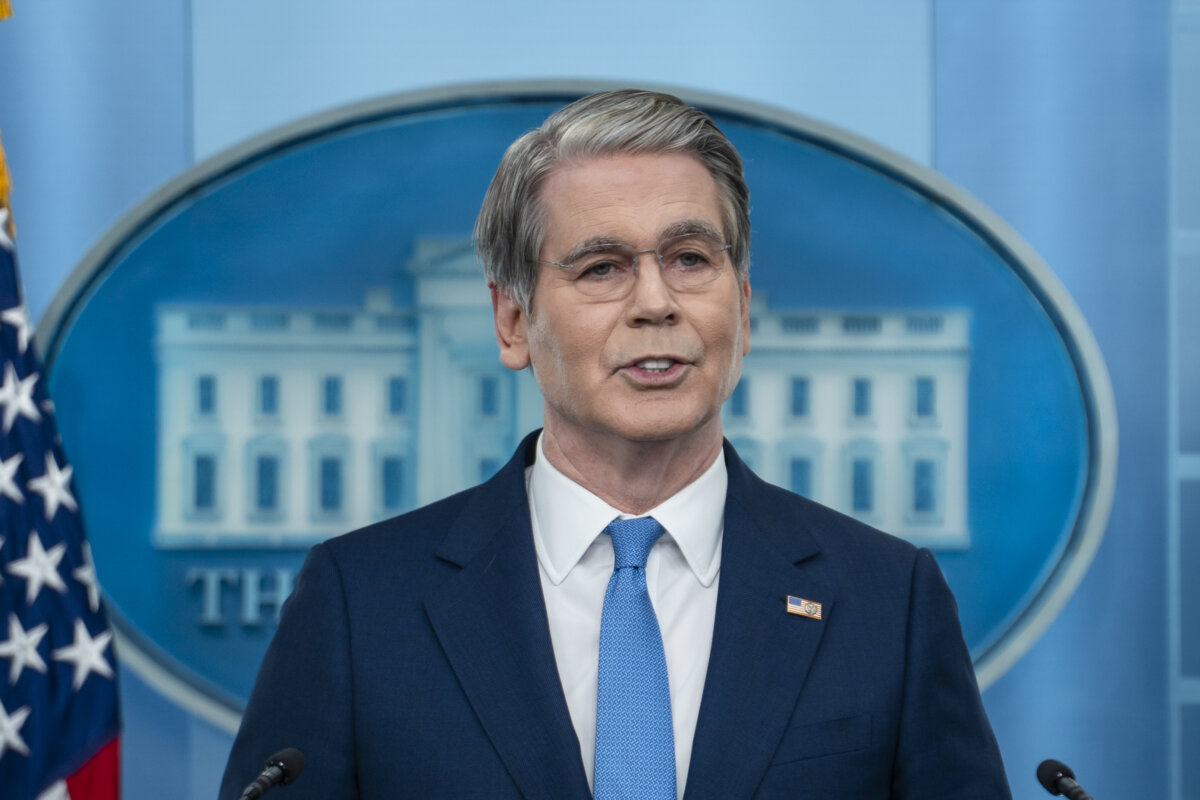
Treasury Secretary Scott Bessent said the United States could sanction overseas artificial-intelligence developers for allegedly extracting capabilities from American models, claiming officials had found U.S. model “watermarks” in many Chinese systems.
“This administration supports open-source models, but what we do not support is IP theft,” Bessent said during a July 21 interview on Fox Business.
“If we see, especially, that overseas models are stealing from our great companies, we have the ability to sanction them because of this theft,” he said.
Bessent did not identify the Chinese companies or models under scrutiny, explain what he meant by “watermarks,” or name the sanctions authority the administration might use.
“We are finding watermarks of our U.S. large-language models on many of the Chinese models, and that’s unacceptable,” Bessent said. “We’re going to be looking at that in the coming days or weeks.”
‘Hundreds of Millions of Hits’
Bessent described the alleged method as distillation, in which outputs from an existing AI system are used to train or improve another model.
“There’s a very technical AI word for it called distillation, but you and I would call it theft,” he said.
Chinese developers had made “hundreds of millions of hits” against large-language models in the United States and were trying to reconstruct “their code and the thought process of the models,” Bessent said.
The White House had already accused foreign entities, primarily based in China, of conducting industrial-scale campaigns to extract capabilities from American AI models.
An April 23 memorandum said the campaigns used tens of thousands of proxy accounts and jailbreaking techniques to evade detection, expose proprietary information, and systematically extract model capabilities.
It directed federal agencies to share information with U.S. AI companies, help the private sector coordinate defenses, develop practices to identify and counter the campaigns, and examine ways to hold foreign actors accountable.
Anthropic Names Chinese AI Labs
Anthropic has accused DeepSeek, Moonshot AI, and MiniMax of running coordinated campaigns to obtain outputs from its Claude models.
The company said in a Feb. 23 report that the three laboratories created approximately 24,000 fraudulent accounts and generated more than 16 million exchanges with Claude.
Anthropic attributed more than 13 million exchanges to MiniMax, more than 3.4 million to Moonshot AI, and more than 150,000 to DeepSeek. It said the requests targeted reasoning, coding, tool use, computer vision, and other capabilities.
The company said it attributed the campaigns through IP-address correlations, request metadata, infrastructure indicators and, in some cases, corroboration from industry partners that had observed the same actors and behavior.
The House Homeland Security Committee and the House Select Committee on the Chinese Communist Party opened a joint investigation in April into the growing use of Chinese-developed AI models by American companies.
The committees identified systems developed by DeepSeek, Alibaba, Moonshot AI, and MiniMax while examining allegations that Chinese companies had extracted capabilities from American frontier models.
The Treasury has not publicly identified a company or model facing sanctions or other formal action.
 Friends Read Free
Copy
Facebook
Tweet
Friends Read Free
Copy
Facebook
Tweet