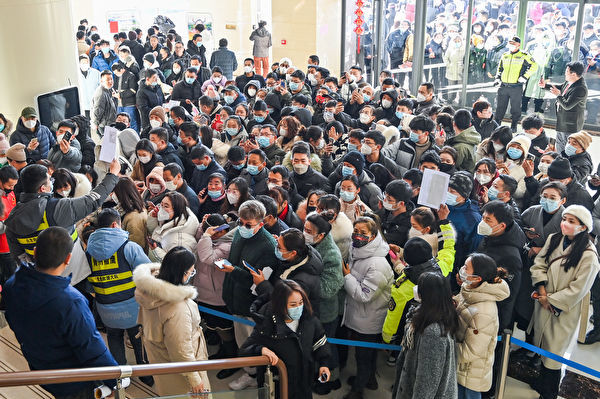
As China’s economic slowdown deepens, workers across the country say opportunities are disappearing, incomes are shrinking, and confidence in the future is fading—pushing many toward gig work or plans to leave the country altogether.
From coastal cities to inland provinces, interviews with residents describe a broad downturn marked by business closures, layoffs, and a weakening private sector. While official messaging continues to project resilience, many say their daily reality tells a different story.
Those interviewed spoke to The Epoch Times on condition of anonymity or by surname only, out of fear of reprisal.
A Downturn Felt Across Sectors
A doctor in Beihai, China, told The Epoch Times that the local economy began deteriorating after the COVID-19 pandemic, as foreign companies pulled out and unemployment rose.
“Almost all the foreign firms have left,” he said. “Young people simply can’t find jobs.”
The doctor said wages in his profession have been sharply cut. His monthly income has fallen to less than 10,000 yuan (approximately $1,400) today from about 20,000 yuan (approximately $2,800) before the pandemic.
“The competition is intense across every industry,” he said. “It’s very hard to make money.”
Others describe similar conditions elsewhere. In Chenzhou, China, a local resident told The Epoch Times that local government finances appear strained, with cost-cutting measures affecting even routine official activities.
Last year, the regime imposed strict limits on spending for official meals, capping them at the level of inexpensive fast food, he said. Infrastructure projects have also stalled. A short stretch of road near his home, approved for paving a year ago, has yet to see construction begin.
Local small businesses are also struggling. The resident said factories have been laying off employees, and some have delayed reopening after the Lunar New Year holidays in February. Shuttered storefronts and empty market stalls have become increasingly common.
Construction workers are often unable to collect wages owed from the previous year.
Young People Face Shrinking Prospects
For China’s younger generation, the outlook appears especially bleak.
Many graduates can only find low-paying jobs—often earning the equivalent of $400 to $500 per month—barely enough to cover rent, according to the retired civil servant. Some have chosen to remain at home, relying on their parents for support, a phenomenon commonly referred to in China as “lying flat,” or opting out of intense competition.
A recent master’s graduate in Beijing, surnamed Xie, told The Epoch Times that most of his classmates remain unemployed months after finishing their degrees. His own job, secured through family connections, pays about 3,000 yuan (approx. $435) per month.
A retired civil servant in Chengdu, China, told The Epoch Times that recent college graduates are struggling to find stable employment.
“It’s not that young people aren’t trying,” she said. “There are simply no opportunities.”
At the same time, private businesses—long a key source of employment—are under increasing pressure.
“Many private companies are barely surviving,” the retired civil servant said, noting that foreign firms have also been scaling back operations in China.
Her own child previously worked for a U.S. company in Shanghai, which later withdrew from the Chinese market, she said. A German firm eventually offered a replacement job, but such opportunities are becoming rarer.
Gig work has become a fallback. Young workers now dominate food delivery and ride-hailing services, she said. While some can earn a basic income through long hours, the work offers little long-term security.
Spending Pullback
Many Chinese citizens are tightening their spending, the retired civil servant said.
“The economy shown on television looks booming,” she said.
“But it’s all propaganda. People may still have some savings, but they don’t dare to spend, because they don’t know what the future holds.”
The cost of living remains high. Basic goods have become more expensive, while public transportation fares continue to rise, according to the retired civil servant.
She contrasted the current mood with the optimism of earlier decades, when China’s economic reforms fueled rapid growth and a sense of opportunity.
Now, she said, tighter controls over media and culture have further dampened public sentiment. Access to foreign media has become more restricted, and state media increasingly emphasize political messaging.
The doctor from Beihai said wealthier families in China are increasingly seeking to move assets overseas, along with their entire families.
“Those with money are finding ways to leave,” he said, describing a trend of sending children abroad first, followed by other family members.
Song Tang and Yi Ru contributed to this report.
 Friends Read Free
Copy
Facebook
Tweet
Friends Read Free
Copy
Facebook
Tweet