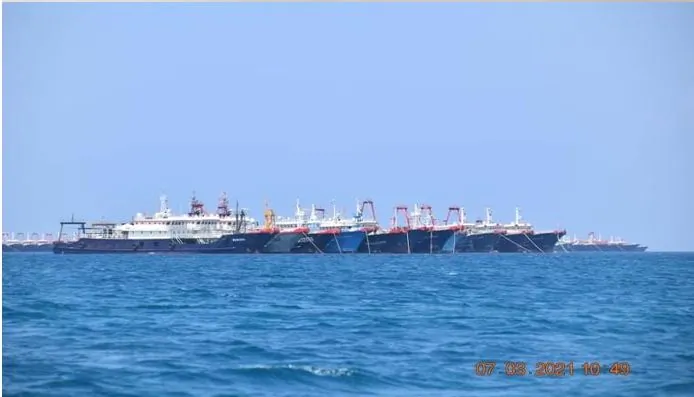

A massive fleet of Chinese maritime militia and coast guard vessels has swarmed a gas-rich area of the South China Sea to provide cover for an unauthorized seabed survey, Philippine authorities said on May 6.
The escalating standoff at Reed Bank represents a direct challenge to the energy security of a key U.S. treaty ally and a fresh test of international maritime law.
Philippine Coast Guard (PCG) spokesperson Commodore Jay Tarriela stated that aerial patrols identified the Chinese oceanographic research vessel Xiang Yang Hong 33 conducting “unauthorized” operations near Iroquois Reef and Rozul Reef, located in the oil-rich Reed Bank.
The Intelligence Threat
According to PCG statements, the Xiang Yang Hong 33 is part of a sophisticated scientific flotilla that includes the Zhuhaiyun, the world’s first autonomous drone mothership capable of deploying 50 unmanned vehicles. The Shi Yan 1, a vessel specialized in hydroacoustics and geophysical exploration, was also monitored.
Research from the U.S. Naval War College’s China Maritime Studies Institute (CMSI) indicates that these vessels are integral to Beijing’s “civil-military fusion” strategy. According to CMSI analysis, these ships collect hydrographic data critical to People’s Liberation Army (PLA) Navy submarine operations and underwater warfare.
“The real issue is not a ship on a map,” Naeem Aslam, chief investment officer at Zaye Capital Markets, wrote on X on May 7. “Reed Bank sits inside the Philippines’ economic zone and is tied to natural gas that Manila needs for energy security.”
Beijing’s Counternarrative
Beijing has dismissed the allegations as “inflammatory propaganda.” Chinese coast guard spokesperson Jiang Lue said the Xiang Yang Hong 33 was conducting a “legitimate marine ecological survey” and accused a Philippine aircraft of “deliberately approaching and harassing” the vessel.
The Chinese Embassy in Manila further asserted that the activities occurred under “China’s jurisdiction,” a claim that deviates from the 2016 international tribunal ruling invalidating Beijing’s “nine-dash line,” a visual representation of the Chinese regime’s claims.
The presence of 41 Chinese vessels—many belonging to the People’s Armed Forces Maritime Militia (PAFMM)—constitutes a massive gray-zone operation. According to an analysis from the U.S. Naval War College, these deployments aim to establish “de facto” control over contested waters by overwhelming local patrols with sheer numbers while staying just below the threshold of traditional military conflict.
This strategy is testing the limits of the 2026 U.S.–Philippines Bilateral Strategic Dialogue. In their most recent joint statement, Washington and Manila reaffirmed that the 1951 Mutual Defense Treaty remains the “bedrock” of their alliance and explicitly covers armed attacks on public vessels, aircraft, and armed forces—including Coast Guard units—anywhere in the Pacific.
For the United States, the stakes extend beyond regional geography. The White House’s 2025 National Security Strategy explicitly links these maritime challenges to the American economy, warning that “one-third of global shipping passes annually through the South China Sea.”
The strategy notes that if a competitor were to control these lanes, it could “impose a toll system over one of the world’s most vital lanes of commerce or—worse—to close and reopen it at will,” outcomes the NSS describes as “harmful to the U.S. economy and broader U.S. interests.”
 Friends Read Free
Copy
Facebook
Tweet
Friends Read Free
Copy
Facebook
Tweet