
The Chinese communist regime has implemented temporary regulatory measures to limit the price hike for retail gasoline and diesel to nearly half of what it would be under its pricing mechanism—but it’s still the biggest increase since the start of this year.
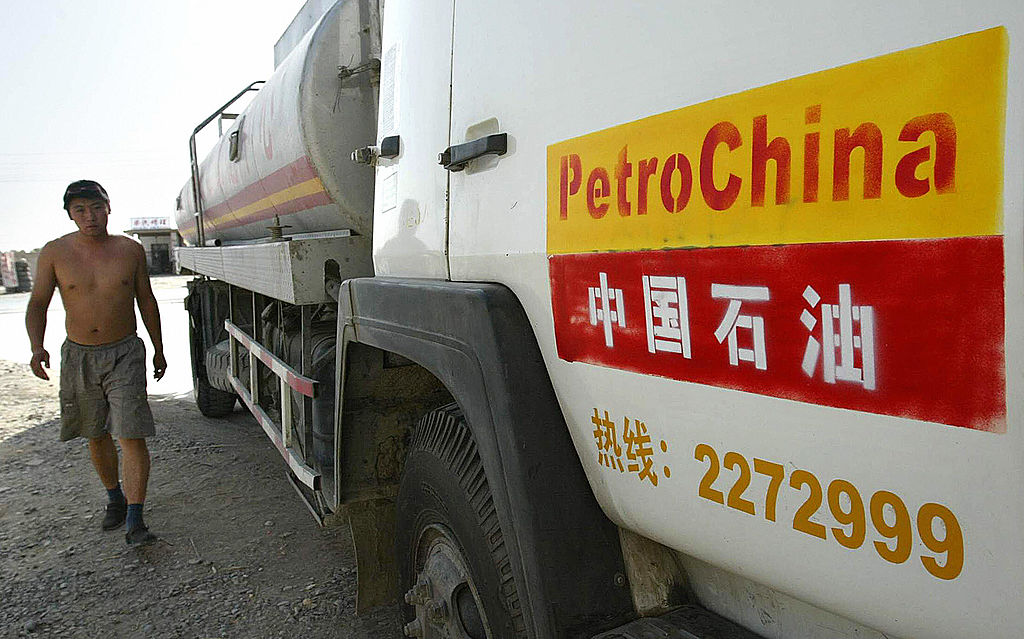
Analysts told The Epoch Times that the Chinese regime is ripping off Chinese people through its state-owned oil enterprises under the pretext of international oil prices jumping because of the Iran war.
China’s National Development and Reform Commission announced on March 23 that, effective from midnight on March 23, the maximum domestic retail prices for standard-grade gasoline and diesel were to be raised by 2,205 yuan (about $320) per metric ton and 2,120 yuan per metric ton, respectively, but following regulatory adjustments, the actual increases amount to 1,160 yuan per metric ton and 1,115 yuan per metric ton.
This oil price hike is the fifth increase so far this year. Despite official government intervention, it’s the largest price surge to date, surpassing the significant increase on March 9, for which the Chinese regime cited the Iran war pushing up international oil prices as a reason.
According to mainland Chinese media reports, private car owners will have to pay an additional 86.5 yuan to fill a 50-liter tank with 92-octane gasoline.
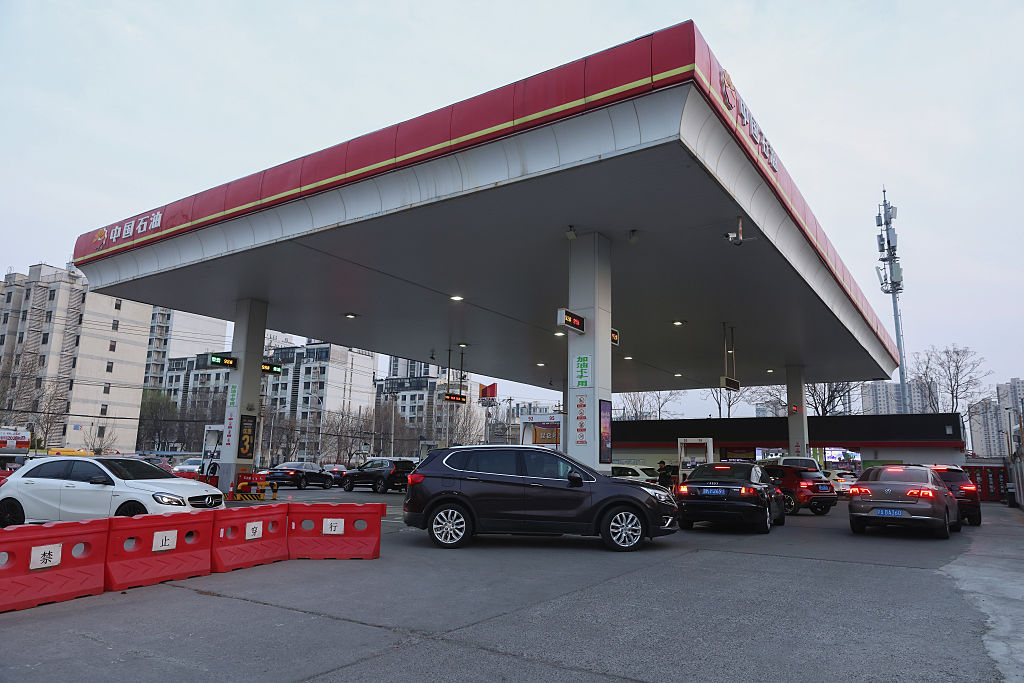
After drivers received advance notice of the price increase from Sinopec, the state-owned China Petroleum and Chemical Corporation, on the evening of March 22, the line of vehicles waiting to refuel at a Sinopec gas station in the Chongwenmen area in central Beijing, stretched for more than 100 meters (about 328 feet).
The same scene appeared around the country, including in Shenzhen and Jiangsu. Some gas stations posted notices that both 92-octane and 95-octane gasoline had sold out, according to Chinese media reports and posts on social media.
Soon after the air strikes on Iran began, the Iranian regime started firing at cargo ships and oil tankers passing through the Strait of Hormuz, blocking the key waterway. However, the Iranian regime announced that it would allow Chinese vessels, along with vessels from a few “friendly” countries, to pass through.
China buys more than 80 percent of Iran’s shipped oil, according to public data for 2025. It has purchased on average 1.38 million barrels per day, representing about 13.4 percent of the total oil that it imported by sea. Chinese refiners have purchased sanctioned Iranian oil at discounted prices, saving about $8 to $10 per barrel.
While Iran has targeted commercial vessels and oil tankers belonging to Western nations at the Strait of Hormuz, Chinese oil tankers have continued their shipments uninterrupted, Davy J. Wong, a U.S.-based independent economist, told The Epoch Times.
Monopolistic Price Hikes by State-Owned Enterprises
China’s current oil supply is neither deficient nor disrupted, Wong said.
“It is simply that the state-owned monopolistic enterprises—such as Sinopec and CNOOC—are capitalizing on the surge in international oil prices to preemptively hike their own rates,” he said of the price increase in China. “In other words, they are engaging in monopolistic price gouging. This does not reflect an actual shortage of fuel or oil within China’s domestic market.”
In critical areas such as the oil industry sector, the regime uses central state-owned enterprises to maintain a monopoly, Wang He, a U.S.-based China observer, told The Epoch Times, “thereby establishing them as a material foundation for the CCP’s rule.”
It lacks competitiveness, and this results in operational inefficiency and necessitates state subsidies, Wang He said.
“Consequently, the oil prices—which are determined based on their production costs and operating expenses—simply cannot compete with those of the international market,” he said.
The entire oil price regulation mechanism of the Chinese Communist Party (CCP) is built upon this very foundation–“the inefficient operation of state-owned enterprises,” Wang He stated.
Although this time the CCP’s regulatory mechanism slashed the price increase by almost 50 percent, Wang He said “the very foundation of this mechanism is false.”
Currently, deflationary pressures in China far outweigh inflation, Wong said. So the oil price increase this time is not caused by inflation, but “is primarily due to state-owned monopolistic oil enterprises, which—capitalizing on international oil price fluctuations—have turned the situation into yet another round of ripping off the Chinese people,” he said.
“It happens this way every single time: When international oil prices rise, they hike their domestic prices even faster; yet when global prices fall, they refuse to follow suit—the oil prices in China seem to be perpetually on the path of price increases,” Wong said.
A doctor of law in Beijing, who gave only his last name, Wang, because of fear of reprisal, shared the same observation, that the overall trend of oil prices in China has been consistently upward—and the increase has been quite pronounced.
“The magnitude of the increase is far greater than that of international oil prices, and the pace of the rise is far faster than that of oil prices in developed countries,” he told The Epoch Times.
Wang said he has been driving in Beijing for a long time.
“If you drive a gas-powered car every day for a regular commute, the fuel roughly costs a little over 1,000 yuan (about $145) per month,” he said.
He said that stabilizing or even decreasing the oil prices are the fundamental means of addressing the high cost of having gasoline-powered vehicles in China.
Wang offered another reason for the high price of fuel in China: the unusually high salaries of the state-owned enterprises that hired a large number of employees. Such entities always report deficits.
“The management at state-owned enterprises faces very little operational pressure due to monopoly. There is simply no justification for paying them such astronomically high salaries,” he said. “Their middle-tier and even entry-level employees also have surprisingly high wages.”
These enterprises must cut their salaries, Wang said, and oil prices will naturally follow suit and decline accordingly.
The CCP’s Way of Generating Revenue Amid a Sluggish Economy
In recent years, amid China’s ongoing sluggish economy, local government finances are facing severe difficulties, including mounting government debt, according to Wang He, the China observer.
“The CCP has resorted to a devious tactic: They are raising the prices of essential utilities—such as oil, electricity, and water—thereby indirectly subsidizing their fiscal deficits through these price hikes,” he said.
Oil prices in China are under the control of state-owned enterprises, which local governments cannot control, Wang He said.
“With the economy failing to gain traction and tax revenues falling short, the CCP has found this new way of generating non-tax revenues,” he said.
The state-controlled price hike amounts to a de facto deprivation of everyday people’s resources, “plunging many citizens into hardship regarding this essential aspect of their livelihood,” Wang He said. Against the backdrop of overall deflation in China, raising oil prices is particularly vexing for the general public, he said.
Wang He predicted that if the oil price increase persists over the medium- to long term, “it will have a significant impact on the Chinese economy.”
“Therefore, we will have to wait and see how events unfold,” he said.
Luo Ya and Reuters contributed to this report.
 Friends Read Free
Copy
Facebook
Tweet
Friends Read Free
Copy
Facebook
Tweet