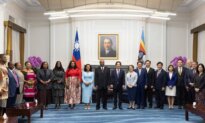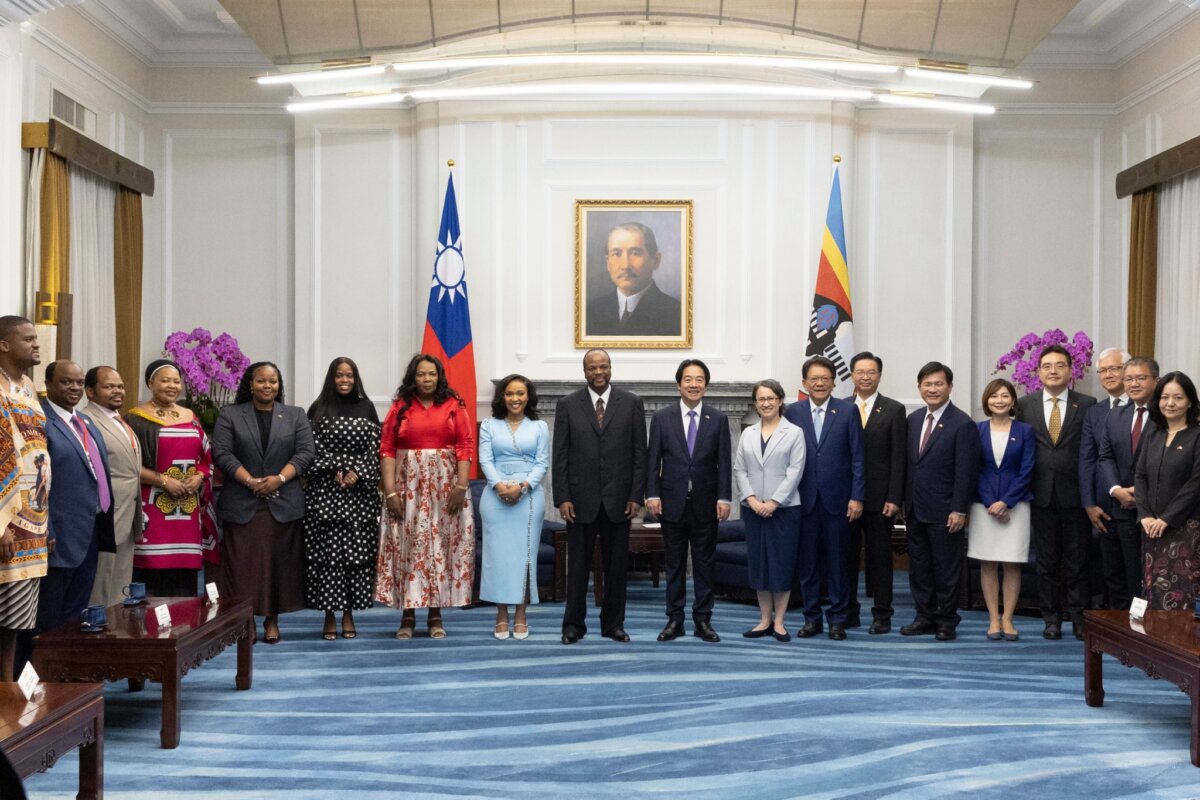
Eswatini’s King Mswati III reaffirmed his country’s 58-year diplomatic relationship with Taiwan on Oct. 9, pledging continued support for Taiwan’s international participation during a state visit ahead of Taiwan’s National Day.
Mswati, whose southern African kingdom is Taiwan’s only formal diplomatic ally on the continent, told President Lai Ching-te that he had looked forward to returning to Taiwan to express his country’s firm support. The king said true friends stand by one another through good times and bad, and described Taiwan as his second home.
The trip is Mswati’s 20th visit to Taiwan since he was crowned in 1986. Taiwan’s Foreign Ministry said the visit is scheduled to continue through Oct. 17, with the king attending National Day celebrations on Oct. 10.
Eswatini is one of Taiwan’s 12 remaining formal diplomatic allies and the only African country that maintains diplomatic relations with Taipei. Although the Chinese Communist Party has never governed Taiwan, Beijing has sought for years to reduce Taiwan’s diplomatic partners and claims sovereignty over the self-governed island.
Visit Follows Disrupted Lai Trip
Lai had originally planned to attend celebrations in Eswatini in April marking the 40th anniversary of Mswati’s accession to the throne.
Taiwan’s Foreign Ministry said Seychelles, Mauritius, and Madagascar unexpectedly withdrew permission for Lai’s chartered aircraft to cross their airspace. Taipei accused Beijing of orchestrating the disruption through political and economic pressure, forcing Lai to postpone the trip.
Seychelles and Madagascar cited their diplomatic positions on China in explaining their decisions, according to the Taiwanese ministry.
Beijing did not directly address Taiwan’s accusation of pressure in its April 22 response. China’s Foreign Ministry instead praised the African countries for adhering to Beijing’s position on Taiwan.
Lai eventually traveled to Eswatini on May 2 after the kingdom sent an aircraft to Taiwan to transport him. During that visit, the two governments signed a customs mutual-assistance agreement and a joint communiqué reaffirming diplomatic ties.
Eswatini Backs Taiwan’s International Participation
Mswati has repeatedly advocated for Taiwan at the United Nations, where Taipei has been excluded from membership since 1971.
At the U.N. General Assembly in September, the king described Taiwan as playing a vital role in global supply chains and urged the international body to accommodate its participation.
“The United Nations should seek appropriate ways to facilitate Taiwan’s substantive participation in UN meetings and activities,” Mswati said.
Lai also thanked Mswati for calling last year for the international community to correctly interpret U.N. General Assembly Resolution 2758. The 1971 resolution transferred China’s U.N. representation from the Republic of China to the People’s Republic of China. Beijing invokes the resolution to support its claim that Taiwan is part of China, while Taipei maintains that it does not determine Taiwan’s sovereignty or address the representation of Taiwan’s people.
Beyond diplomatic support, Lai said Taiwan wants more Taiwanese companies to invest in Eswatini, including through the Taiwan Industrial Innovation Park, which he described as a potential gateway to African markets.
Mswati said members of his delegation would participate in international business exchange events in Taiwan during the visit. He expressed hope that the two countries would expand bilateral trade and develop closer partnerships between their businesses.
During the Oct. 9 meeting, Lai and Mswati witnessed the signing of an agreement on mutual legal assistance in criminal matters by Taiwan’s Justice Minister Cheng Ming-chien and Eswatini’s Minister of Justice and Constitutional Affairs, Prince Simelane.
Taiwan’s Justice Ministry said the agreement would support investigations into cross-border telecommunications fraud, money laundering, and organized crime.
 Friends Read Free
Copy
Facebook
Tweet
Friends Read Free
Copy
Facebook
Tweet