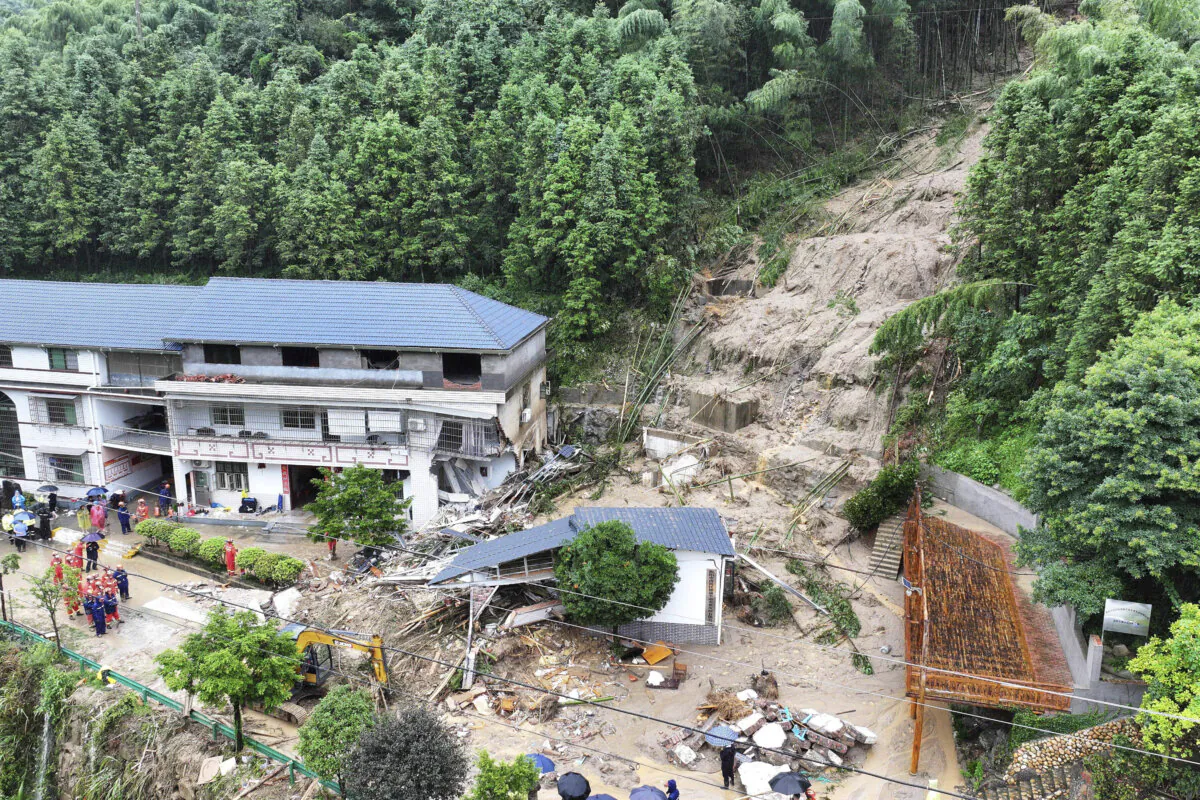

Shimen County, under Changde, Hunan Province, China, has been hit by extreme rainfall since May 17. State-run news agencies reported that the death toll had risen to six by 8 a.m. on May 21, with 10 others still missing. More than 100,000 residents were affected.
Some residents said the losses appeared far greater and that some villages were left cut off without power, water, or communications.
The disaster struck as heavy rain swept across central and southern China, affecting Hunan, Hubei, Guangxi, Guangdong, Jiangxi, Anhui, Guizhou, and Hainan provinces.
Record Rainfall Hits Mountain Area
The rainfall in Shimen reached historic levels. From May 17 to May 18, the county recorded 339.2 millimeters (about 13.3 inches) of rain in 24 hours, according to Chinese media reports. In Hupingshan, one of the hardest-hit areas, 244.5 millimeters (about 9.6 inches) fell in six hours overnight, according to state-run media outlet Xinhua.
The upper reaches of the Xieshui River rose sharply. Chinese news portal Sina stated that the Shuanghe hydrological station in Shimen recorded a surge of 8.76 meters (about 28 feet). Other source material said water levels at upstream stations rose by more than 12 meters (about 39 feet), breaking records since those stations were established.
Xinhua reported damaged bridges, collapsed roads, destroyed houses, fallen power poles, overturned vehicles, as well as villages trapped by blocked roads, power outages, and communication failures.
Residents Say Villages Were Swept Away
Residents said the actual devastation far exceeds official numbers. A Shimen resident, using the pseudonym Chen Li out of fear of retaliation, told the Chinese edition of The Epoch Times that many individuals had lost contact or had passed away and that the death toll was “definitely” higher than reported. Chen said that entire villages were flooded, and some residents were swept away by the floodwaters.
Chen said several villages were left without water, electricity, lighting, or phone service, making it difficult for residents to seek help or contact relatives. Roads to some villages had collapsed or been blocked by landslides, preventing rescue vehicles and supplies from reaching them, according to the resident.
A man who only provided the name Wang out of fear of reprisal and had been working in Guangdong Province rushed back to his family’s home in Nanbei town’s Jinhe village after floodwaters and mudslides struck. He told state-run Red Star News that his 78-year-old mother, 83-year-old father, and 80-year-old uncle were swept away. He said he later identified his mother’s body in a neighboring township, while the other two remained missing.
Other residents described how quickly the water rose. A shop owner near Xieshui Bridge told Jimu News, the digital media arm of state-run Hubei Daily, that the water rose to chest level in about 10 minutes while she was in a basement storage area, forcing her to abandon her goods and flee.
Another shop owner told the media outlet that she and her husband fled to higher ground after the water rapidly rose to the first-floor ceiling of their store.
Disaster Drew Complaints Over Low Visibility Online
The flooding also fueled public frustration over how little visibility the disaster received on domestic social media.
A now-deleted Shanghai Observer article published on May 19 carried the headline, “Hunan mountain village floodwaters surged 8.76 meters; migrant workers across the internet urgently appeal: This is not trending online; Some elderly people are still missing.”
The original Shanghai Observer article page now states, “The article does not exist or has been taken offline.”
The article described Xu Yanni, a native of Hupingshan working in Changsha, who kept checking her phone from early May 18, gathering news from group chats and scattered messages: Roads were blocked, signals were intermittent, and villagers were unaccounted for. It also noted her frustration that, despite the severity of the disaster in her hometown, it never appeared in top headlines or search results.
The disaster’s limited online presence reflects a broader trend of information control in China under the ruling Chinese Communist Party, in which topics deemed politically sensitive or likely to cause embarrassment are frequently censored, deamplified, or redirected. The U.S. State Department has described Beijing’s “information manipulation” as spanning propaganda, disinformation, and censorship. Freedom House stated in its 2025 internet-freedom report that Chinese authorities “wield immense power to censor and manipulate online content.”
Questions Over Warnings, Water Release
Residents also questioned whether local authorities moved people out of harm’s way in time.
Chen told The Epoch Times that heavy rain began on May 17 and reached historic levels on May 18, arguing that officials had time to evacuate residents from vulnerable areas.
Chen also said locals suspected that flood-control management at Zhangjiadu Hydropower Station may have worsened flooding downstream. The resident alleged that water was not released early enough and was later discharged suddenly, contributing to flooding in Suojie township.
Residents also pointed to broader preparedness concerns, including homes built into cut slopes, insufficient early-warning equipment, poor river dredging, and inadequate pre-flood hazard inspections.
Rescue Work Hampered by Washed-Out Roads
Rescue teams faced washed-out roads, landslides, rockfalls, and mudslides. In one case described in Chinese media reports, rescuers took nearly eight hours to reach an area just 2.7 kilometers (1.7 miles) away in a straight line because mountain routes were blocked.
The same access problems were central to residents’ concerns. Chen told The Epoch Times that some cut-off mountain villages lacked emergency supplies, drinking water, electricity, and phone service, leaving residents with no reliable way to call for help.
More Rain Raises New Risks
The Shimen floods occurred amid a broader regional heavy rainfall event across central China. Chinese weather reports state that heavy rainfall from May 15 to May 20 affected 14 provincial-level regions, and that several areas broke historical rainfall records.
Forecasters warn that additional rain could hit northern Hunan and nearby regions from May 23 to May 27, overlapping with areas already saturated by earlier storms.
 Friends Read Free
Copy
Facebook
Tweet
Friends Read Free
Copy
Facebook
Tweet