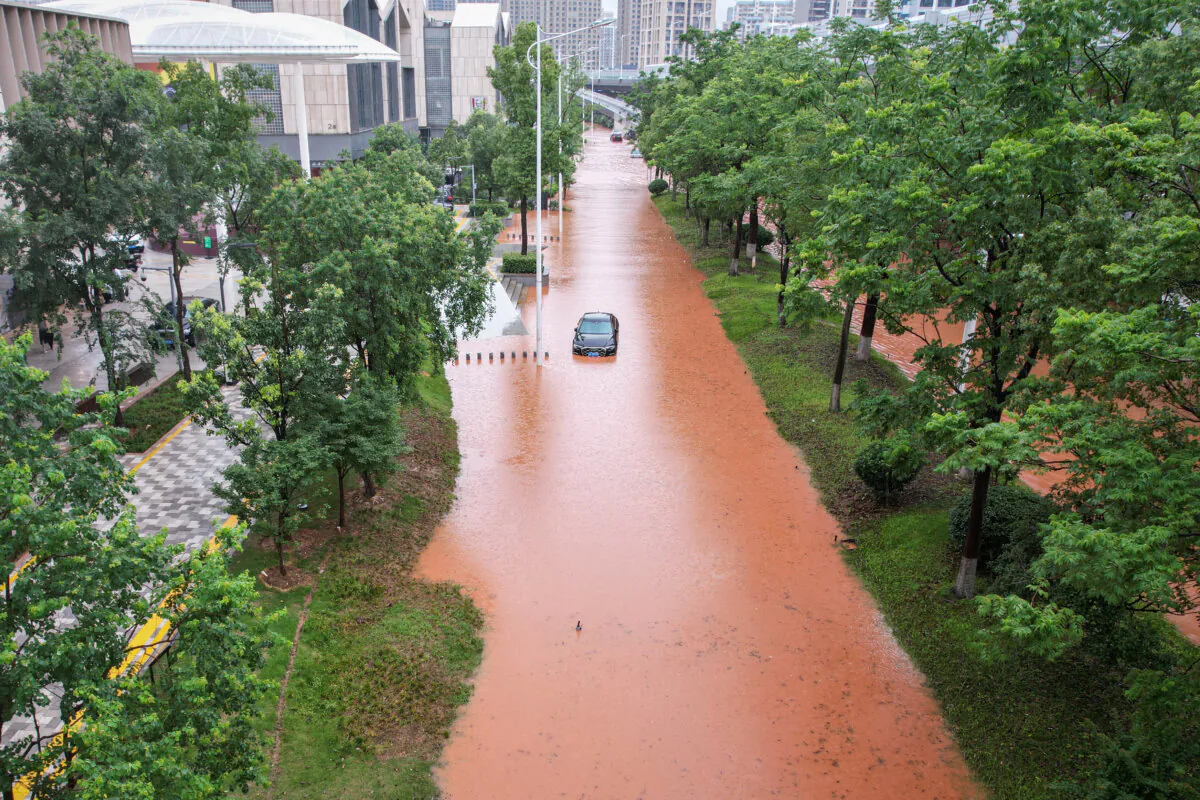

Heavy rain battered several provinces in central and southern China over the weekend, submerging streets, disrupting transportation, forcing emergency transfers, and prompting residents to question local drainage systems and public information about reservoir releases.
The storms hit as China’s central weather authorities warned that a large-scale rain system was continuing across southern China. State media outlet Xinhua reported that from 8 a.m. on May 17 to 8 a.m. on May 18, 628 weather stations nationwide recorded heavy rainstorms, while 40 stations recorded extreme rainstorms. Central Meteorological Observatory officials said parts of Shandong, Anhui, Hubei, Hunan, Guizhou, Guangxi, and Guangdong provinces were expected to see heavy rain from late May 18 through May 19.
Jingzhou Shuts Down
Local media outlet Hubei Daily reported that Jingzhou, a city in Hubei Province, activated an emergency response for urban flooding on May 18 and ordered the central urban area to impose what local authorities called the “Five Stops”—suspending work, production, business operations, transportation, and classes.
Xinhua reported that the latest round of heavy rain had killed three people in Hubei Province by late May 18, all in Baishuihe village in Xuan’en County, Enshi Prefecture, where flash flooding caused a river to overflow into low-lying areas.
From the afternoon of May 16 to 1 p.m. on May 18, 337 townships across 46 Hubei counties, cities, and districts recorded more than 100 millimeters (about 4 inches) of rain, with 27 townships exceeding 300 millimeters (nearly 12 inches), and a maximum of 507 millimeters (about 20 inches) in Wuli township, Hefeng County.
Drainage Problems
While official accounts emphasized record rainfall and emergency deployments, residents posting video footage online focused on repeated urban flooding.
Video footage and comments circulating on Chinese social media show flooded roads, submerged vehicles, residents wading through water, and people joking that visitors could come to Jingzhou, an inland city, to “see the sea.”
The latest flooding came after several years of official statements promoting drainage and flood-control upgrades in Jingzhou.
In 2021, a China Radio International (CRI) report stated that Jingzhou authorities had inspected and maintained rainwater pump stations, dredged drainage networks at flood-prone points, and prepared emergency pumping equipment aimed at preventing roads from flooding during the rains.
In 2022, Hubei Daily reported that Jingzhou had been selected as a provincial “sponge city” pilot. The report stated that the city planned to invest 4.82 billion yuan (about $709 million) over three years in 29 sponge-city projects and aimed by 2024 to ensure timely drainage in older urban areas and prevent “urban sea-watching” in newer districts.
A 2025 Jingzhou Daily article presented the city’s flood-control history in celebratory political language. It described decades of flood-control work along the Jingjiang section of the Yangtze River, including dike reinforcement, digital reporting tools, and shoreline management.
The 2026 flooding renewed public scrutiny of those earlier celebratory accounts. Residents’ online complaints did not dispute that Jingzhou had seen extreme rainfall. Their questions focused on whether years of drainage work, monitoring systems, flood-control projects, and official claims of improved resilience had produced enough visible protection when severe weather arrived.
Hunan Evacuates Thousands
In Hunan Province, flash floods struck Shimen County in Changde after what state media outlet China News Service described as a historically rare extreme rainstorm. Reports citing Hunan meteorological data state that Shimen County recorded 363.5 millimeters, or about 14.3 inches, from 7 a.m. on May 17 to 7 a.m. on May 18.
The disaster killed one person and left two others missing, while authorities transferred and resettled 18,406 residents, according to the state media outlet.
Reservoir Questions
In Jiangxi Province, heavy rain hit Ganzhou and nearby areas beginning on the night of May 15, with Shangyou County among the hardest-hit places. Chinese state media and reports state that heavy rain flooded low-lying areas, submerged roads and vehicles, and triggered landslides that affected traffic.
Residents, who requested anonymity out of fear of reprisal, also raised questions about reservoir releases. A teacher in Shangyou County told The Epoch Times that her school and a nearby public square were flooded, with water reaching about 2.3 meters, or roughly 7.5 feet, deep. A local source familiar with the situation told The Epoch Times that a reservoir in Shangyou County may have failed, potentially worsening the flooding, but the source did not provide further details.
Guangxi Earthquake
A separate disaster added to the pressure on local emergency systems. According to the China National Earthquake Data Center, a magnitude 5.2 earthquake struck Liuzhou in Guangxi shortly after midnight on May 18, prompting emergency inspections of buildings, roads, bridges, mines, utilities, and geological hazard sites. Xinhua reported two people dead and one missing.
The quake-hit region also faced more rain. China Weather reported that from May 18 to May 20, Guangxi would see frequent rainfall along with strong convective weather. The forecast warned that continued rainfall would increase the risk of flash floods, small and medium river floods, urban and rural waterlogging, landslides, and mudslides.
 Friends Read Free
Copy
Facebook
Tweet
Friends Read Free
Copy
Facebook
Tweet