
News Analysis
The phenomenon of “involution,” or “nei juan”—a Chinese buzzword meaning “inward curl” that describes intense competition to survive ongoing socioeconomic woes in mainland China—has rapidly rippled over Hong Kong.
This trend is profoundly disrupting the local economic structure and industrial dynamics through multiple channels, including soaring real estate debt, a growing talent mismatch, and an accelerating shift in consumption patterns.
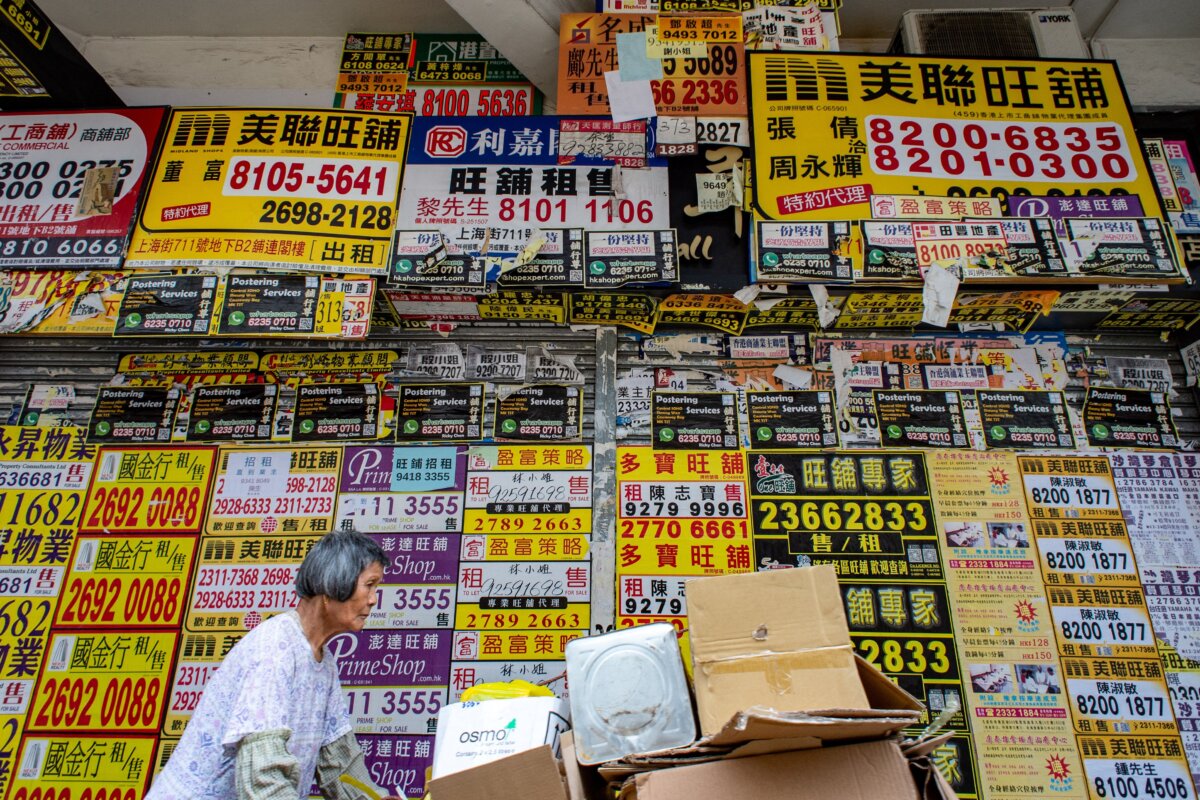
While private homes maintain a low vacancy rate, office towers and retail spaces face a deepening crisis. High-value properties are caught in a massive deleveraging wave among developers and investors, compounded by transformations in grassroots labor and consumption behaviors. These complex challenges are adversely affecting demand and pricing power in the high-end property market.
New World’s Refinancing Plan
A striking case is New World Development, a leading Hong Kong real estate firm that is wrestling with a net debt of approximately HKD 124.6 billion ($16 billion).
New World Development has a soaring net debt ratio of 57.5 percent and losses of nearly HKD 7 billion ($890 million). With only HKD 21.9 billion ($2.8 billion) in cash and bank deposits available, the company has faced immense pressure to repay its short-term debt.
New World’s debt woes exceed many of its peers. As of Dec. 31, 2024, based on corporate annual reports, CK Hutchison Holdings reported a net debt ratio of 16.4 percent, while Sun Hung Kai Properties stood at 17.8 percent.
On May 30, New World Development announced a delay in dividend payments for its Series A and B U.S. dollar perpetual capital securities, warning that payments for Series C and D might also be deferred. On June 6, the company confirmed the deferral of Series C and D dividend payments to the next distribution date, signaling intensified cash flow management pressures.
According to a Bloomberg report, New World Development is expected to finalize a HKD 87.5 billion ($11 billion) refinancing plan by the end of June, one of the largest ever in Hong Kong’s history.
Cash collection difficulties, financing constraints, and ongoing property sell-offs by tycoons have significantly weakened the company’s ability to service debt through operational performance and asset disposals, reported Bloomberg.
Long deemed as one of Hong Kong’s four major property developers, New World Development has, in terms of market capitalization, fallen out of that top tier.
Price Involution of Large Properties
The Centa-City Leading Index, a weekly measurement of private residential property prices in Hong Kong, currently stands at 135.57 points, reflecting a sharp decline of nearly 30 percent from its peak of 191.34 in August 2021.
According to the Hong Kong Property Report, published by the Rating and Valuation Department in April, the vacancy rate for private residential properties remains low at 4.5 percent, consistent with the 20-year average. However, office and commercial spaces saw steeper rates of 16.3 percent and 11.8 percent.
When developers or investors scramble to sell properties to settle debts, high-value retail shops and office spaces—already burdened by elevated vacancy rates—struggle to command premium prices. This leads to distressed sales at steep discounts, fueling the phenomenon of property price involution, where premium assets are sold below market value due to oversupply and declining demand.
The wave of property disposals by seasoned investors has already been underway. In April, veteran investor Jacinto Tong Man-Leung sold his self-occupied penthouse at Hong Kong Parkview for HKD 138 million ($17.6 million), according to Bloomberg.
Hong Kong newspaper Ming Pao reported this month that Gale Well Group, where Tong serves as CEO, has listed Jade Beach Villa, a large luxury mansion plot spanning over 100,000 square feet, at a price of approximately HKD 1.5 billion ($190 million), down from HKD 2 billion ($255 million) in February.
In May, a luxury residence where prominent entrepreneur Chan Ping Chi had resided for decades, was repossessed by the bank and listed for sale at HKD 430 million ($55 million), reported Bloomberg.
Surge in Highly Educated Professionals Taking Low-Skill Jobs
A recent study by the New Century Forum found that the number of university-educated workers in low-skill jobs has reached an all-time high, increasing from 66,200 in 2003 to 194,000 in 2023—nearly tripling over two decades.
This surge is expected to intensify with a Hong Kong immigration initiative launched in 2022, designed to attract skilled professionals from Mainland China and beyond. The influx of external talent is raising the employment threshold, pushing more local graduates into lower-skill roles, and exacerbating involution in the labor market.
The program has gained significant traction. According to a Labour and Welfare Bureau survey, by the end of 2024, approximately 116,000 applications were received, with nearly 92,000 approved. Over half of these approved applicants have secured employment, primarily in management and professional roles, earning a median monthly income of HKD 50,000 ($6,400).
Hong Kong’s total employment is 3.7 million, down from 3.8 million in 2019.
Given the continued influx of talent, the trend towards involution is likely to persist, adding further strain to the job market.
Consumer Spending Shifts Toward Mainland China
The growing displacement of skilled talent into lower-wage roles is reshaping consumption patterns in Hong Kong.
At the recent shareholder meeting of Hong Kong and China Gas, executive director Wong Wai-yee said, “We hope the SAR government will encourage Hong Kong residents to stay local or attract more mainland visitors to dine and shop in Hong Kong.”
Even at home, Hong Kong residents are turning to Taobao, a Chinese e-commerce platform headquartered in Hangzhou in eastern China, signaling a shift in consumption towards the mainland.
Earlier this year, JD.com, a Beijing-based online retailer, entered the Hong Kong market, offering services like free shipping on single items and “price match guarantees,” with same-city delivery within four hours. As mainland platforms leverage logistics and price wars to capture the local market, the geographical boundaries of Hong Kong’s consumption are blurring, putting long-term pressure on local retail and office property values.
Local leader Hong Kong Technology Venture, whose flagship e-commerce platform is HKTVmall, is fighting for survival. According to its 2024 annual report, the platform boasts 1.6 million monthly active users. However, it faces fierce competition from subsidized mainland platforms, which enjoy technological advantages. In response, HKTVmall has introduced 8-hour delivery services and even offers fresh produce deliveries within just three hours.
The growing trend of northward consumption, coupled with fierce competition in rapid delivery services, is intensifying downward pressure on local retail values. This is not limited to traditional retail—industries such as design and IT are undergoing a process of involution as products become increasingly similar.
Amid these challenges, Hong Kong is grappling with a triple structural dilemma: declining liquidity in high-end assets, a mismatch in mid-tier talent, and the outflow of grassroots consumption. As a result, the city appears to be entering a new economic phase marked by involution.
 Friends Read Free
Copy
Facebook
Tweet
Friends Read Free
Copy
Facebook
Tweet