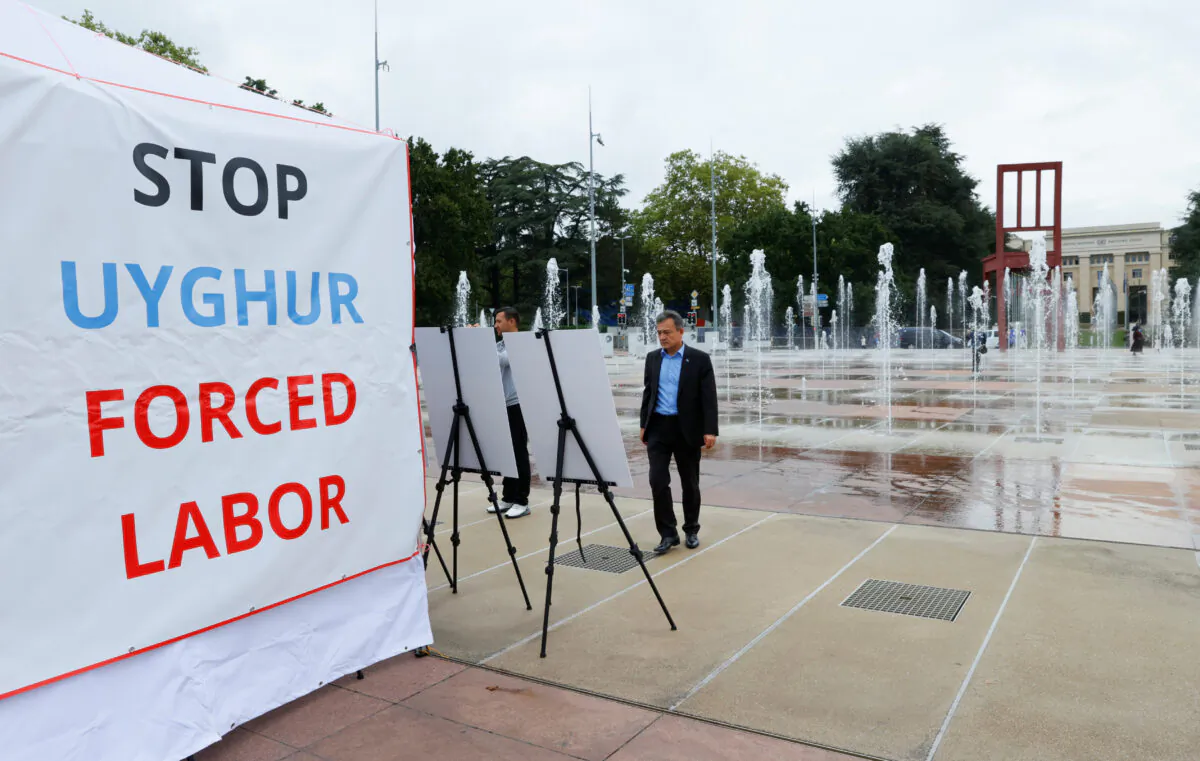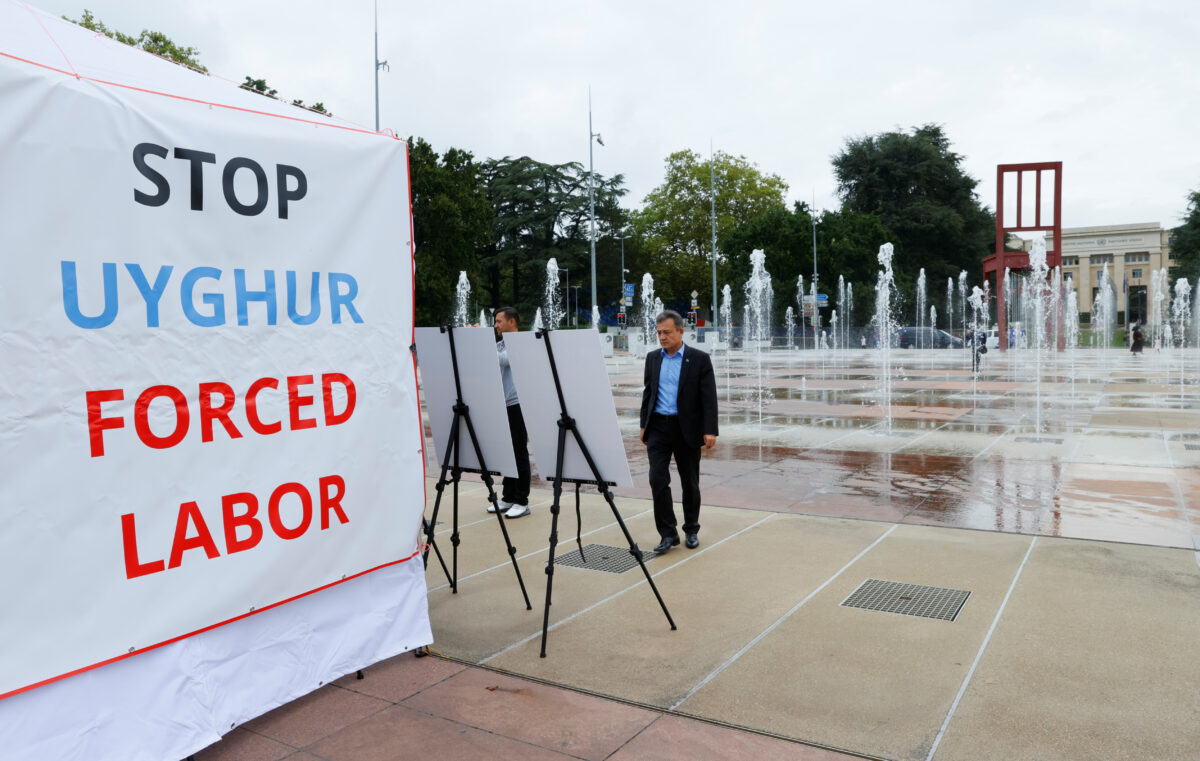

A bipartisan group of lawmakers wants to know whether enforcement is keeping pace after the Department of Homeland Security last month added 43 companies to its forced-labor Entity List—the largest single expansion since the list was created.
Their Sept. 3 letter welcomed the expansion but cited reports of “substantially declining detention activity” in some high-risk sectors, continued imports through transshipment hubs, and what the lawmakers described as “hundreds more Entity List packages” remaining in the approval pipeline.
Reps. John Moolenaar (R-Mich.) and Chris Smith (R-N.J.) led the request for a DHS briefing within 30 days. It was also signed by Reps. Ro Khanna (D-Calif.), Jim McGovern (D-Mass.), Bennie Thompson (D-Miss.), Carlos Gimenez (R-Fla.), Young Kim (R-Calif.), and Sen. Jeff Merkley (D-Ore.).
The lawmakers want DHS to explain what it is stopping at the border, what is being released, how quickly companies are being added to the Uyghur Forced Labor Prevention Act Entity List, and how the government is tracing Chinese inputs that move through other countries before reaching the United States.
“Strong enforcement protects human rights, supports American workers, and helps ensure that U.S. businesses are not undercut by illegal and unfair trade practices,” they wrote.
A Wider Range of Products
The Uyghur Forced Labor Prevention Act, or UFLPA, took effect in 2022. It creates a rebuttable presumption that goods made wholly or partly in Xinjiang, or by entities on the UFLPA Entity List, were made with forced labor and are barred from entering the United States unless the importer meets the law’s requirements.
DHS said in its 2025 UFLPA strategy update that U.S. Customs and Border Protection (CBP) had reviewed more than 16,700 shipments worth nearly $3.7 billion under the law and denied entry to more than 10,000.
The government has also widened the range of products receiving closer scrutiny. Its high-priority sectors include apparel and cotton, seafood, aluminum, polysilicon, and newer areas such as copper, lithium, and steel.
The Aug. 3 Entity List expansion brought the total to 187 entities and reached industries ranging from textiles and food to pharmaceuticals, aluminum, copper, lithium, and battery materials.
One addition, Xinjiang Tianyun Organic Agriculture Co., produces fish, including salmon. The Forced Labor Enforcement Task Force said it had reasonable cause to believe Tianyun participates in government-sponsored recruitment and labor-transfer programs involving Uyghurs, Kazakhs, or Kyrgyz people. DHS also listed the company under a separate UFLPA category covering entities that source materials from Xinjiang or government-linked labor programs.
The lawmakers specifically asked DHS how it is handling forced-labor exposure in seafood supply chains, including abuses aboard fishing vessels, transshipment, and coordination with other federal agencies.
Labubu Brings the Issue to Consumer Goods
The congressional letter also points to consumer products, including Labubu toys made by Beijing-based Pop Mart.
In May, advocacy groups State Armor and the Victims of Communism Memorial Foundation asked DHS and CBP to investigate after isotopic testing of 20 Labubu products purchased in the United States found that cotton in 16 was traceable to Xinjiang, according to their letter.
The groups asked CBP to detain and test related shipments and urged the Forced Labor Enforcement Task Force to consider adding Pop Mart and associated entities to the UFLPA Entity List. Their letter said the testing was conducted by Oritain, which uses chemical signatures to assess geographic origin.
That finding concerns where the cotton came from. A separate labor investigation has focused on Jiangxi Shunjia Toys Co., a major manufacturer of Labubu products for Pop Mart.
 Labubu toys on display inside a Pop Mart store in San Jose, Calif., on June 6, 2025. (Conner Lee/The Epoch Times)
Li Qiang, founder and executive director of China Labor Watch, told The Epoch Times on Sept. 4 that the organization’s concerns go beyond ordinary violations of Chinese labor law.
“Our investigation identified indicators that we believe are relevant to a forced-labor assessment, including the withholding of workers’ wages, elements of involuntary work, and exploitation of workers’ vulnerabilities,” Li said.
Li said China Labor Watch has submitted additional evidence to CBP that has not been made public while the matter remains under review.
“The central concern is whether particular employment practices restrict workers’ genuine ability to leave or refuse work, rather than simply whether the factory violated Chinese labor law,” Li told The Epoch Times.
Li said firsthand worker testimony is particularly important in forced-labor investigations but generally needs to be corroborated through interviews with other workers, employment and payment records, recruitment information, company and supply-chain records, photographs, and other documentation.
“The key issue is not simply demonstrating serious labor-law violations, but establishing evidence of coercion or other indicators relevant to forced labor,” he said.
CBP has not publicly announced a Labubu-specific enforcement action.
Questions Over Enforcement
The lawmakers asked DHS for shipment outcomes broken down by sector and country, staffing levels devoted to UFLPA enforcement, the evidence importers must provide to overcome the law’s presumption, and information on newer supply chains such as silicon-carbon battery anodes and critical minerals.
They also want to know how DHS is using artificial intelligence to check shipment country of origin and supply chain documentation, and how the department is working with foreign governments to reduce transshipment and strengthen forced labor import restrictions.
Under DHS’s public process, any member agency of the Forced Labor Enforcement Task Force may recommend an entity for addition to the UFLPA Entity List. Member agencies review the recommendation, and additions are decided by majority vote.
CBP acknowledged questions from The Epoch Times about shipment releases, sector-specific enforcement trends and the difficulty of tracing Chinese upstream inputs through third countries, but said it needed more time to research the questions.
DHS had not responded by publication.
The lawmakers asked DHS to provide the briefing by Oct. 3.
 Friends Read Free
Copy
Facebook
Tweet
Friends Read Free
Copy
Facebook
Tweet