
German Chancellor Friedrich Merz urged the European Union to strengthen its trade defenses against countries that distort competition, putting trade policy on the agenda days before EU leaders meet in Brussels amid mounting Chinese pressure on Europe’s industrial base.
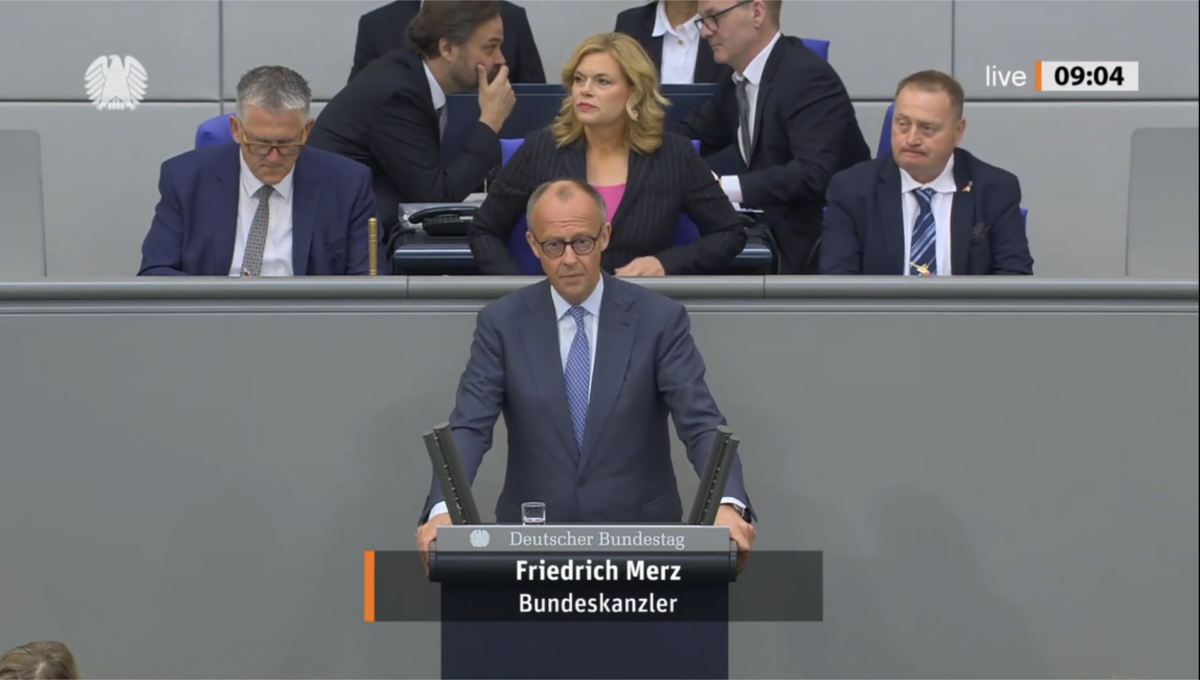
Merz did not name China in his June 11 government statement before the Bundestag, but he said EU leaders meeting on June 18–19 would discuss how to expand the bloc’s trade-policy “toolbox” when other countries fail to follow common rules.
“Where others do not comply with common rules, we cannot and will not stand idly by,” Merz said. “We protect our interests and our economy against trade-distorting practices of other states.”
The remarks came as the EU’s goods deficit with China reached 98 billion euros (about $114 billion) in the first quarter of 2026, the highest level since the third quarter of 2022, according to Eurostat.
EU imports from China rose from 121 billion euros ($140 billion) in the first quarter of 2024 to 145 billion euros ($167 billion) in the first quarter of 2026, while EU exports to China fell over the same period.
The European Parliament said lawmakers are expected to debate the future of EU-China economic relations with Commission and Council representatives on June 17.
The Parliament’s agenda note said criticism of Beijing has grown over market-access asymmetry, export controls on critical raw materials and some technologies, and China’s distortive industrial policies.
For Germany, the issue cuts in two directions, according to the Centre for European Reform (CER), a London-based think tank. German companies still depend heavily on Chinese demand, but Chinese manufacturers are increasingly competing against German firms in cars, machinery, chemicals, electrical equipment, aircraft manufacturing, and clean-technology equipment.
A June policy brief by the CER said Germany is facing what it called “China shock 2.0.” The group said German exports to China have fallen by about one percentage point of GDP as Chinese firms replace foreign suppliers at home and expand abroad.
The report cited Jürgen Matthes of the German Economic Institute as saying that, at the peak of Germany’s China export boom in 2021, about 1.1 million German jobs depended directly or indirectly on final demand in China. Since then, German exports to China as a share of GDP have fallen by more than 40 percent.
Berlin’s Balancing Act
Merz’s speech stopped short of calling out Beijing directly.
He framed trade policy as part of a broader effort to make Europe more competitive, saying the EU benefits from open and fair trade and should continue expanding trade ties with other partners.
At the same time, he said Europe should use the size of its single market to enforce fair and transparent competition.
“We want stability and predictability for the long-term success of companies in Europe,” Merz said.
European Council President António Costa said in a June 11 invitation letter to members ahead of the June 18–19 meeting that leaders would discuss global macroeconomic imbalances and their implications for Europe’s competitiveness and prosperity, with the aim of providing guidance to the European Commission (EC).
The EC has been reviewing options for stronger responses to Chinese industrial overcapacity. Those tools could include tariffs, penalties on state-subsidized goods, restrictions in public procurement, and measures that go beyond product-by-product investigations.
The EU has already imposed duties on Chinese-made battery electric vehicles. The CER said the bloc’s current system remains too narrow and slow to respond to broader state-backed industrial pressure from China.
The EU’s trade-defense system includes anti-dumping and anti-subsidy duties, which the European Commission describes as tools to protect European production against international trade distortions.
Debt Line Remains
Merz paired his trade-defense message with a warning against new European borrowing.
At its upcoming meeting, the European Council is expected to discuss the EU’s long-term budget for 2028–2034, as well as Ukraine, the Middle East, global economic challenges, European defense and security, migration, illicit drugs, and economic policy coordination.
Merz said EU funds should be directed toward sovereignty, competitiveness, and defense. But he rejected new joint borrowing.
“New European debt is no solution,” he said.
That position keeps Germany closer to its traditional fiscal caution than to the more interventionist industrial policy often favored in Paris.
The CER said Germany should stop weakening EU instruments that it may need to defend its own industrial base, arguing that France has often pushed harder than Berlin for stronger protections.
 Friends Read Free
Copy
Facebook
Tweet
Friends Read Free
Copy
Facebook
Tweet