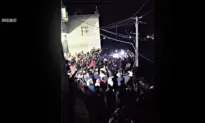
Thousands of residents in a county in China’s Yunnan Province have gathered in recent days to protest a government mandate requiring cremation, according to residents who spoke to The Epoch Times on condition of anonymity out of fear of reprisal.
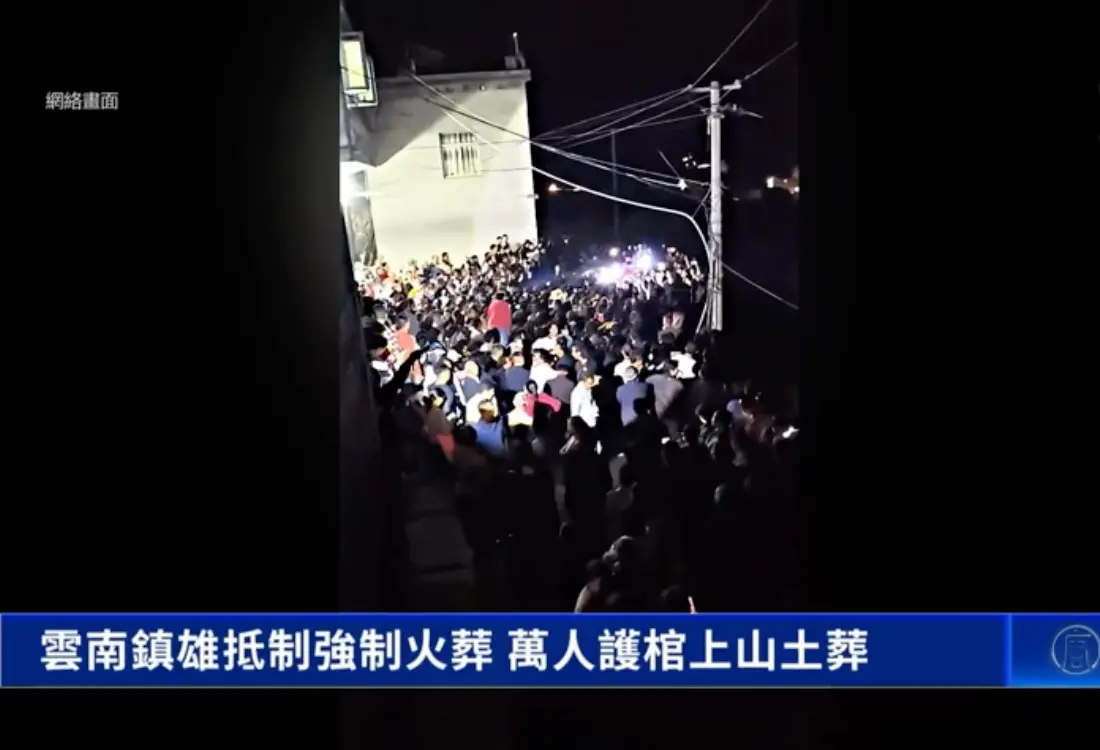
The latest protests took place on the night of Sept. 14 in Zhenxiong County, where residents from 14 townships gathered to escort the coffins of two elderly people to burial sites despite the presence of hundreds of police officers. One resident estimated that at least 20,000 people took part.
“We oppose cremation and insist on burial. Fourteen townships in Zhenxiong have united. Tonight, we sent off two elderly people from Jianshan and Anjiapo. There were at least 20,000 people, and many couldn’t get in or couldn’t move,” a Zhenxiong resident surnamed Wang told The Epoch Times.
Another resident, surnamed Chen, told The Epoch Times the local population considers burial an important tradition.
“Everyone says that the dead should be laid to rest in the earth and return to their roots,” he said.
Fear of Exhumation
Residents said hundreds of police officers were deployed to the area but did not intervene directly as the crowds escorted the coffins to burial sites. Some residents remained overnight to guard the graves, fearing authorities would later exhume the bodies and take them away for cremation.
“We have 200 or 300 villagers guarding the graves. We didn’t sleep all night,” a woman surnamed Zhang told The Epoch Times. “The government has gone too far. After we bury them, it wants to dig them up and cremate them.”
The confrontation follows a similar incident two days earlier involving a 16-year-old boy who died of leukemia, according to a report on Chinese news portal Sohu.
The boy, He Guoqiang, died on Sept. 6 after two years of treatment. His family had planned to bury him on Sept. 12.
Residents said they learned that local authorities planned to send about 200 people to prevent the burial and take the body for cremation. Thousands of people from surrounding villages and townships subsequently gathered to support the family.
On Sept. 12, a large crowd escorted He’s coffin up a mountain and successfully buried him. Residents said the size of the crowd made it difficult for authorities to intervene.
A resident who traveled to support the family told The Epoch Times that local authorities appeared to be using the 16-year-old boy’s burial as a test case to enforce the new policy and deter others from resisting. Residents have since organized around-the-clock watches at the grave, bringing tents and staying overnight to guard against possible attempts to exhume the body.
Residents also alleged that authorities in the county have previously exhumed bodies that had already been buried and taken the remains for cremation.
These allegations could not be independently verified by The Epoch Times.
The dispute has also spread across Chinese social media. Residents said livestreamers attempting to broadcast the confrontations had their accounts shut down.
For many residents of Zhenxiong, the dispute is not simply about burial costs but about longstanding funeral traditions. “Burial brings peace” and returning to one’s ancestral home are deeply rooted ideas in traditional Chinese culture, while cremation can conflict with traditional beliefs about preserving the body.
Long-Running Dispute Over Cremation
China has promoted cremation for decades, officially citing goals such as conserving land and changing traditional funeral practices. The regime issued the Regulations on Funeral and Interment Administration in 1997, while allowing local governments to designate areas where cremation was required and areas where burial reforms were implemented.
In mountainous Zhenxiong, however, traditional burial remained widespread for years because of difficult transportation, limited funeral infrastructure, and the lack of widespread access to crematoriums.
Residents have previously resisted cremation policies in the county. In January 2013, following a major landslide in Zhenxiong, local authorities required victims’ remains to be cremated, prompting protests, according to Chinese state media People’s Daily.
More recently, in November 2025, more than 1,000 villagers in the region confronted authorities attempting to take away a body, according to video footage posted on X by YesterdayBigcat, a well-known account among the Chinese diaspora and civil-rights circles that documents collective protest events in China.
Similar disputes have emerged elsewhere in China. In November 2025, residents in Xifeng County, Guizhou Province, protested against what they described as mandatory cremation and the exhumation of graves. During that confrontation, villagers shouted at officials, “If the Communist Party wants to dig up ancestral graves, then dig up [Chinese leader] Xi Jinping’s ancestral graves first,” according to video footage posted on X by YesterdayBigcat.
The protests in Zhenxiong reflect a broader conflict between China’s efforts to expand cremation and traditional burial practices that remain deeply rooted in parts of rural China.
Tang Bing and Xiong Bin contributed to this report.
 Friends Read Free
Copy
Facebook
Tweet
Friends Read Free
Copy
Facebook
Tweet