

This article includes affiliate links, which may earn us a commission, to support truthful and independent journalism at no extra cost to you.
Every September 17, Constitution Day gives Americans an opportunity to revisit the document that has shaped the nation’s system of government for more than two centuries. Yet recognizing the Constitution’s importance is not the same as understanding how it works.
For many students—and plenty of adults—constitutional concepts can feel distant or difficult to remember when they are encountered mainly through textbooks, lectures, and occasional tests. Recent research illustrates the challenge. According to the 2025 Annenberg Constitution Day Civics Survey, 70 percent of U.S. adults could name all three branches of government, but knowledge of individual First Amendment rights was considerably less consistent. While 79 percent identified freedom of speech, only 48 percent named freedom of religion, 36 percent named assembly, 34 percent named freedom of the press, and 12 percent named the right to petition the government.
That makes Constitution Day more than a commemorative date. It can also be an opportunity for families, teachers, homeschoolers, and community groups to ask a simple question: How well do we actually understand the Constitution?
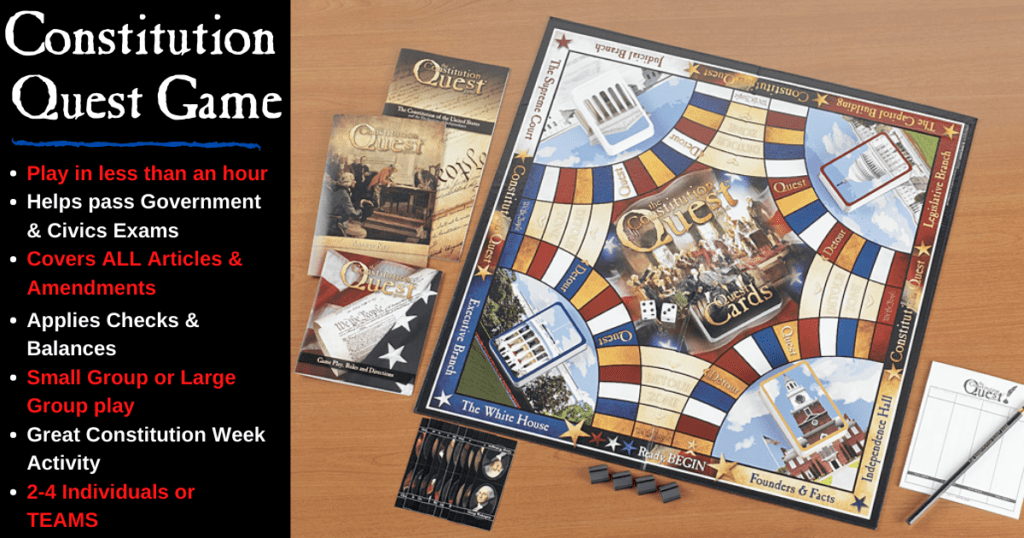
Constitution Quest is an educational board game that helps people learn and review the U.S. Constitution through gameplay. According to its website, the game covers all seven Articles and 27 Amendments, has been sold since 2011, and is intended for teachers, students, families, and community groups. The company describes it as nonpartisan and suitable for players with different levels of constitutional knowledge.
🇺🇸 Turning Constitutional Learning Into Something You Do
The Constitution can sometimes feel difficult not because its ideas are unimportant, but because many of its concepts are abstract. Terms such as separation of powers, ratification, due process, and enumerated powers can be challenging to retain when they are encountered only on a page.

That does not mean Constitution Quest should replace a civics textbook, teacher, or formal government course. Its value may be strongest as a reinforcement tool. A student might first learn about the branches of government or the Bill of Rights through regular coursework, then encounter the same concepts later during gameplay.
Repetition in a different setting can make information easier to remember without making the activity feel like another worksheet or test.
♟️ More Than a Trivia Game
Although Constitution Quest may initially sound like constitutional trivia, its scope extends beyond isolated historical facts.
The game covers the Constitution’s seven Articles and all 27 Amendments, giving players exposure to both the original structure of the federal government and the ways the Constitution has changed over time.
The seven Articles establish much of the framework of American government, including Congress, the presidency, the federal judiciary, relationships among the states, the amendment process, federal supremacy, and ratification. The amendments build on that framework, beginning with the Bill of Rights and continuing through later changes involving voting rights, presidential succession, congressional terms, and other parts of the governmental system.
Learning those subjects together can help players see the Constitution less as a collection of facts to memorize and more as an interconnected framework.
🧑🧑🧒🧒 Learn Together Screen-Free Way
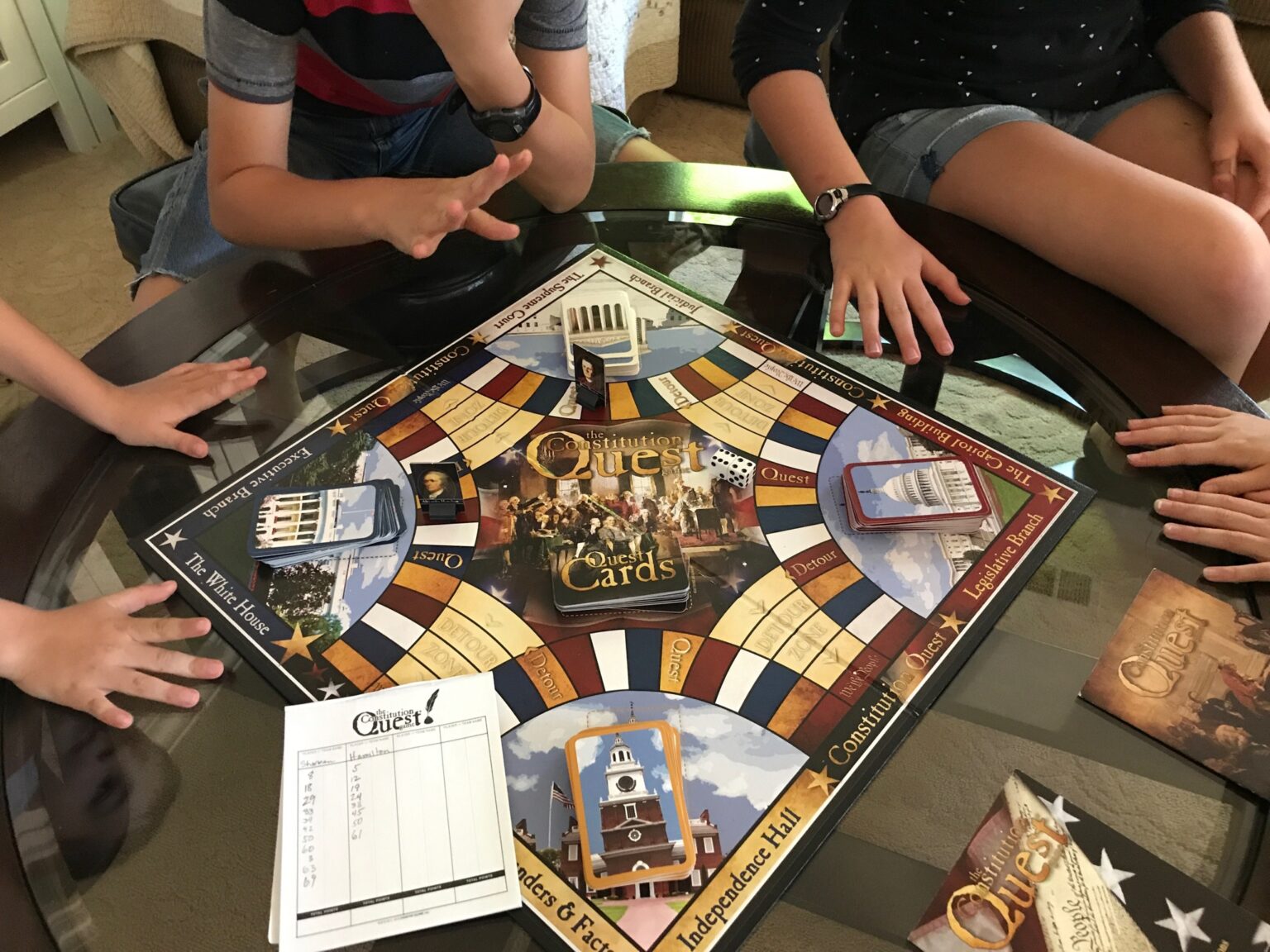
Educational apps, online quizzes, videos, and digital learning platforms can all be useful, but a traditional board game creates a different kind of interaction. Players sit around the same table, hear one another’s answers, and have opportunities to ask questions or discuss unfamiliar concepts as they come up.
The company says families, classrooms, and community groups use Constitution Quest throughout the year to learn and review constitutional principles. At the same time, its interactive format is intended to encourage discussion about civic responsibility.
For parents looking for more screen-free activities, that gives the game an additional practical advantage. It combines education, conversation, and entertainment rather than treating civic learning as another solitary assignment.
📚 A Natural Fit for Homeschooling Families

Rather than treating the game as a separate subject, parents could use it after completing a unit to reinforce previously introduced material. A family might study the Bill of Rights during the week and then use the game for review. Later, after studying Congress, the presidency, or the federal courts, questions that previously seemed unfamiliar may suddenly become recognizable.
The format can also make it easier for family members at different learning levels to participate together. Younger students, older siblings, and parents do not necessarily have to be studying the same material at the same time to take part.
🧑🧑🧒🧒 Bringing Several Generations to the Same Table
One of the more interesting possibilities for Constitution Quest is using it outside a formal educational setting altogether.
Because it is designed for players with different levels of knowledge, the game can become a multigenerational family activity. A grandparent may remember something learned decades ago, a teenager may recognize a concept from a recent class, and a parent may discover that something assumed to be familiar is harder to explain than expected.
Nobody necessarily has to arrive at the table as the expert.
That can make constitutional learning feel less formal and more conversational. Instead of asking children to sit through another lesson, a family can make civic knowledge part of an ordinary game night.
🇺🇸 A Different Kind of Constitution Day Classroom Activity

Constitution Day often brings special readings, videos, quizzes, or classroom discussions. Constitution Quest can provide another option by turning some of that review into a group activity.
Teachers might divide students into teams, rotate smaller groups through the game, or use questions encountered during play as starting points for a broader classroom discussion. This format may be especially useful for students who participate more readily in interactive activities than in conventional lectures.
The game could also have value beyond September 17. Government classes, American history courses, civics clubs, libraries, and after-school programs could use it throughout the academic year to reinforce material students have already studied.
📖 Nonpartisan Approach to Civic Education
Teaching government can become complicated when contemporary politics enters the conversation.
Constitution Quest describes itself as nonpartisan, which is particularly useful for an educational product focused on constitutional government. The goal is to help players better understand the framework of government itself rather than persuade them toward a particular party or political position.
That makes the game potentially useful in classrooms and families where people may hold different political views.
👉 What You Get With Constitution Quest
For readers considering the game for Constitution Day, homeschooling, or family use, Constitution Quest is sold as a complete educational board game rather than a supplemental workbook or digital subscription.
The official site describes the game as a Constitution curriculum presented in game form, covering the seven Articles and all 27 Amendments. Its materials are designed around structured gameplay that allows players to review constitutional principles while competing and interacting with one another. The company says the game is easy to learn and suitable for younger students, adults, beginners, and more experienced learners.
The company’s gallery shows a traditional boxed board-game setup with a game board, cards, playing pieces, and other physical components, making it something families or classrooms can bring out repeatedly rather than use once and discard. The game is actually Made in America.
For a family interested in civics, a homeschool household that can incorporate it into coursework, or a teacher planning to use it with multiple classes, the reusable format may make the price easier to justify. Someone looking only for a one-time Constitution Day activity may find free classroom resources more economical.
That distinction is worth making because Constitution Quest is best viewed not simply as a novelty for September 17, but as an educational game that can be brought out repeatedly throughout the year.
⭕️ Sometimes the Best Lesson Is Discovering What You Don’t Know
The Annenberg survey provides a good example. Most respondents recognized freedom of speech, but considerably fewer could recall the other freedoms protected by the First Amendment. Only 12 percent named the right to petition the government, while 18 percent could not identify any of the five First Amendment protections.
Those results show why occasional civics review can be worthwhile even for adults who consider themselves reasonably informed.
A board game makes those knowledge gaps less intimidating. Getting a question wrong during family game night is different from getting one wrong on an exam. A missed question can immediately become an opportunity to find the answer, discuss it, and perhaps remember it the next time.
That may be one of Constitution Quest’s strongest qualities: it makes reviewing foundational civic knowledge easy enough to do on one’s own.
📆 Not Just for September 17
Constitution Day provides an obvious occasion to play Constitution Quest, but limiting the game to one day a year would miss much of its potential.
Families could bring it out during Independence Day or Presidents’ Day, homeschoolers could use it throughout a civics unit, and teachers could use it for review before exams or at different points in an American government course. Libraries, youth groups, community organizations, and civic clubs could also incorporate it into educational activities.
The company’s own materials emphasize year-round use by families, classrooms, and community groups rather than positioning it solely as a Constitution Day product.
That makes sense. The Constitution continues to shape debates about government authority, individual rights, elections, federal courts, and the balance of powers regardless of the date on the calendar.
🇺🇸 Constitution Day Is a Good Place to Start
The U.S. Constitution was signed in Philadelphia on September 17, 1787. More than two centuries later, Americans continue to debate how its provisions should be interpreted and applied. Productive debate, however, starts with knowing what the document says and understanding the governmental system it created.
That makes Constitution Day an appropriate opportunity not simply to celebrate the Constitution, but to learn more about it.
For families, homeschoolers, teachers, and community groups looking for something more interactive than another reading assignment, Constitution Quest provides an approachable way to put constitutional knowledge on the table—literally. It combines education, discussion, and entertainment while covering the seven Articles and 27 Amendments in a format intended for different ages and levels of experience. The company has sold the game since 2011, giving it a relatively long history for an educational product of this kind.
Constitution Quest will not replace serious study of American government, nor should it. Its value is more straightforward: it can make people curious enough to ask another question, look up an unfamiliar amendment, or discover that there is more about the Constitution they would like to understand.
On Constitution Day—or an ordinary family game night—that is a worthwhile place to begin.
You can order Constitution Quest now using code ET15 to enjoy special discount for The Epoch Times Readers, or call 951-587-5425.
Reference
Annenberg Public Policy Center. (2025, September 11). Americans’ knowledge of civics increases, Annenberg survey finds. University of Pennsylvania.
 Friends Read Free
Copy
Facebook
Tweet
Friends Read Free
Copy
Facebook
Tweet