Commentary
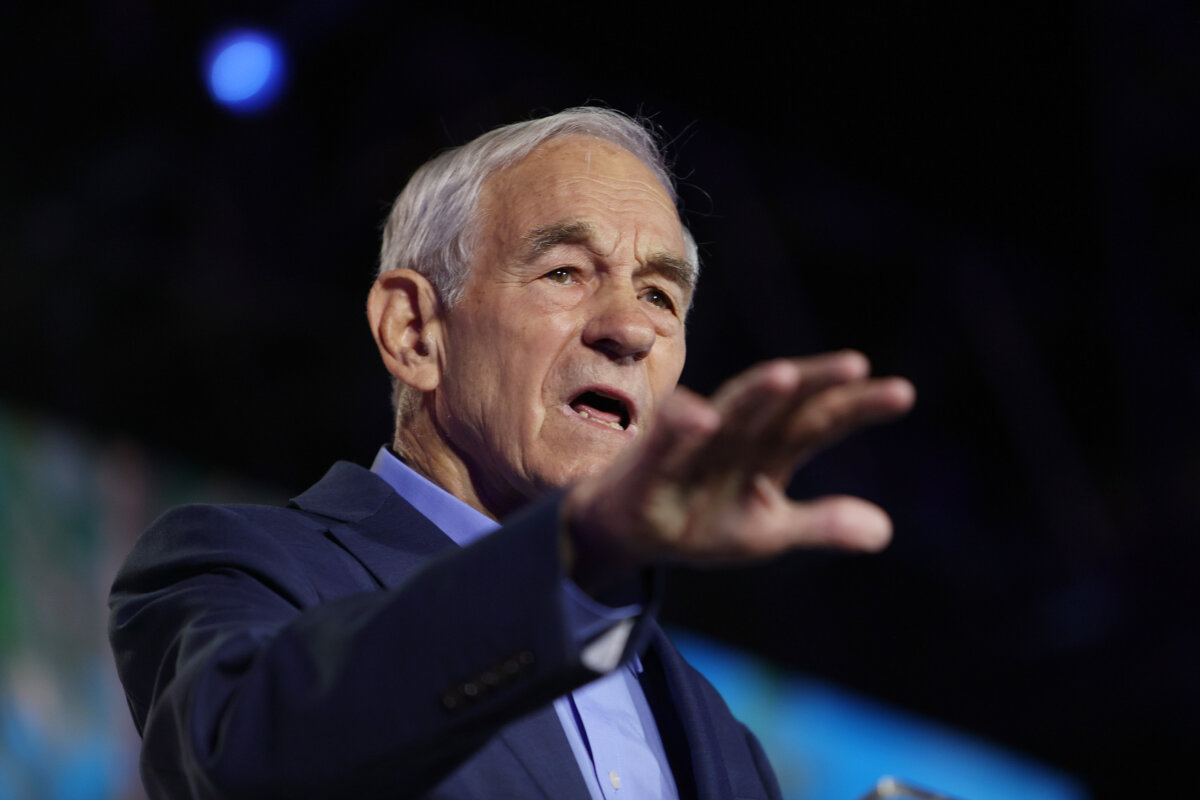
The famous pro-freedom statesman and intellectual leader Dr. Ron Paul is turning 90. A birthday party at his home attracted luminaries from around the country to pay tribute to the great man. This is well-deserved. When the history of our times is written, his prophetic voice will stand out for its consistency in defense of freedom, individual rights, peace, and the vision of the Founders of America.
My first encounter with his thought dates from Cold War times, in which he consistently stood for the gold standard and a genuine defense of the country, versus the fashionable doctrine of “mutually assured destruction.” In college, I chose his intelligent outlook as the subject of several on-campus speeches. I then wrote my undergraduate thesis on the gold standard, using mostly resources that he put together.
Without an internet in those days, I called his congressional office, and they sent a huge care package to me of every bill that Paul had introduced and many other books besides. My thesis ended up breaking records for length in my program, coming in at more than 200 pages, as I recall. That kicked off a lifetime obsession I have had with the subject of money and its quality, and, in addition, the whole idea of human freedom itself.
It was my great fortune that following a journalism program in Washington, Paul picked me to be his personal research assistant for his new career out of office and as head of a new nonprofit. It was a dream job, and the first one I had as an actual adult. My job was to do the economic research, again, before there was an internet. So it was endless hours at the libraries and ordering data from all sources.
Paul was an excellent but exacting boss. His voracious curiosity concerning the facts of any subject was so intense that I never wanted to be caught without the answers. In those years before I made my way to graduate school, I mostly worked 16 and more hours a day, producing as much in the way of research documentation as was possible for me at the time.
I lived at the office, leaving only in late evening hours to eat a microwavable meal, sleep, and get back to work again with the sun up. Those were the days, experiencing professional life for the first time and reading everything I could get my hands on, producing an endless stream of reports.
At this point in his career, Paul had gone back to his OB-GYN medical practice of delivering babies, and he would often come into the office in scrubs. He was always so very happy following the birth of a child. He had a broad smile and could never stop talking of the miracle of life. Following that inevitable soliloquy, he was back asking for data on money supply and dollar valuations and financial regulations.
How fortunate I was to have my first real-world boss be Ron Paul. As I got to know him, I found out what so many others have discovered through the years. He is a man of dogged attachment to principle, but his firm convictions were matched by a humility, curiosity, earnestness, and deep sincerity and concern for all.
As the years went on, it always made me sad that people could not have known him the way I knew him, which is as a fundamentally good, compassionate, and humble man.
His main intellectual influences were formed in the 1970s following the “Nixon shock” that ended the gold standard. In those days, the proponents of fiat floating exchange rates predicted that the price of gold would collapse. The hard money crowd said the opposite and strongly recommended gold as a buy. Who was correct? It was rather obvious in time, and Ron Paul had already started leading the charge. Eventually, he was put on President Ronald Reagan’s gold commission, producing the epic minority report that was the most comprehensive case for gold written at the time.
Paul was called a “gold bug,” which is fine, but it would be more accurate to call him a freedom bug. He was mainly influenced by a professor he had in college, Hans Sennholz, who was a student of Ludwig von Mises, the Austrian economist who had emigrated from Vienna to Geneva, then immigrated to the United States in 1940. The first real economics book I read in college was, in fact, by Sennholz, which is why I always had the sense that I could trace Paul’s intellectual evolution.
To cut to the chase, Ron Paul had fallen in deep love with the idea of freedom. This one idea explains most human progress. It explains the ennoblement of man in history. It explains most great technologies. It accounts for why we have order even when it is not legislated or imposed. It explains charity and faith and family. Freedom’s absence explains war, exploitation, poverty, and most human suffering.
This was an insight he gained from his teachers and one that informed his long career in public service. He was elected to represent his Texas district in the U.S. House of Representatives. It was clear immediately that he would not be a normal politician. He would never vote for deficits. He would never trade votes. He was known to be impervious to lobbying, so the lobbyists knew not to bother with him. He introduced bill after bill that he knew would never become law, so why did he do it? He could never help himself: He somehow had to do the right thing.
This was true for matters of war and peace, too. He would not support the wars of Democrats, but would not support the wars of Republicans, either. This was true during the Cold War, when he refused to support taxpayer funding of any of the reputed “freedom fighters” who were later revealed to be jihadists and thugs in disguise, and true after the Cold War, when he passionately opposed U.S. intervention in Panama, Haiti, Syria, and Iraq. He stood up to all the warmongers with grace and evidence from history and the Constitution.
What I learned from Ron Paul was that there was always a unity between a well-formed ideology and the facts of any particular case. This is what formed his constant conviction that liberty was both right and practical, true and workable, moral, and the source of the greatest good for the greatest number. He never once deviated from this position. It is also why he was fearless: He knew the reality and conviction matched in the commitment to human freedom as a first principle.
Even in the earliest days of COVID-19, he was the first major public figure to cry foul about the facts and handling of the case. As a well-trained medical doctor, he knew for certain of the tradeoffs of severity and prevalence, knew that no vaccine could work in the long run, and had a well-honed instinct that government was up to no good and that all intervention would lead to disaster.
How I recall so well how everyone once again abandoned him to take the fashionable view instead. He was almost entirely alone in this view, but, once again, he was entirely correct. Eventually, public opinion caught up to him.
And this is what strikes me about his current status as the godfather of liberty in our times. Having followed his career carefully since 1984, I’ve seen time and time again how he would step out ahead of the curve and alone on a range of issues from the Fed to war to the deep state to infectious disease. Ignoring all consultants and political fashions, he would simply say what’s true. Each time, even his purported followers would often distance themselves from his views—too “extreme,” too soon—waiting until the coast was clear to gather around him again.
It was a pattern that just kept repeating.
Whole books will be written about his career, so I can only add my personal knowledge from my years of working with him. This is a man with a heart of gold. There is not an insincere or malicious bone in his body. He is the rare case of the leader of a “movement” who has always risen above his followers in stature, sincerity, knowledge, and honesty. In that sense, he stands with few others, but the name that comes to mind is Thomas Jefferson.
Happy 90th birthday, Dr. Paul. Thank you for what you have done for our country and done for me personally. In so many ways, you are my teacher and inspiration. Because of your willingness to speak out when it mattered, countless times for so many decades, millions can count themselves among your students. Someday, the whole world may claim the status, too.
Views expressed in this article are the opinions of the author and do not necessarily reflect the views of The Epoch Times.
 Friends Read Free
Copy
Facebook
Tweet
Friends Read Free
Copy
Facebook
Tweet