Commentary
The annals of modern history are filled with ideologically inspired individuals convinced that their opponents are not merely mistaken but morally illegitimate and, therefore, expendable.
Inspired by the goals of revolutionary socialism, many have concluded that violence is a necessary instrument of progress. Mayhem and murder are mistakenly seen as a path to a more perfect world.
In this troubling context, Paul Thomas Anderson’s 2025 Academy Award-winning film, “One Battle After Another,” amounted to a cinematic tribute to a violent era. The movie casts Leonardo DiCaprio as an aging Age of Aquarius revolutionary who is drawn back into conflict when old enemies reappear.
Some viewers praised the film for its emotional depth and political relevance. More sensible people saw it as nostalgia for an exceedingly unsettled time. The script celebrated ideological militants and provided implicit approval of violence as a tool of social justice.
Nihilism Among the Possessed
The theme of “One Battle After Another” brought to mind Fyodor Dostoyevsky’s prophetic 19th-century novel “The Possessed.” Written in response to the rise of Russian nihilism and revolutionary Marxism, his novel remains one of the most penetrating examinations of political fanaticism ever written.
In the seventh chapter, Dostoyevsky describes a conspiratorial meeting that sets the tone for the entire book. The author depicts a loose collection of intellectuals, idealists, students, opportunists, and malcontents who are tentatively exploring revolutionary ideas.
Their discussion reveals that many political activists are less motivated by genuine concern for the common good than by vanity, resentment, ambition, or a desire for destruction itself. The principal character, Pyotr Verkhovensky, manipulates a diverse group of activists into a determined revolutionary conspiracy.
Dostoyevsky’s central insight is that revolutionary violence rarely begins with a clear plan for murder or terrorism. It begins with abstractions. Once people become convinced that history itself is on their side and existing institutions are irredeemably corrupt, moral constraints weaken. Opponents cease to be fellow human beings and instead become obstacles to progress.
In Dostoyevsky’s story, a Russian town’s descent into arson, murder, and chaos served as a warning. A society engulfed by the fire of revolution symbolizes more than physical destruction; it represents the civic disintegration that occurs when ideological zeal replaces genuine human compassion.
Revolutionary nihilism ultimately consumes not only its enemies but the nation itself. Russia’s eventual descent into Bolshevism proved that Dostoyevsky was right.
Blood and Progress
Similar accounts of political violence are found in American scholar Noah Rothman’s recent book, “Blood and Progress.” Rothman chronicles the same wave of revolutionary violence that was at the center of Anderson’s award-winning film.
Far from being an era defined solely by New Left idealism, the 1960s and ’70s witnessed bombings, assassinations, kidnappings, riots, and campaigns of political intimidation.
Among the events Rothman recounted were violent demonstrations, urban riots, bombings, kidnappings, and murders undertaken by factions like the Weather Underground, the Symbionese Liberation Army, Germany’s Red Army Faction, Italy’s Red Brigades, and Quebec’s Front de libération du Québec.
All such militant organizations—including more recent examples such as BLM, Antifa, and Hamas—condone political violence on the pretext that Western democracies are irredeemably oppressive and revolutionary action is morally necessary.
Since the late 19th century, the rhetoric employed by revolutionary movements has been remarkably consistent. Activists have repeatedly portrayed society as fundamentally corrupt, depicted their opponents as agents of oppression, and insisted that extraordinary circumstances justify extraordinary measures. The language varies, but the underlying assumptions remain the same.
Echoes of a Violent Past
In the 21st century, Western societies are hearing echoes of earlier patterns. Episodes of rioting, looting, arson, violent confrontations with police, attacks on political opponents, and increasing incidents of assassination should remind democratic societies that political extremism remains a persistent danger.
Social media intensifies this pathology by rewarding outrage and depicting political opponents as existential threats.
Movements that support what they believe to be progressive reforms become dangerous when they reject democratic persuasion in favor of coercion, threats, and unlawful obstruction.
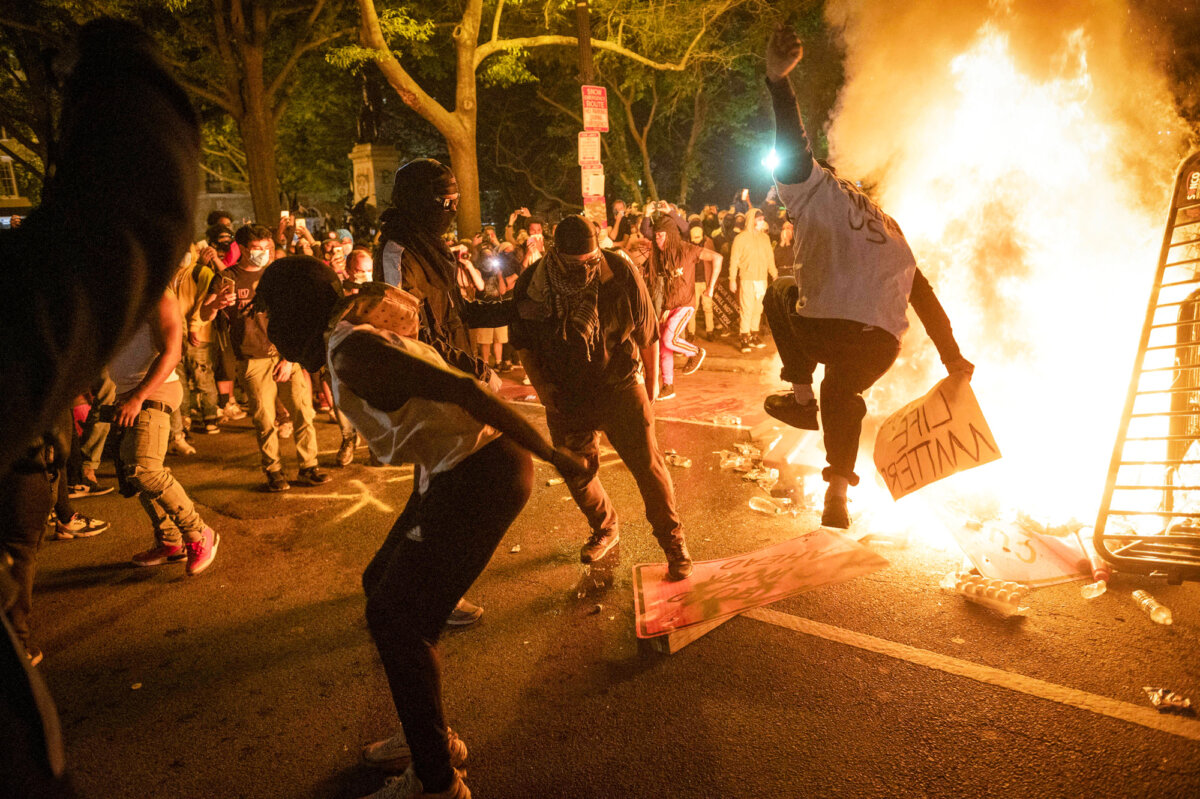
Recent events should remind us that this danger is not confined to the history books. The summer of 2020 provided a particularly important example. Following the death of George Floyd, a significant number of Black Lives Matter supporters took to rioting, looting, arson, property destruction, and clashes with police.
The Minneapolis unrest resulted in extensive destruction and became a vivid reminder of how quickly protest can turn to mayhem. Over the past two years, American open-border radicals have employed similar tactics.
In 2024, the current president of the United States survived two active assassination attempts: a July 13 shooting in Butler, Pennsylvania, which took the life of an innocent bystander, and another by an armed man discovered near his golf course in Florida.
In April this year, no less an establishment figure than the former American FBI director was indicted for allegedly threatening the president in an Instagram post with seashells arranged to display “86 47,” a code commonly seen as a death threat toward Donald Trump.
In December 2024, UnitedHealthcare CEO Brian Thompson was deliberately shot to death in New York City. The shooter became a virtual folk hero for radical young socialists.
In September 2025, conservative political activist Charlie Kirk was brutally assassinated while speaking at Utah Valley University.
Taken together, these and other incidents point to a disturbing pattern: the willingness of ideologically driven individuals to regard political opponents, public officials, corporate leaders, or cultural adversaries as legitimate targets for violence rather than fellow citizens with whom they disagree.
Liberty Depends on the Rule of Law
What happens when political grievances are combined with the perception that democratic institutions are incapable of delivering justice? This is an enormously troubling question.
Political violence may not belong exclusively to the left or the right. But once militants begin to regard it as a legitimate means of settling disputes, the idea itself becomes contagious. One side’s justification becomes another side’s excuse.
This is precisely the danger that Dostoyevsky wrote about. Political violence begins with people who believe that institutional processes are inadequate, that their opponents are morally beyond the pale, and that extraordinary measures are justified. Once a society crosses that moral barrier, violence will be permitted in the name of almost any cause.
Progressive political missions have evolved—from racial equality to democratic socialism—but the totalitarian temptation remains the same: to substitute coercion for persuasion, destruction for discourse, and chaos for the rule of law.
Free nations can’t survive that substitution for long. Once violence is tolerated as a normal path to political change, history has demonstrated that neither liberty nor justice will long survive.
Views expressed in this article are the opinions of the author and do not necessarily reflect the views of The Epoch Times.
 Friends Read Free
Copy
Facebook
Tweet
Friends Read Free
Copy
Facebook
Tweet