

Commentary
The White House Office of Trade and Manufacturing Policy recently detailed these mechanisms in its report “The Great Transshipment Scam,” which outlines how Chinese exporters evade U.S. Section 301 tariffs using a “shadow transshipment network” spanning more than 40 jurisdictions. Exporters obscure product origin through minor processing, repackaging, relabeling, re-invoicing, and shell entities.
Beyond economic tariff evasion, the Chinese Communist Party has weaponized these transshipment routes to serve broader geopolitical goals, allowing restricted dual-use technology, industrial machinery, and defense components to circumvent global sanctions and supply active military conflict zones in Russia, Iran, and Burma (Myanmar) while maintaining plausible deniability.
In the Russia–Ukraine war, transshipment channels operating through Hong Kong, Central Asia, Turkey, and the United Arab Emirates handle vast volumes of critical dual-use technology feeding the Russian defense-industrial base. Middleman trading firms purchase Western-designed and Chinese-produced tech, alter shipping manifests, and re-invoice cargo to evade regulatory oversight before delivering it to Russian state enterprises.
According to Ukrainian Foreign Intelligence Chief Oleh Ivashchenko, Kyiv has uncovered supply lines connecting Chinese entities directly to 20 Russian military manufacturing plants. These shipments include tooling machines, gunpowder, specialty chemicals, equipment, spare parts, and technical documentation, particularly for the aviation sector.
Declassified enforcement data further highlight Chinese and third-country suppliers providing microelectronics directly to key Russian defense contractors, such as SMT-iLogic, the primary producer of Orlan reconnaissance drones. Other lines funnel specialized machinery parts to suppliers of Russian naval engine manufacturers and military aviation repair depots.
By bypassing export controls through these intermediate jurisdictions, Moscow fills critical technical gaps, maintains high-volume missile and drone production, and sustains its war effort despite ongoing international sanctions, with devastating consequences for Ukrainian civilians daily.
Similarly, Iran sustains its military production and operational capabilities through complex acquisition, transshipment, and intelligence networks across Asia and the Middle East. To bypass international export controls and sanctions, agents affiliated with the Iranian Ministry of Defense and Armed Forces Logistics establish disposable front companies, primarily in Hong Kong, to source regulated dual-use items, including microchips, sensors, guidance gyroscopes, and engine components. Financial settlement relies on offshore accounts and small financial institutions under Chinese jurisdiction, allowing entities to move funds without triggering Western SWIFT tracking or compliance alerts.
Physical delivery depends on transshipment hubs and intermediate free-trade zones in Southeast Asia and the Middle East, where goods are relabeled or misdeclared under commercial Harmonized System (HS) customs codes before shipment to Iranian ports such as Bandar Abbas. Beyond drone electronics, these supply routes deliver critical chemical precursors, including bulk shipments of sodium perchlorate for solid rocket fuel. Alongside Chinese supply channels, Tehran maintains reciprocal exchanges with other partners, providing uncrewed aerial vehicle designs to Russian forces in return for advanced industrial machinery and technical support.
Beyond component supply chains, Iran uses foreign commercial space assets to enhance military targeting and operational intelligence. China-based geospatial and satellite firms, such as Chang Guang Satellite Technology, MizarVision, and The Earth Eye, provide Tehran with overhead imagery detailing allied troop movements and base facilities. This satellite data feed directly into Iranian missile and drone targeting architectures, expanding on previous intelligence support provided to proxy groups such as the Houthis.
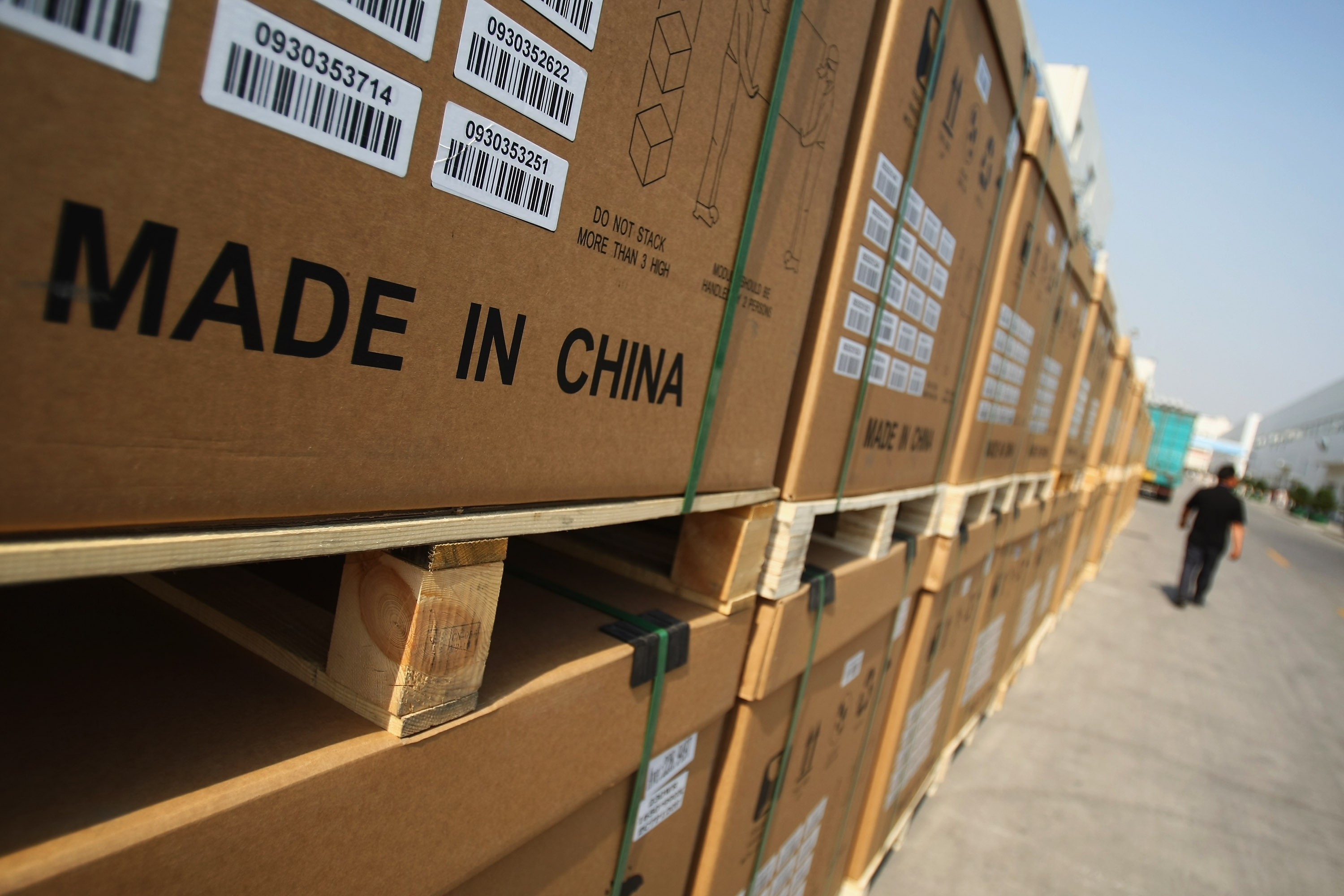 A man passes the photoelectric board products cased at the plant in Baoding, China, on June 24, 2009. (Feng Li/Getty Images)
Direct state transfers primarily cover heavy ordnance, whereas dual-use electronics, drone components, electronic warfare systems, raw materials, and specialized munitions rely on multi-layered third-party channels. Investigative reporting by the U.N. special rapporteur on Myanmar and the Special Advisory Council for Myanmar documents how Chinese state-backed suppliers and border transit hubs facilitate these transfers to feed the junta’s domestic defense factories. Ground supply lines operate through Yunnan border gates, while maritime and regional transshipment rely on offshore intermediaries.
To procure restricted inputs, private and state-adjacent entities registered in Hong Kong and mainland China serve as intermediary purchasing agents. These networks collaborate with Burma-based crony firms, such as Royal Shune Lei Co. and Dynasty International, which establish offshore entities in third jurisdictions to contract with foreign manufacturers. Dual-use equipment, machinery, and raw manufacturing inputs (such as copper, steel, and lubricants) are routinely imported under civilian commercial declarations to conceal their military end-use at junta defense facilities.
Once delivered to these defense facilities, imported components and knocked-down kits are assembled, re-marked, or repainted as locally produced Burmese equipment, obscuring their foreign origin. Beyond pure procurement, Beijing selectively opens or restricts overland border corridors to exert strategic leverage over the junta, calibrating trade flows based on regional stability, the activity of ethnic armed organizations, and the security of Chinese infrastructure projects.
While Beijing officially prohibits direct lethal military aid, it tolerates domestic commercial space vendors, regional brokers, and corporate front entities providing technological and reconnaissance inputs. This arrangement allows Beijing to maintain formal diplomatic distance; however, because Chinese regulatory authorities retain the oversight required to halt these exports, their continuation indicates state complicity.
Views expressed in this article are the opinions of the author and do not necessarily reflect the views of The Epoch Times.
 Friends Read Free
Copy
Facebook
Tweet
Friends Read Free
Copy
Facebook
Tweet