
Commentary
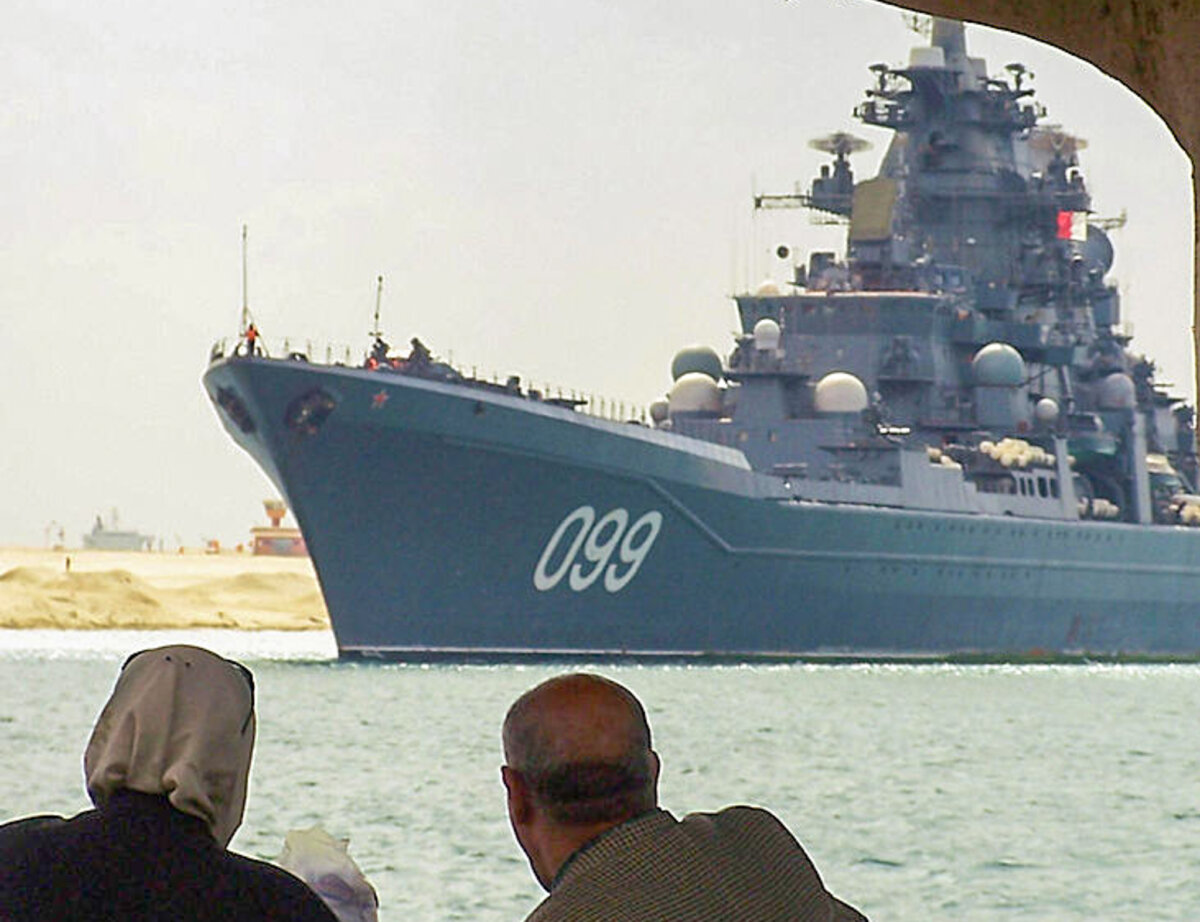
Few warships embody Cold War competition like Russia’s Kirov battlecruisers. Conceived at the height of United States–Soviet competition, these heavily armored, armed-to-the-teeth nuclear-powered battlecruisers were deployed to provide an asymmetric counter to U.S. carrier dominance. However, after the collapse of the Soviet Union, poorly maintained, unmodernized Kirovs fell into disrepair. And with one very notable exception, they seem fated to be decommissioned.
The notable exception is the Admiral Nakhimov, which has emerged from nearly three decades of dry docking and is now conducting sea trials. Its specs are impressive, but is this modernized Cold War relic a game-changer, a symbolic gesture, or something in between?
The ship’s origins lie in the Cold War’s frosty depths. The third of four Kirov battlecruisers, its keel was laid on May 17, 1983, at the Baltic Shipyard in Leningrad (now St. Petersburg) and was launched on April 25, 1986, joining the Soviet Northern Fleet on Dec. 30, 1988. Originally named the Kalinin in honor of a Bolshevik revolutionary, it was renamed Admiral Nakhimov in 1992 in honor of a Crimean War naval hero.
At 827 feet (252 meters) long with a 94-foot (28.5-meter) beam, it displaces 28,000 tons, powered by two KN-3 nuclear reactors delivering speeds of more than 32 knots and near-unlimited range. Its 762-person crew, while larger than that of modern destroyers and cruisers, is still less than one-fifth that of a U.S. carrier.
The battlecruiser served only nine years before entering Severodvinsk’s Sevmash shipyard for maintenance. The maintenance period turned into more than a decade of being mothballed because of lack of funds, courtesy of Russia’s post-Soviet economic collapse. Its fate remained uncertain until 2013, when a 50-billion-ruble contract was let, signaling that it was to be modernized and overhauled, not scrapped. The process of modernization was excruciatingly slow, but by August of 2024, with rebuilt reactors, fully digitized fire control/weapons management systems, new offensive and defensive weapons, and a complete mechanical overhaul, the Nakhimov began sea trials. Commissioning is scheduled for 2026.
Unsurprisingly, its dimensions and propulsion remain, but its innards have been transformed. The 20 very powerful P-700 Granit supersonic “carrier killer” anti-ship missiles, each with a 750-kilogram warhead featured on the original ship, have been replaced by 176 vertical launch cells (VLS)—80 for surface strike, 96 for air defense. These house Kalibr-NK cruise missiles (range of 1,553 miles/2,500 km), Oniks anti-ship weapons (range of 373 miles/600 km), and Zircon hypersonic missiles (Mach 9, range of 621 miles/1,000 km). The new weapons configuration includes 32-48 SAMs, (range of 81 miles/130 km) and the Pantsir-ME combined gun/missile close-in air defense system. Anti-submarine weapons include Paket-NK torpedoes, Otvet missiles, and three Ka-27 ASW helicopters. Its new AK-192M 5.1-inch gun can be used to attack land, air, and sea targets. Radars and sensors have been upgraded to counter stealth threats. It’s now a multi-role flagship with state-of-the-art weapons systems with a whole lot of offensive power and formidable defenses.
Factoring in inflation and devaluation, the cost escalated from 50 billion rubles ($700 million) in 2013 to at least 200 billion rubles ($2.2 billion) and possibly considerably more by 2025. Critics call it a money pit amid sanctions and war, yet Moscow sees both symbolic and deterrent value, with its 30-year life extension making it a more cost-effective alternative to new construction. For context, a brand-new, much smaller, conventionally powered 9,000-ton Arleigh Burke destroyer costs about $2.5 billion.
Soon to be Russia’s only remaining true capital ship, the Nakhimov’s revival does not change the overall strategic picture when it comes to naval power. The United States fields 11 carriers (10 Nimitz-, 1 Ford-class). What’s more, like U.S. carriers, Nakhimov faces submarine threats. A single U.S. nuclear-powered attack submarine could sink it. Hence, an effective deployment of the Nakhimov requires a defensive screen of submarines, frigates, or destroyers—a major commitment for Russia’s much smaller post-Soviet collapse fleet. And, as is the case for U.S. carriers, the benefits of its superior nuclear-powered range, speed, and endurance are somewhat mitigated by reliance on its relatively slow, fuel-hungry, conventionally powered escorts.
Yet the Nakhimov is far from irrelevant. Far more than any other single surface warship, it poses a unique threat to any carrier within its missile range. Eighty UKSK VLS cells launching Zircon hypersonics (Mach 9, range of 621 miles/1,000 km) are a challenge for the Aegis-based defenses of a carrier’s escorting destroyers. A large missile salvo from it and its escorts does pose a threat to a $13 billion carrier and its 4,000-plus crew.
Further, presence matters. In the Arctic, the Greenland-Iceland-UK gap, or the Pacific, the Nakhimov forces NATO resource allocation, diverting assets from hotspots such as the South China Sea. As Russia’s Northern Fleet flagship, replacing the soon-to-be-retired Pyotr Velikiy, it anchors carrier-less task groups, projecting hypersonic reach to U.S. shores. Even when in port, it exerts a “fleet-in-being” effect, forcing competitors to position resources to counter potential sallies. All the above make it a credible threat, which, unlike a submarine, is very visible, can exercise sea control, and thus needs to be countered.
Although it doesn’t majorly change the strategic naval balance, the Nakhimov is at least somewhat of a game changer that will force Russian competitors to deploy significant resources to counter it, making it far from irrelevant. Further, from a Russian perspective, its successful modernization, while Russia was under severe sanctions, is a very visible symbol of Russian determination to overcome what Russia believes have been decades of NATO efforts to prevent Russia from regaining its rightful place on the world stage as a Great Power. This, plus its actual real-world capabilities, makes the $2.5 billion to $3 billion spent on its modernization a worthwhile investment from a Russian perspective.
Views expressed in this article are the opinions of the author and do not necessarily reflect the views of The Epoch Times.
 Friends Read Free
Copy
Facebook
Tweet
Friends Read Free
Copy
Facebook
Tweet