
Commentary
China may have leveraged the Aug. 5 lunar impact of the upper stage of a SpaceX Falcon-9 rocket to test space-warfare satellite technology. At the same time, the incident raises questions about whether China will be transparent about the moon-crashing stage of its future lunar landing vehicles.
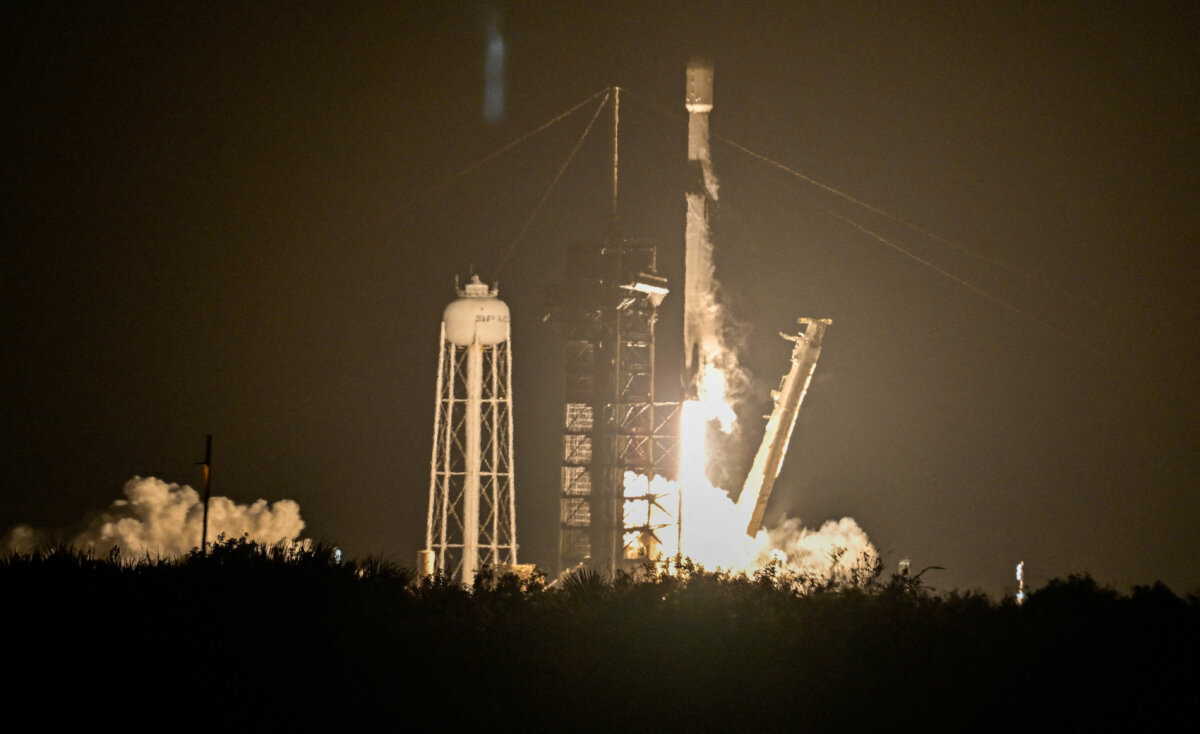
The Aug. 5 moon crash of a nearly 8,600-pound upper stage of a SpaceX Falcon-9 rocket created a new 60-foot-wide crater, demonstrating the destructive power of a piece of space junk traveling at 5,400 miles per hour.
Since 1959, more than 60 spacecraft or other man-made objects have crashed into the moon, including the 30,000-plus-pound third stages of the Apollo 13 to Apollo 17 missions, which were used to create seismic tests, and the March 4, 2022, impact of the 6,400-pound third stage of a Chinese Long March-3C rocket, which created a 95-foot crater.
But on Aug. 6, Chinese state media were quick to tout that the Falcon-9 crash had been observed by China’s Gande-1 01, a “commercial space debris monitoring satellite” just launched on July 24 on a Lijian-1 commercial space launch vehicle.
On Aug. 7, Chinese state media CGTN reported:
“A Chinese commercial space debris monitoring satellite has successfully tracked and recorded the moment a SpaceX Falcon 9 rocket second-stage remnant smashed into the moon, marking a significant achievement for the country’s commercial space monitoring capabilities.”
The day before, the South China Morning Post noted the Gande-1 01 observation:
“In a show of space surveillance strength, a newly launched Chinese satellite tracked a piece of a SpaceX Falcon 9 rocket crashing into the moon and captured footage of its impact.”
Eventually, the Gande constellation will consist of 120 satellites.
A July 27 Xinhua report noted that Gande-1 “is equipped with an onboard artificial intelligence-aided computer, which enables the satellite to flexibly carry out routine surveillance, emergency response and rapid tracking missions, without frequent ground intervention” and that it “also features orbital transfer capability, allowing it to conduct close-range observation and other sophisticated in-orbit operations.”
With state media also reporting that Gande-1 01 had observed the Falcon-9 upper stage at a distance of 236,000 miles, it appears that this constellation is a classic Chinese civil-military “dual-use” satellite constellation that could help a People’s Liberation Army (PLA) national missile defense system intercept enemy nuclear warheads and could also help target enemy satellites for destruction by PLA combat satellites.
But declaring that the Gande constellation can track objects in orbit around the moon means that it can also help extend PLA space combat power to lunar orbits.
The Falcon-9 lunar crash has also raised concerns about how to deconflict a near-term spike in unmanned and manned space travel to the moon.
The U.S. National Aeronautics and Space Administration (NASA) envisions 79 missions to the moon by early 2036, and China will also undertake numerous missions as both countries build moon bases.
In an Aug. 17 op-ed in the weekly SpaceNews, Therese Jones, research manager at the European Space Policy Institute and a former senior adviser at NASA, wrote:
“By 2030, both the United States and China anticipate crewed landings on the lunar surface. With a mere two to four years until those landings are scheduled to occur, there is minimal time to coordinate lunar safety guidelines to not only protect robotic missions, but also the human lives and infrastructure needed for long-duration crewed missions.”
Jones suggested that governments and private companies, which will be increasingly significant lunar actors, have a role to play in forming agreements and establishing common practices to deconflict the growing human traffic to the moon.
To be sure, this is a problem worthy of the effort of busy diplomats and space bureaucrats; crashing rocket stages not only have the potential to create large holes in lunar bases that could be occupied by humans, but they also often contain unspent toxic rocket fuel.
But within this larger challenge of managing lunar traffic and avoiding collisions between rocket stages is a more specific problem: Will China do its part to help manage its lunar traffic and its purpose-built, crash-designed lunar lander propulsion stages so they do not threaten the moon bases?
China’s future Lanyue manned lunar landing vehicle uses a separate propulsion stage to sustain lunar orbit and then decelerate the manned spaceship as it approaches the moon, but the stage is discarded to crash into the moon just before the manned spaceship lands.
By the time the propulsion stage expends its fuel, it could weigh about 4,000 pounds, meaning that it could do some damage if it hit another country’s moon base.
Chinese sources indicate that this crashing propulsion stage could also be used for other payloads, such as large pressurized lunar rovers, meaning that China’s moon base architecture will feature frequent “bombing” propulsion stages that could threaten other nations’ astronauts.
This danger is coming into focus as both the United States and China target landing zones near the South Pole’s Shackleton Crater, the landing location for Chang’e-7, China’s next unmanned lunar probe, now delayed from a previously scheduled Aug. 24 launch.
However, China’s willingness to deconflict its lunar traffic and its crashing propulsion stages could be in some doubt following the example of its umbrage at being called out for cavalier behavior during its July 6 test launch of a JL-2 submarine-launched ballistic missile (SLBM).
On Aug. 11, at the Conference on Disarmament in Geneva, a U.S.-led statement signed by 41 countries, reacting to China’s SLBM test, called on countries to provide 24 hours’ notice before testing long-range missiles.
The statement continues:
“Notifications should include such information as the generic class of the ballistic missile or SLV, the planned launch notification window, the launch area, and the planned direction. Countries should also provide clear notices for airmen and mariners consistent with international standards to reduce risk, including in expected impact or landing areas. Regularized, transparent notification arrangements do not constrain any nation’s military development or operational needs. Instead, they reduce the risk of miscalculation, build confidence, and reflect a shared commitment to security.”
On Aug. 12, according to Chinese state media outlet Global Times, China’s Ambassador for Disarmament Affairs Li Chijiang “criticized the move as ‘microphone diplomacy,’ saying it amounted to political manipulation and blatant double standards that China would neither accept nor tolerate.”
It is conceivable that as moon base traffic increases, along with China’s increased use of crashing propulsion stages, statements similar to that made on Aug. 11 at the Conference on Disarmament will be issued by the space-faring nations seeking “regularized, transparent notification arrangements.”
The Chinese regime’s unwillingness to be transparent about its Earth-crashing long-range missiles does not bode well for its willingness to be transparent about its moon base traffic and its moon-crashing propulsion stages.
Views expressed in this article are the opinions of the author and do not necessarily reflect the views of The Epoch Times.
 Friends Read Free
Copy
Facebook
Tweet
Friends Read Free
Copy
Facebook
Tweet