
Commentary
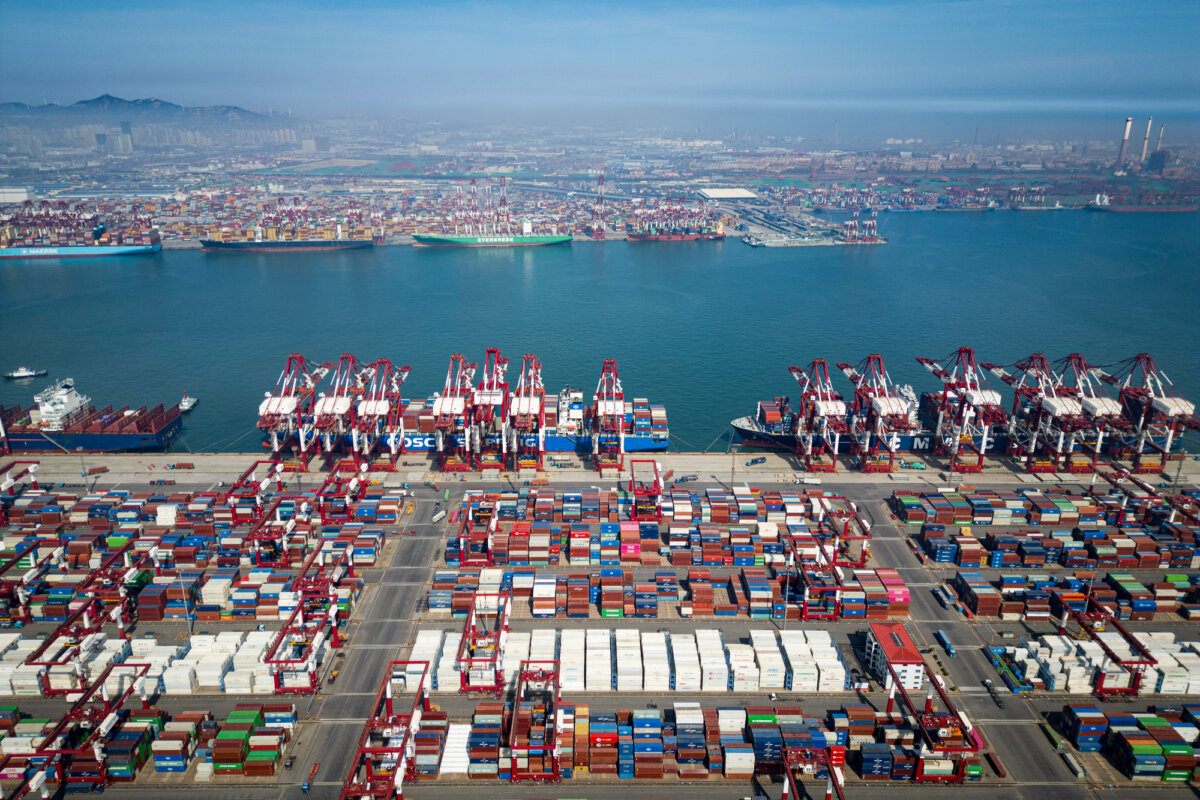
China’s supply chains are expanding globally, including in Hungary, Serbia, Morocco, Egypt, and Thailand. As these locations indicate, the expansion is a response to not only U.S. tariffs, but also European tariffs on Chinese goods.
What started as Chinese industrial expansion into the United States and Europe to acquire technology, and into places such as Vietnam and Mexico for transshipment to the United States, is now going global, with transshipment to Europe as well.
Along with China’s global supply chain expansion come Beijing’s attempts to impose international governance on global industries through regulations and standards developed by the Chinese Communist Party (CCP). These attempts at extraterritorial governance compete with and counter U.S. and European regulations and standards, for example, against forced and child labor in China’s cotton industries.
The CCP on Aug. 5 imposed counter-sanctions on six U.S. entities, including human rights and responsible business organizations, that allegedly assisted “illegal” U.S. sanctions against forced labor in the Xinjiang region.
Beijing is trying to increase its global influence by imposing its own global governance, buttressed by increasing exports and limiting imports to make the world more dependent on China, but not vice versa.
The world is responding with tariffs to stop China’s gargantuan trade surplus, which hit $1.2 trillion last year and is on pace to reach the same heights this year, from further decimating global industrial ecosystems.
This tariff strategy, which now receives positive coverage in some mainstream financial media, originated in the United States, spread to the European Union, and has been used in various forms by Canada, India, Russia, Indonesia, and Turkey.
However, the CCP is devising ways around the tariffs, including acquiring manufacturing companies in target economies, diverting exports to other countries, and transshipping to countries that impose tariffs.
According to the Peterson Institute for International Economics, “While China’s share of bilateral US imports fell by 7 percentage points from 2017 to 2024, its share of value added in US imports—which also includes Chinese products, parts, and other content shipped from other countries—fell just 2 percentage points.”
Many of China’s exports evaded U.S. tariffs by flowing in different forms—for example, as electronics or auto parts—to third countries that assembled finished goods and then shipped them to the United States, laden with transshipped Chinese parts. U.S. tariffs had an effect on Chinese imports, but less than intended because of China’s use of transshipment.
Simultaneously, Chinese companies have acquired technology and circumvented tariffs by purchasing industrial companies in highly developed target economies. Since the mid-2000s, China has made strategic investments in more than 130 European auto parts manufacturers, primarily in Germany and France. These helped Chinese firms acquire manufacturing technologies and methods and provided them with a near-guaranteed outlet for parts exports, even where tariffs existed.
Even with low tariffs, China’s price discounts still make direct exports competitive. A Goldman Sachs analysis recently found that for solar panels, heavy-duty trucks, LED screens, and shoes, China’s price discount relative to its global competitors ranges from 52 percent to 63 percent. This is due to China’s distortionary subsidies and coordination that advantage its exports at the expense of U.S. and allied free market manufacturing.
Until China’s currency value rises to a fair market level, its deflation reverses, and China’s economy refocuses on the Chinese consumer, its global supply chains will continue to expand and exploit global demand while evading tariffs.
To counter China’s currency devaluation, some have proposed an international currency accord enforced with coordinated international tariffs against China. This would pare back China’s export economy and its reliance on global supply chains, as long as the tariffs also apply to transshipments and to Chinese companies that relocate abroad but remain under Beijing’s control. It would force China’s economy to supply its own consumers, which would improve living standards in China and increase jobs abroad.
China’s trade surplus and global supply chains are both assets and liabilities for Beijing. They give the CCP influence in the countries in which Chinese firms do business. But they are provoking pushback in the form of tariffs, forcing Chinese companies to invest in fixed assets abroad that are vulnerable to increased foreign taxation and robbing Chinese citizens of jobs that supply the Chinese consumer with the necessities of a good life.
Taxing China’s global supply chains with coordinated tariffs is getting mainstream attention and is an effective way to send a message to Beijing: Leave our thriving industries alone, and refocus China’s industrial might on helping Chinese consumers, not on building CCP influence.
To this end, democracies and their allies that can tax China’s global supply chain should follow America’s lead and do so, thereby protecting jobs, promoting democracy, and weakening authoritarianism.
Views expressed in this article are the opinions of the author and do not necessarily reflect the views of The Epoch Times.
 Friends Read Free
Copy
Facebook
Tweet
Friends Read Free
Copy
Facebook
Tweet