
Commentary
Before 1949, China had only 22 of the 5,000 large dams worldwide. Today, China’s top water resources official boasts that the country has since built 94,877 dams of various sizes.
What’s surprising, however, is that the number of dams cited by Minister of Water Resources Li Guoying has actually dropped by 3,689 since the end of 2020, when authorities reported 98,566 dams.
Why has the number of reservoirs decreased significantly in just a few years? Were some of them destroyed during floods?
Or is there another reason—perhaps one the public isn’t supposed to know about?
Numerous Dams
China currently has more dams than any other country in the world—nearly half of all global dams are located there. Despite ongoing efforts to build new dams, the total number is, paradoxically, declining.
By the end of 2020, China reported having 98,566 dams of various types, an exponential increase compared with the 1949 figure.
In terms of the age of these dams, 87.1 percent of them were constructed before 1979, and nearly 48 percent were built before 1969, meaning that roughly half are more than 50 years old, according to a research paper published on China’s Hydro-Science and Engineering Journal in February 2023.
However, as of 2025, the number of dams had declined to 94,877 from nearly 99,000 in 2020.
These reservoirs are supposed to serve various functions—flood control, power generation, irrigation, water supply, navigation, tourism, and fisheries. Among these, flood prevention and drought relief are considered the primary purposes. The numerous floods and dam failures in China, however, show that the dams have fulfilled neither of these functions.
CCP’s Top Leader Acknowledges Deficient Dams
A 2024 joint directive issued by six government departments, titled “Notice on Strengthening the Safety Management of Dams,” noted that Chinese leader Xi Jinping acknowledged that China has too many high and deficient dams that potentially threaten the country.
It is rare to see the top leader of the Chinese Communist Party (CCP) commenting directly on the danger posed by Chinese dams. Xi’s concerns could become a reality based on the following information.
The International Commission on Large Dams says large dams are those greater than 15 meters (about 49 feet) in height with a storage capacity greater than 3 million cubic meters (about 793 million gallons). There are about 50,000 large dams in the world, half of them in China, according to the nongovernmental Internal Displacement Monitoring Center.
In addition, many of China’s dams are much higher than that. A 2023 Chinese science report claims that China has 232 dams taller than 100 meters, including 23 classified as “super-high” dams, exceeding 200 meters. Six of the world’s 11 tallest dams are located in China.
Most of these towering dams are concentrated on the Tibetan Plateau and its surrounding areas—a region that, according to a 2013 Yale University research report, is geologically unstable and sits at an average elevation of 4,500 meters, or about 14,800 feet. The area is prone to frequent geological disasters such as earthquakes, landslides, rockfalls, and mudslides, posing major safety concerns.
An earlier report by Probe International, a Canada-based environmental and public policy research body, states that 98.6 percent of the dams under construction in western China are located in zones with moderate to very high seismic hazard and could “trigger disaster—earthquakes, even tsunamis.”
“In a worst-case scenario,” Probe International warned in 2012, “dams could collapse, triggering a tsunami-like wave that would annihilate everything in its path—including downstream dams—and result in catastrophic loss of life and property.”
According to publicly available data from Chinese hydrology experts, between 1954 and 2021, a total of 3,558 dam failures occurred in China—an average of 52.3 failures per year. This translates to an annual failure rate of 5.3 per 10,000 dams, far exceeding the internationally accepted threshold of 1 per 10,000.
The CCP’s dams typically lack technical design and are built with a directional blasting technique, which uses the energy created by the blasting to throw the mountain rocks in a predetermined direction to form a dam. By using this technique, the need for traditional tasks such as excavation, transportation, filling, and compacting—whether performed manually or with machinery—is significantly reduced.
Jiao Yong, former vice minister of Water Resources and currently chairman of the Chinese National Committee on Large Dams, acknowledged during a 2017 conference that more than 95 percent of Chinese dams are constructed from earth and rock, raising concerns that these dams had not been effective in preventing floods.
Another senior Chinese official also acknowledged the serious risks associated with the safety of Chinese dams. On April 22, 2021, then-Vice Minister of Water Resources Wei Shanzhong said at a news conference that at least 80 percent of China’s more than 98,000 dams were constructed in the 1950s to the 1970s and that more than 31,000 of them had not undergone the mandatory safety assessments within the required timeframe.
“Risks associated with the safe operation of dams remain prominent,” Wei warned at the time.
One notable case of public dissent involves the Longpan Dam on the Jinsha River, the upper stretches of the Yangtze River flowing through the provinces of Qinghai, Sichuan, and Yunnan in western China. The dam was originally named the Tiger Leaping Gorge Dam. Since 2004, the project faced fierce opposition from local residents and civil society, leading to its suspension.
However, in an effort to quell public resistance, authorities later renamed the project Longpan Dam and included it in the CCP’s fourth economic and social development five-year plan (2021 to 2025).
Beijing formulates a five-year plan outlining the country’s national economic and social development goals over a five-year period. It serves not only as an economic guide but also as a mechanism of political control, reinforcing the CCP’s dominance over national planning, industrial policy, and even societal behavior.
On Nov. 25, 2024, the Sichuan provincial government announced the land acquisition scope for the Sichuan section of the Longpan Dam, which affects one township and four administrative villages in Derong County, Garze Tibetan Autonomous Prefecture, marking the start of the project.
Major Dam Failure Incidents in China
China’s flood control system is built around three core components: dams, levees, and flood detention and storage areas. Among these, dams are considered the most crucial—they are designed to provide proactive control over floodwaters. However, because of the great number of tall and aging structurally deficient dams in China, when floods strike, the primary concern often shifts from managing the flood to ensuring the structural safety of the dams themselves.
As a result, Chinese dams often respond to incoming floods not by containing them, but by releasing water, frequently without warning. This has led to several catastrophic dam failure events.
One such tragedy occurred in August 1975, when more than 50 dams on the Huaihe River in China’s central Henan Province collapsed one after another because of heavy rainfall during Typhoon Nina, causing up to 230,000 deaths. It is also known as the 1975 Banqiao Dam failure, the worst dam disaster in history.
On Aug. 27, 1993, the Gouhou dams in Gonghe County in China’s northwestern Qinghai Province on the Tibetan Plateau collapsed. The dam failure claimed 320 lives, according to Chinese water conservancy experts, and remains a stark warning of the dangers posed by structurally vulnerable dams.
On Aug. 7, 2010, a massive mudslide struck Zhouqu County in the Gannan Tibetan Autonomous Prefecture of China’s northwestern Gansu Province, killing 1,557 people and leaving 208 missing, as reported by Chinese state media China News.
One contributing factor to the disaster was “large-scale water conservancy construction projects, which disturbed the local geological structure during excavation and construction, making the area more susceptible to secondary disasters such as landslides and mudslides,” according to a 2010 report by Tencent’s Chinese online news website, citing Yang Yong, a Chinese geological expert.
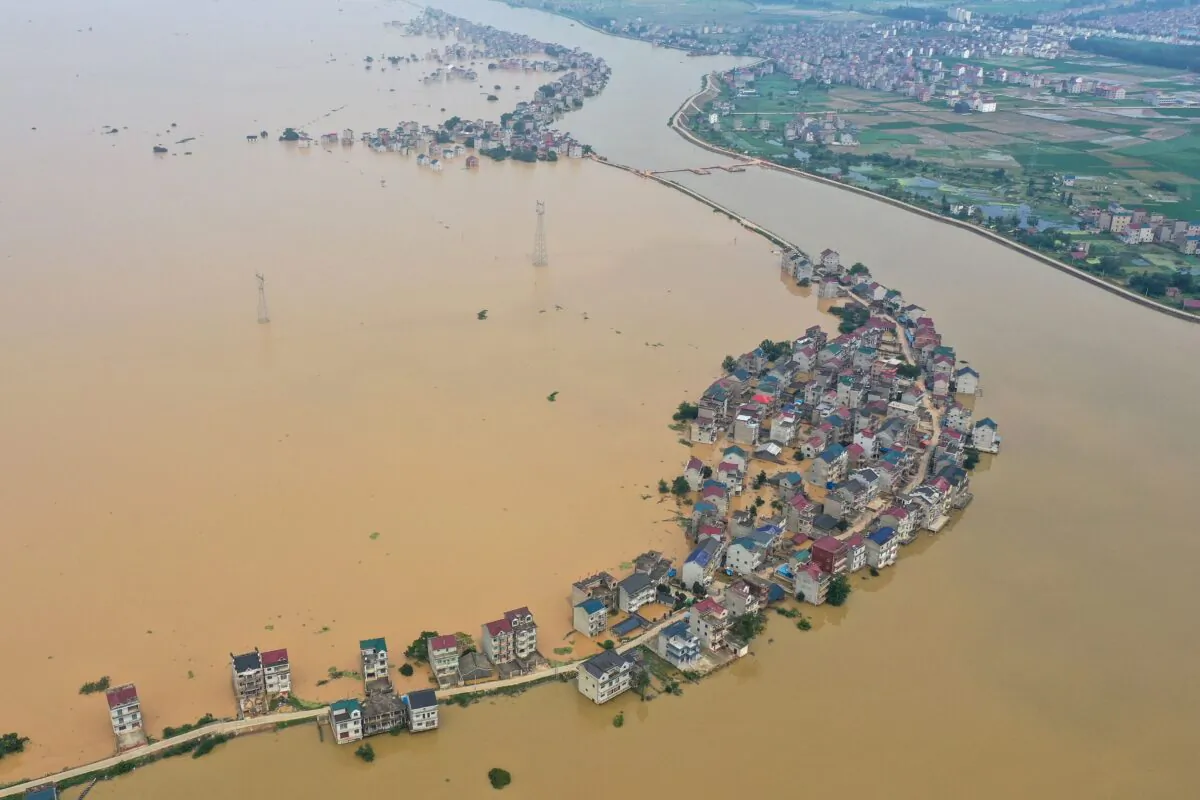
More recently, on July 1, 2024, Pingjiang County in Hunan Province in southern China experienced the most severe flooding since 1954. The county’s largest dams, the Huangjindong dams, which have a storage capacity of 96 million cubic meters, carried out emergency water releases to protect the dams from structural failure.
The dams, known as the Huangjindong Reservoir by the local people, were reported to be the largest in Pingjiang by Hunan Daily, an official publication of the provincial government, in 2019. According to the publication, construction of the dams began in 1990 and was completed and put into operation in 1995. In March 2014, the Dam Safety Management Center of the Ministry of Water Resources classified it as a Category 3 dam, meaning that it had serious structural defects or safety hazards and could not operate safely according to its original design.
Following suit—and under mounting pressure from its release of water—190 other dams across the county also began emergency discharges. This dramatically increased water levels in the Miluo River, the county’s main waterway. Local residents, however, received no advance warning of the discharges or instructions to evacuate.
On July 2, 2024, authorities reported that the floods had affected 364,582 people, but no casualties were mentioned.
China has experienced an overwhelming number of dam failures—570 in 1973 alone. Yet disaster reporting is frequently downplayed, censored, or outright suppressed by state-controlled media, leaving the public with incomplete or misleading information.
Typically, Chinese regime ministers use the annual major national conferences to deliver reports filled with “positive energy” messages. Yet during the 2025 National People’s Congress, the minister of water resources delivered an unusually sobering update: a sharp decline in dam numbers, exposing the hidden risks within China’s vast dam system.
Views expressed in this article are the opinions of the author and do not necessarily reflect the views of The Epoch Times.
 Friends Read Free
Copy
Facebook
Tweet
Friends Read Free
Copy
Facebook
Tweet