Commentary
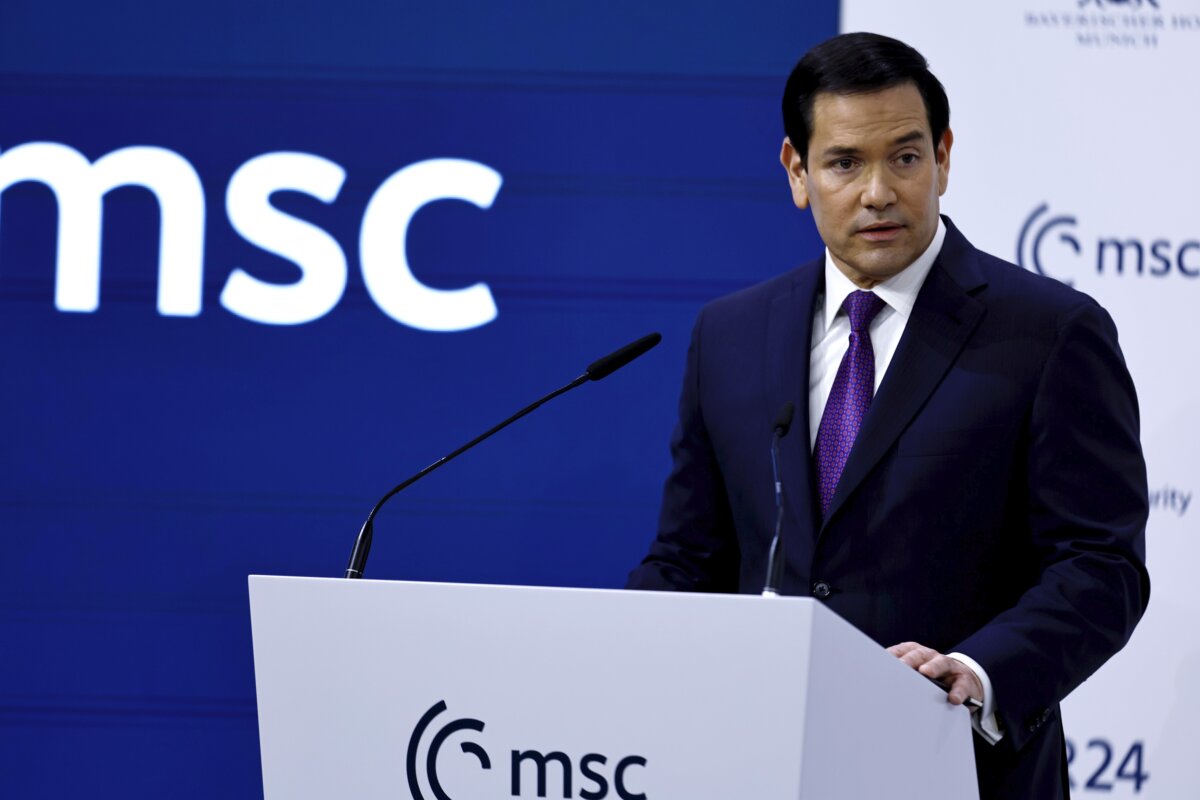
U.S. Secretary of State Marco Rubio gave a seminal, very successful, and much-appreciated address to the Munich Security Conference on Feb. 14. He emphasized that the United States and Europe are effectively inseparable, that the alliance between them had repelled the mortal threat of Soviet communism, and that any thought of it being obsolete or superfluous was nonsense.
Although he did not address the subject in these terms, Rubio confirmed that the controversy over Greenland is, like President Trump’s threats not to defend those ostensible allies that took insufficient steps to defend themselves, an illustration of the president’s technique of opening with a shock-and-awe demand or assertion well beyond the solution that he is prepared to accept.
Rather than chastising his European audience for failed socialistic economic policies and for such porous borders that they were frittering away European civilization, as Vice President J.D. Vance did at the same forum a year ago, Rubio took the stance that Western Europe and the United States had made substantially the same mistakes contemporaneously. He emphasized that President Trump is successfully leading America out of this policy morass, and recommended the same course to his audience.
“We do not want our allies to be weak, because that makes us weaker,” he said. “This is why we do not want our allies to be shackled by guilt and shame. We want allies who are proud of their culture and their heritage, who understand that we are heirs to the same great and noble civilization, and who together with us, are willing and able to defend it. … We do not want allies to rationalize the broken status quo rather than reckon with what is necessary to fix it, for we in America have no interest in being polite and orderly caretakers of the West’s managed decline.”
“The alliance that we want is one that is not paralyzed into inaction by fear – fear of climate change, fear of war, fear of technology,” Rubio continued. He sketched “an alliance ready to defend our people, to safeguard our interests, and to preserve the freedom of action that allows us to shape our own destiny – not one that exists to operate a global welfare state and atone for the purported sins of past generations. An alliance that does not allow its power to be outsourced, constrained, or subordinated to systems beyond its control; one that does not depend on others for the critical necessities of its national life; and one that does not maintain the polite pretense that our way of life is just one among many and asks for permission before it acts.”
He was emphatic and eloquent in stating that the last thing the United States and its government wished was the end of the transatlantic era, and that although Americans live in the Western Hemisphere, they have a permanent connection to Europe.
Rubio recounted the policy failures of both the United States and Europe that led to the deindustrialization that reduced the wealth of the West, its productive capacity, and its independence, as well as the loss of sovereignty over supply chains. He concluded that this “was not a function of a prosperous and healthy system of global trade. It was a foolish but voluntary transformation of our economy that left us dependent on others for our needs and dangerously vulnerable to crisis.”
Rubio denounced mass migration as “a crisis which is transforming and destabilizing societies all across the West.”
“Controlling who and how many people enter our countries is not an expression of xenophobia,” he said. “It is not hate. It is a fundamental act of national sovereignty. And the failure to do so is not just an abdication of one of our most basic duties owed to our people. It is an urgent threat to the fabric of our societies in the survival of our civilization itself. And finally, we can no longer place the so-called global order above the vital interests of our people and our nations.”
All of these reflections came as a very welcome reassurance and eye-opener to his mainly European audience. It may easily be understood that the Europeans found President Trump and his methods an even greater shock than Americans did. And since Europeans are always prone, whether justly or from envy or incomprehension, to underrate American statesmanship—other than when they are totally dependent upon it—they had dug themselves into a deep hole of loneliness and pessimism at the thought that the United States was effectively demolishing the Western Alliance and replacing it with a spheres-of-influence agreement with China and Russia.
Of course, this was an unfounded fear and nothing that Trump did or said could possibly be construed as anything of the kind. What he is really aiming at is for Europe, which is of a vastly greater economic and military power than Russia, to live up to its strategic potential, while assisting in the creation of a subtle containment strategy opposite the Chinese involving the principal countries of India, Japan, and Australia. Ultimately it would also include Russia, China’s ancient rival in the Eurasian landmass, after Russia has successfully been induced out of the smothering embrace of Beijing.
While Rubio did not put it in quite these terms, he underscored that Europe and America had made the same errors, and that the United States is slightly ahead of most of Europe in recognizing those errors and making appropriate policy corrections. Having reaffirmed that Europe and America had shared the same triumphs and made the same mistakes, he proclaimed the American ambition to reaffirm the Western Alliance, work with the Europeans in meeting these new challenges, and bring the Western world to new summits of positive influence and achievement. He and his message were almost rapturously received in Munich.
Rubio was followed to the podium by the Chinese foreign minister, who thanked him for the upbeat and conciliatory tone of his remarks—even though Rubio had made it clear that China is not always a scrupulous rival, to which the West had to organize a rigorous and powerful response.
Secretary Rubio had an outstanding success, and in the course of his address and bilateral meetings he had with many of the leaders present, he moved the Western Alliance a long way towards a state of reform and unity that augurs well for the next 75 years of this most successful international association in history.
Views expressed in this article are the opinions of the author and do not necessarily reflect the views of The Epoch Times.
 Friends Read Free
Copy
Facebook
Tweet
Friends Read Free
Copy
Facebook
Tweet