
Commentary
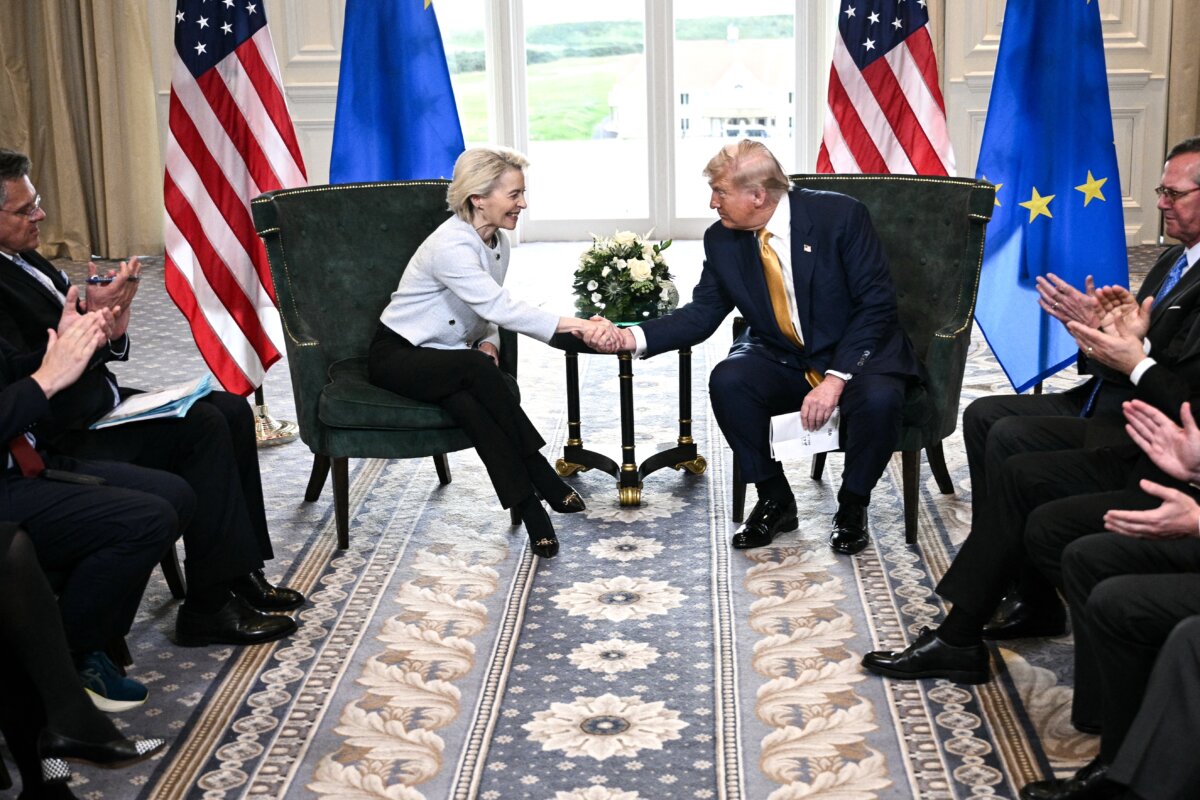
The agreements the United States has signed with its main trading partners are both positive and realistic. They demonstrate that, in 2024, the world was not a trade paradise of spontaneous cooperation among free-market companies as per David Ricardo’s ideal, but rather a statist system filled with barriers against U.S. businesses and political efforts to pick winners and losers.
The controversy surrounding the agreement between the United States and the European Union can only be explained by three reasons: animosity toward any achievements of the Trump administration, ignorance about the only realistic alternative, or because critics of the deal were genuinely satisfied with the protectionism and European barriers in place in 2024.
Critics of the deal must answer two questions:
What was the only real alternative?
The only real alternative was a collapse in European exports; a loss of competitiveness versus Japan, the UK, South Korea, and other partners; greater offshoring of companies; and, crucially, keeping existing European trade barriers.
What would the critics have done?
Critics must explain how they would have achieved supposedly better deals when global export leaders have signed agreements like that of the EU. They need to share with us what essential information they have that the EU negotiators do not, reportedly enabling them to achieve better conditions than Japan, the UK, South Korea, Indonesia, Vietnam, the Philippines, Saudi Arabia, Qatar, Australia, China, and others. Is it reasonable to think that EU negotiators were stupid or reckless and did not weigh all options to achieve a beneficial agreement?
Claiming that the agreement with the United States is detrimental is, inadvertently, to defend the trade barriers with Europe’s main global partner as if they were wonderful and should be preserved. It also stems from a fantastical vision of global trade, imagining that the U.S. market could be replaced by others.
What’s worse is that some seem to believe that all of this is Trump’s fault—a favorite in today’s economic analysis—and that, in four years, a Democratic president or a softer Republican will return everything to the way it was in 2024.
This is a mistaken vision. Biden kept all the tariffs from the Trump and Obama administrations and increased several of them.
Why wasn’t there a significant outcry when the EU implemented substantial trade barriers or when Democratic presidents established tariffs? The outrage frequently conceals bias against Trump and conveniently overlooks Europe’s persistent imposition of new barriers on U.S. products.
Why wasn’t there an outcry over the EU’s tariffs on U.S. chemicals, agriculture, livestock, automobiles, and manufacturing equipment—or over the 2030 Agenda, the New Green Deal, the carbon dioxide tax, and all the constant excessive regulation? It took Mario Draghi to remind us that the EU imposes more hidden tariffs on itself than the United States does.
Many claim that if the EU and others set up trade barriers, the U.S. response should be to remove, not add, tariffs. That sounds beneficial in theory but fails to consider the full geopolitical, monetary, and commercial picture. The United States would not just lose in manufacturing and the role of the U.S. dollar with oversized trade deficits; it would also end up absorbing the overcapacity and subsidizing the working capital problems of other countries.
America’s trade deficit doesn’t originate from free-market cooperation but largely from politically imposed barriers on U.S. companies. This is why many countries would prefer a 15 percent tariff to removing all their non-tariff barriers.
We cannot ignore the significant tariff and nontariff barriers that have been explicitly established to exclude U.S. products. Those barriers are then utilized to benefit politically connected countries in relation to the EU—such as Turkey or Morocco, or even China.
The number of zero-for-zero tariff sectors is clearly positive, and the list is expected to increase over time. Lifting some of the EU’s nontariff barriers is also positive and in line with the recommendations of the Draghi report.
By accepting a 15 percent tariff instead of eliminating all their nontariff barriers, America’s trading partners are admitting they would rather pay the cost than relinquish regulatory power, and they acknowledge that there is no simple way to just replace the U.S. consumer.
It’s also disingenuous to claim that buying American energy is pricier than buying Russian energy. Such arguments reveal the enormous bias and contradiction, especially given record European imports of Russian Liquefied Natural Gas in 2024. This agreement helps diversify supply and ensures security during crisis periods.
Some media outlets have misrepresented the agreement’s military equipment element. It is false that the agreement requires the EU to buy only U.S. military equipment. These are two distinct topics, and the agreement does not reduce investment in European companies. The commitment is positive for the EU’s rearmament plans and does not undermine domestic investment projects.
European Keynesian analysts, who have quietly observed massive tax hikes and employment cost increases of more than 50 percent, cannot credibly claim that a 15 percent tariff is devastating when just recently they insisted 30 percent tariffs would have a minor impact. The consensus estimates claimed that only 0.3 percent to 0.5 percent impact in three years for the EU. The European Central Bank and others described the effects as “manageable,” “bearable,” and with low impact on inflation.
The Keynesian consensus can’t, on one hand, say that a 30 percent tariff would have a limited, bearable impact and minimal inflation effect and a few months later insist that a 15 percent tariff will be disastrous. This only serves to fit a narrative that anything agreed with Trump must be detrimental.
The EU could have negotiated zero tariffs if it had agreed to eliminate all non-tariff barriers but chose a compromise to keep most of its regulatory framework. In any case, this result is far preferable to losing the trade surplus and access to the U.S. market. Therefore, the EU does not “lose”—it accepts a small tariff, as have Japan, the UK, and South Korea, because it wishes to keep most of its nontariff barriers.
The truly devastating alternative would have been a loss of market share to other countries and the maintenance of barriers that perpetuate European economic stagnation—not to mention missing out on a key agreement for defense, technology, and energy.
Everyone wins with deals that create a fairer and more open trade framework than what existed in 2024. The benefit for the EU is about 150 billion euros annually, conservatively estimated, if commitments are fulfilled.
The United States wins, and the EU wins as well, with an agreement that strengthens trade ties, corrects an unfair trade deficit, removes barriers, and increases the number of zero-tariff sectors. Plus, both sides gain a crucial alliance in defense, energy, and technology—all without limiting investment in homegrown industries.
The only real alternative was no deal and subsequent economic and trade collapse for the EU.
Negotiators from the EU and the United States recognized this situation and successfully reached a significant agreement that benefited both parties.
Views expressed in this article are the opinions of the author and do not necessarily reflect the views of The Epoch Times.
 Friends Read Free
Copy
Facebook
Tweet
Friends Read Free
Copy
Facebook
Tweet